Thursday, 29 September 2022

UPDATE.

 A MOST WELCOME GIFT.


Knowing of my interest in horse drawn logistics,  Mark at Man of Tin blog recently contacted me to offer me a book about British Army horses that was now surplus to his requirements. I gratefully accepted and the book arrived today.

WOW....the book is an original official War Office publication from 1933. I had expected a reprint perhaps rather than such a valuable original. Just a brief thumb though reveals a wealth of information on the British Army's horse management policies and practices that will be so useful to me.

I cannot express my thanks enough to Mark for his generosity and this most welcome addition to my library. Naturally I will publish a full review of the book once I have fully digested it.

Thanks Mark !!!!!

Wednesday, 28 September 2022

BOOK REVIEW: THE TALE OF A FIELD HOSPITAL.


This book is a reprint of an account written in 1900 by Sir Frederick Treves, a highly regarded surgeon who volunteered for service in the Boer War as a consultant to the British Army Medical Service.

The account details the activities of No.4 Stationary Field Hospital during the three months of the Ladysmith relief expedition in late 1899 and early 1900.  As such it covers the battles of Colenso and Spion Kop from a medical point of view and how No. 4 hospital cared for the majority of the casualties of both actions.

The style of writing is typical of the period and rather wordy at times however there is a great deal of useful information on how a field hospital operated and the conditions behind the lines and there are also a  number of fascinating photos included. There is even a short chapter on the hospital's pet dog including a photo!!

As is to be expected from a book written so soon after the event  there is a lot of patriotic praise for the British soldier and his endurance under difficult circumstances. Strangely however, there is no mention of the medical work performed by the author whatsoever.

Overall an excellent first hand contemporary account, although rather limited in scope, of an interesting aspect of the Boer War.


Thursday, 22 September 2022

BOOK REVIEW: CHARGE TO GLORY !

 A GARLAND OF CAVALRY EXPLOITS.


This is a book from my library acquired some years ago in a second hand book store.

The book relates the story of cavalry  from Marengo to Fondouk in 1943 detailing the significant impact that cavalry had on each of the ten engagements discussed. There is also an opening chapter covering the general history of the cavalry arm through the ages.

The intention of the author is to provide an understanding of the "cavalry spirit" and describe how that "cavalry spirit" sometimes led to bold victory and sometimes to rash defeat.

The ten engagements are discussed at length culminating in a detailed account of the decisive cavalry action for which the battles are particularly known.

The writing style is excellent and the book is addictive reading and highly recommended to anyone interested in the "cavalry spirit" and what that actually meant on the battlefield.


Sunday, 18 September 2022

UPDATE.

CAMPAIGN WARGAMES SHOW. 


Following my visit to COLOURS last week I yesterday visited CAMPAIGN at Milton Keynes.

There was quite a difference between the two shows in that CAMPAIGN is in an open square in the middle of the Milton Keynes shopping Centre and was frankly poor in comparison to COlOURS. There were only about 4 or 5 traders although there were a lot of gaming tables. However when I arrived about 1pm not a single game was in progress and many of them had not even set up.

After lunch and some shopping with my wife who came along with me, we returned to the show around 4pm in time to see most of the games either packing up or gone. Overall very disappointing and not worth the 200 mile round trip or the £10 parking charge, that said we did have a very nice lunch.

While I can recommend COLOURS I cannot do the same for CAMPAIGN based on what I saw, or more rightly, did not see !!!!  I think that concludes my visits to wargame shows certainly for this year. Will I go again next year.....I really do not know yet.

On another note, my post about COLOURS last week has had not a single view by any reader, am I wasting my time writing posts, of course not as I do it for my own pleasure and if others like it great, if not, so be it.

Sunday, 11 September 2022

UPDATE.

COLOURS WARGAMES SHOW. 


Yesterday I attended my first ever wargames show at Newbury. 

The round trip was 270 miles almost all of which was on motorway or dual carriageway but amazingly my car delivered 49.1 mpg, I guess having 9 gears helped along with the extraordinary technology in the vehicle but still a great result from a big heavy petrol car with a larger than average engine.

I spent a good couple of hours going around the huge number of trade stands and inspected the wargames closely. My conclusion is that I am not a wargamer.... the games were interesting but not to my taste. I did like the trade stands and spent a lot of time checking out the many books on offer. However I found nothing to buy.

Steve Johnson, in his report on the show, said that it was more like a trade show with some wargames tacked on and I agree with that assessment. Nevertheless I am pleased I went and I am currently planning to visit the CAMPAIGN show in Milton Keynes next week.

On the modelling front, once again I have virtually nothing to report. Since my last update all I have done is complete the arm of service and rank insignia of a cavalry regiment and a heavy artillery battalion, maybe two hours of work at most. The long summer and continuing reasonable weather have left little time for modelling. I am almost looking forward to the nights drawing in with rain and cold so I can get back into painting and building my armies.


Friday, 2 September 2022

BOOK REVIEW: SO THEY RODE AND FOUGHT.


This is a withdrawn library book picked up a few years ago at a second hand book sale.

The author was an officer of the Indian army who, on partition in 1947, transferred to the Pakistani army and retired as a Major General.

The book details the history of cavalry in Asia with particular emphasis on the cavalry of the Indian army before independence. Every cavalry regiment that ever existed is listed with details of its history. There are also fascinating chapters on life as a cavalryman, the horses and battles all in chronological order.

As a King's Commissioned Indian Officer, the author had a unique perspective on the pre independence Indian army however it is also quite apparent that his views and life as an officer were very similar to British officers.

Overall a good book and very recommended if you are interested in the cavalry of the Indian army before 1947.


Thursday, 25 August 2022

WARGAMING 19TH CENTURY LOGISTICS.

A Challenge for Wargamers ????

I have always been very interested in military logistics especially during the second half of the 19th century when army commanders began to face the almost insuperable problems created by the simultaneous use of railways and horse drawn wagons. The huge increase in the size of armies during this period, encouraged by the availability of railways to both move and supply these armies at the strategic level, created enormous problems for generals because the tactical transport system at this time still remained the horse drawn wagon. Although these difficulties probably reached a peak in the early days of WW1 during the German advance into France and Belgium, they had been building ever since railways first came into substantial military use during the US civil war.


About 300 Union supply wagons at Brandy Station, just one supply column.


Interestingly the armies of Imperial France, wholly dependant on the horse drawn wagon, still managed to reach Moscow in 1812, further than the Wehrmacht in 1941, despite that army's considerable railway and motor vehicle resources. I am very well aware of the relative size of the forces involved and the issues the Germans faced in Russia in 1941/2 in supplying their forces adequately and that recourse was made to horse drawn transport to a very substantial degree. Nevertheless the Germans did possess a huge number of motor vehicles and enjoyed an enormous railway supply capacity up to the Polish frontier, far greater in fact than was actually needed. Napoleon however had nothing other than horse drawn wagons to bring supplies from his bases in central Germany. Despite the ultimate failure of the French invasion and the desperate nature of the retreat, the simple fact that they did get as far as Moscow at all surely says something about the inherent strength of a horse based logistic system.

Another example from this period is that of Mercer's horse artillery battery at Waterloo. After his heavy action at Quatre-Bras the day before, Mercer's battery was out of ammunition. He was advised that a resupply could be found on the road to Brussels. He sent a wagon train overnight to search for this ammunition. They were fortunate enough to find the ammunition, and some most welcome food,  and returned next morning not long before the battle commenced. I am left to speculate on the outcome of the battle if that resupply had not taken place. Without ammunition, Mercer's battery would not have been able to participate and the French cavalry charges, which they played a large role in defeating, might have been successful. Could Napoleon have thus won the battle before the Prussians appeared later in the day?

During the US civil war the battle of Gettysburg gives a wonderful illustration of the capabilities of the horse drawn wagon . One of General Lee 's objectives for the invasion of Pennsylvania, was to "requisition" as much material and supplies as possible. During the retreat from Gettysburg Lee had some 3000 wagon loads of "requisitioned" supplies and materials preceding his withdrawing combat forces. In fact the quantities captured enabled Lee to supply his Army of Virginia for the best part of another year. This poses the question as to whether the war could have ended a year earlier if the Union cavalry had been more focused on recapturing or destroying these supplies during the retreat.

This battle also raises another example of the issues faced by commanders in the horse based supply era. Prior to Pickett's charge, Lee had commanded his artillery to bombard the Union position. Unfortunately the supplies of artillery ammunition immediately available provided for a somewhat limited barrage. The reserve ammunition was still many miles to the rear, basically due to faulty logistical management. Consequently Pickett's charge took place after  far less damage had been inflicted on the Union forces than Lee planned. The charge of course failed, would it have failed if the reserve ammunition had been readily available, now that is a question.

There are other examples of logistical issues dramatically impacting military operations in these years. No one can read the history of the Zulu war without noting the amount of time, energy and resource that Lord Chelmsford devoted to securing enough transport to supply the British advance into Zululand. As a result the British army had plenty of supplies, especially ammunition, readily to hand. Nevertheless the battle of Isandhlwana was lost for two reasons. Firstly the tactical error of  deploying the British infantry companies too far in advance of the camp, up to 1000 yards in some cases, thereby making resupply of ammunition virtually impossible. Secondly the logistical failure whereby British army supply practise at the time only permitted the opening of one ammunition box at a time, an error that Chelmsford subsequently corrected during the battle of Ulundi when boxes of ammunition were opened throughout the British positions before the action even started.

These logistical matters fascinate me and lead me to conclude that the capabilities of a horse drawn supply system were far better than is commonly supposed provided the supplies being moved were restricted to rations and basic ammunition loads etc.  Of course during this period many campaigns were carried out using only the ammunition supplies actually carried with the armies. Resupply from base other than for rations or artillery ammunition did not regularly arise before WW1. Even then the railways ensured vast quantities of supplies could be brought forward and problems only arose if armies advanced so fast that the horse drawn transport could not keep up in a timely fashion. For example, every offensive on the Eastern front in WW1, by either side, eventually fizzled out, not because of enemy resistance but through lack of supplies.

As is no doubt clear to the reader of this blog, to ensure they do not run short of supplies or essential supporting resources, my armies have a very substantial logistical capability. Certainly  far more  than other modellers of this era may think appropriate given that supply units are not  glamorous compared to cavalry or even infantry. 


A Woodscrew Miniature Army Quartermaster battalion, just one of 24 such units, drawn up waiting for the order to advance.


With that in mind I wonder how much notice wargamers take of logistical matters, including  resupply from base, when fighting 19th century battles, not much would be my guess. In fact I believe that most wargamers do not pay much attention to whether their troops have sufficient ammunition or food to actually fight a battle or especially a campaign.  Additionally, how many wargamers consider such vital logistical matters such as remounts or forge wagons to shoe cavalry or even fodder to feed horses. Given the examples listed above are wargaming rules realistic in respect of logistics when it is commonly understood that warfare is 90% logistics and 10% tactics ??


Friday, 19 August 2022

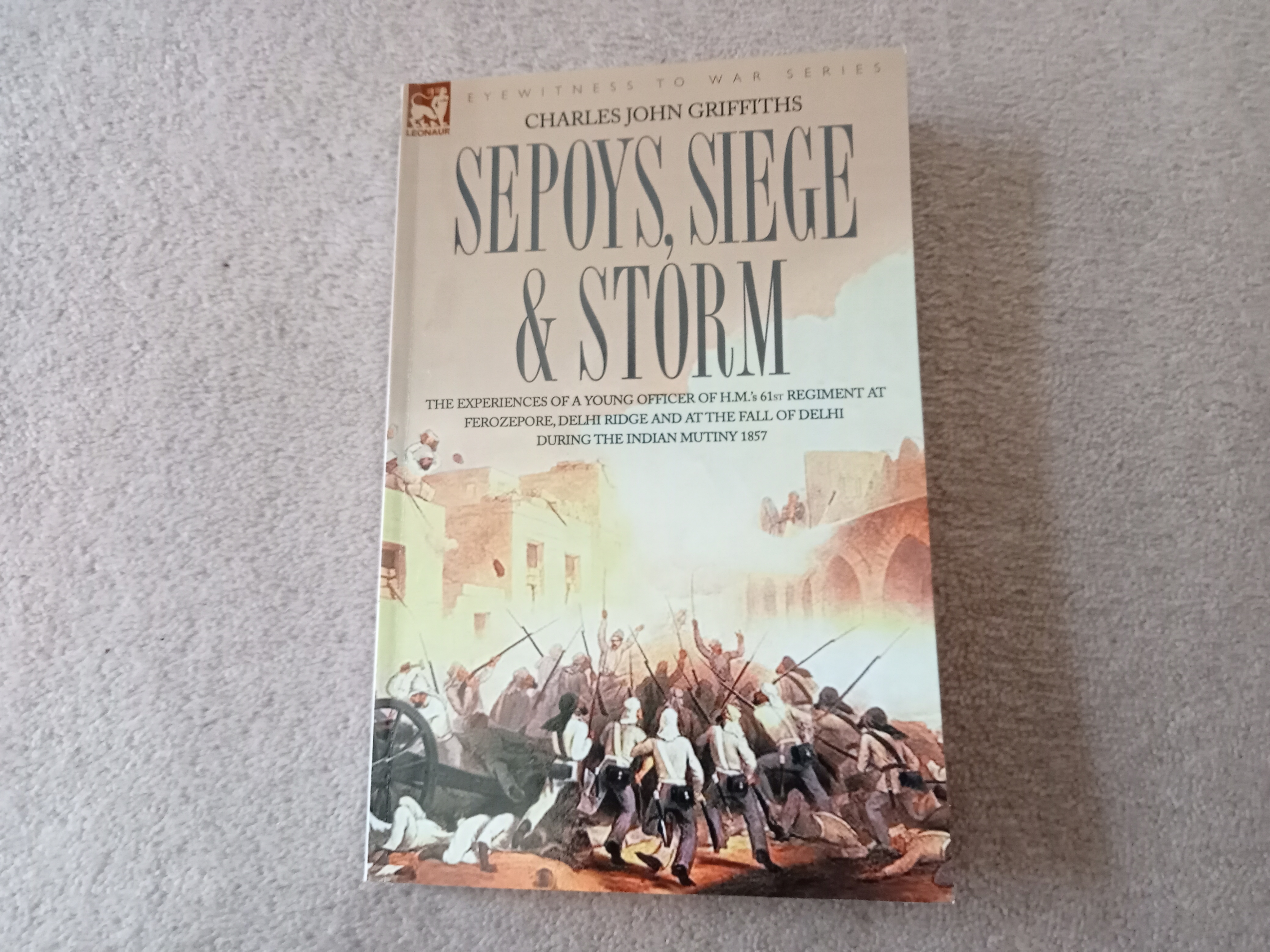
BOOK REVIEW: SEPOYS, SIEGE & STORM.

 THE EXPERIENCES OF A YOUNG OFFICER OF H.M.'s 61st REGIMENT AT FEROZEPORE, DELHI RIDGE AND AT THE FALL OF DELHI DURING THE INDIAN MUTINY 1857.


Yet another book from my library, this is a reprint of a volume originally published sometime around 1890 as far as I can tell. The book only covers a period of about one year. The author served in India from 1852 and was invalided home early in 1858 as a result of debilitation caused by the conditions suffered by the besieging army at Delhi.

The book gives great detail on the initial outbreak of the Mutiny at Ferozepore where the author was stationed and where his Regiment inexplicably remained for several months before being sent to Delhi. The siege and assaults on Delhi are covered in great detail including the very poor conditions. 

A whole chapter of the book covers the work of collecting the riches of the city by the Prize Agents and the very tardy payment of prize money which was clearly quite a priority for the author and many of his comrades.

An excellent book and highly recommended as a first hand account of the Siege of Delhi during the Indian Mutiny.


Friday, 12 August 2022

BOOK REVIEW: THIS BUSINESS OF WAR.

 Recollections of a Civil War Quartermaster.


Another book from my library. Although the book includes a full account of the authors war service it also details a great deal about  this man's fascinating life and origins having been written as a sort of autobiography for his children and grandchildren. The book was eventually published in 1913 just four years before his death at 94.

William Le Duc, whose father was a French immigrant, was a successful lawyer and businessman prior to the war. Wishing to serve the Union on the outbreak of war but having no military experience he asked how he could best serve and was told by a friend to apply for a quartermaster post where his business experience and skills would be most useful. This he did and was appointed a Captain Quartermaster.

He served throughout the war finishing as a Brigadier General. There is a great deal of useful information about the activities of a quartermaster but one of the most interesting aspects of the book is that the author knew many of the leading Union generals prior to the war, in fact he went to school with Sherman. His analysis of these various generals is fascinating and instructive. 

Overall a highly recommended book not only for the information about quartermaster activities but also in recording the very interesting life of a businessman in the 1840's and 50's and after the war when he served four years as Commissioner of Agriculture in President Hayes cabinet.


Saturday, 6 August 2022

IMAGI-NATIONS. PART 46

 THE STRATEGIC SITUATION AFTER THE SECOND SINO-UNION WAR.


In Spring of 1890 the UNION Army High Command put forward a radical proposal to the President of the UNION and his Cabinet. The proposition was to use the port of Miami as a base and ship the bulk of the UNION army to Bombay in India and from there to launch an invasion of China. From the Indian border to Peking and Shanghai, the major manufacturing cities of China, was around 1000 miles, considerably less than the 6000 miles from the UNION's border with China to those cities. The intention of the invasion would be to destroy  Chinese arms production for at least a generation and destroy as much as possible of  the Chinese army.

The initial reaction of the President and his senior colleagues was to see the plan as ridiculous. However they agreed to a presentation by the Army commander and his senior officers. In that presentation the Cabinet was reminded that India was a British colony and the British and Indian governments had experienced many years of difficulties with China along the common border. Northern India was not heavily populated and the Chinese had long believed that the border should be pushed south to give China more land for their ever growing population. This had resulted in several Chinese incursions into Indian territory and a number of skirmishes between the opposing militaries. It was the opinion of the UNION army's senior officers that the British and Indian governments could be favorably disposed to assisting the UNION in launching an invasion if only to relieve for many years the pressure on their northern border.

The army presentation then moved to reiterating that The Second Sino-Union war had been a close run thing and the Chinese army had proven to have become very formidable. It was inconceivable that China would not seek to attack the UNION in the future just as soon as they felt strong enough, therefore the UNION must launch a preemptive strike to destroy the growing threat that China presented. Invasion from the UNION was impractical given the distances involved but logistically an invasion via India was possible. Indeed the Army command suggested the British might be especially supportive because it was only by using the British merchant fleet that the transport to and ongoing supply of the UNION army in India could be achieved and that would be very profitable for the British.

The presentation then moved to a general discussion of the strategic situation in Tian. Following the invasion of Iran some few years before the Arab countries were now fully focused on resolving the future government of their countries following the rise to power of military officers rather than the religious leaders who prevailed prior to the war. It was expected that this internal conflict would continue for many years which meant there was no threat towards Mexico for the foreseeable future. 

Following the defeat of Germany and Russia earlier in the year the Russians were not considered to be a threat as they had been pushed out of Ukraine and the bridges over the Volga river had been destroyed. UNION and Ukrainian troops guarded the river and could easily foil any bridge building effort although given the recent strategic thinking of Russia, it was highly unlikely they would ever consider attacking the UNION without an ally. That ally had previously been Germany but following the UNION annexation of the Rhineland and destruction of the bridges over the Rhine any future threat from Germany was impractical and therefore considered very low risk indeed.

Overall the only realistic threat to the UNION for the foreseeable future came from China therefore it would be strategically prudent to incur the risks of an invasion of China from India if the British and Indian governments agreed. It was understood that much construction work would be needed not only in Miami but certainly in Bombay and from there to the Chinese border to support an invasion but again such work would be very profitable for Britain and India. After much debate the President agreed the plan was practical and strategically sensible and it was resolved that the British should be approached informally to understand the likely reaction to such an extraordinary proposition.

As expected the initial British reaction was astonishment but after some discussion and consideration they began to appreciate the concept was actually attractive. The whole enterprise would be very profitable to the British, would provide huge investment in India and would entail little actual risk for the British. Whatever the outcome of the actual invasion, the Chinese would be seriously weakened and the threat to India would diminish for some time. In addition, supporting the UNION would cement ties with Britain and perhaps provide for some UNION military support against China if required at some later date.

In the Spring of 1891 a secret treaty was signed between the UNION, British and Indian governments to allow the UNION to launch an invasion of China from India and for all parties to cooperatively construct the logistical facilities necessary to support such an operation. A special clause also committed the British to provide all the shipping necessary to transport and maintain a UNION army in India of up to 800,000 troops for a period of not less than five years. Detailed planning for the expedition could now commence.

FOOTNOTE:  Readers should remember that the timeline of Tian is 130 years behind Earth. Therefore the year 1891 in Tian is 2021 on Earth. Future published articles will therefore be more or less in real time rather than historical time and will likely relate the events of the previous month(s). I hope this is understandable.


Tuesday, 2 August 2022

UPDATE.

 Since my last update a few weeks ago I regret to say I have done no modelling whatsoever !!!!! So what have I been up to...well as usual, I really can not say !!!! Going out on day trips, shopping, gardening and other essential chores have occupied most of my time. I guess it is just that time of year.

However I do have one thing to report. Readers may recall my purchase of a couple of new air guns last year. These have been great fun and have been used in the garden as they are only about 60% of the maximum power allowed in this country. That said I have often wished for a full power rifle.  Such a gun is not safe in the garden and the nearest ranges, over 25 miles in opposite directions, are expensive and one is only open at weekends.

However recently a new small range opened only 10 minutes from home and it is very inexpensive. So early last week I visited said range and found it to be perfect for me. In addition, being only small, I could book the whole thing for a couple of hours for only £5. Here was something to think seriously about !!!!

Perhaps not surprisingly by the end of last week I was the proud owner of a brand new air gun !!!! 


The gun is an AIR ARMS (British made) S510TR Tactical with an ELEMENT scope. My existing guns are all traditional wood stock etc so the tactical look appealed as something different. The gun is as powerful as is allowed under British gun laws and is a PCP powered 10 shot repeater.

Yesterday I took it to the range for the first time. The gunshop who sold it to me fitted the scope and zeroed it in at 10 meters on their inhouse range. On my range I started shooting at 30 meters and after only a few minor tweeks of the scope, found myself shooting very tight groups  to 40 meters. The gun is superb quality. The scope is good too but a bit unforgiving in respect of you have to look very squarely down the sight to get an clear view. However after an hour or so I got the hang of it. I had a great couple of hours and fired over 100 pellets.


The shooting shed, plenty of space for up to four shooters but each booking is exclusive which suits me. At least I know I will not get shot in the rear when I go mess with the targets !!!!


There are actually a wide variety of targets down range but most cannot been seen in this photo. I was shooting at those furthest away, around 40 meters.

I am sure many will not see the appeal of this or any gun but it amuses me and I am in the fortunate position of being able to indulge myself to some extent. In fact I have already booked the range again for Wednesday afternoon!!!!


Sunday, 24 July 2022

BOOK REVIEW: MEKONG FIRST LIGHT.

 An infantry platoon leader in Vietnam tells it like it was.


This is the final book review from my library about Vietnam, at least for the time being.

The book tells the story of a dedicated and very professional officer who served two tours in Vietnam. After an undistinguished education and early life the author decided to join the army simply because he could think of nothing else to do with his life. He joined up as a private but soon qualified, to his surprise, for officer candidate school. His first years in the army soon proved to him that in fact he was highly suited to army life.

Following his commissioning he joined 9th infantry division as a platoon commander and commenced training his troops prior to deployment of the division to Vietnam.  Almost at the end of his Vietnam tour, one of his men said " Before we got to Vietnam, the troops all thought you would be the first lieutenant killed, and in the end, you were the only one left, we were all wrong. You were the best."

The author became the consummate soldier and officer as recognised by promotion to Captain and his transfer to Special Forces. He also served as an advisor with the Royal Thai Army on its deployment to Vietnam. By the end of his service the author was clearly on the path to a long and distinguished military career. However he became very disenchanted with how the war was being managed and finally decided to leave after over four years service.

The book details an interesting and motivational life story and is one of the best accounts of action in Vietnam I have ever read while pulling no punches about the vicious nature of the war and its long term impacts on those who served. An excellent book and highly recommended.


Monday, 18 July 2022

UPDATE.

 So the UK heatwave commences. 

This morning at 9.30am the temperature was 74 in the garden, at 10.30am it was 84 and now at noon it is 90 with the hottest part of the day still 3 or 4 hours away so looks like the forecast was right that we could have record breaking heat today and tomorrow.

I have decided to stay at home for the next couple of days. The house is shut up with windows closed and curtains and blinds drawn. I intend to spend the time doing the long overdue painting of my new cavalry regiment.

We are just so unprepared for this sort of heat in the UK. With a previous record high of 101 and forecasts of 104 or even more over the next couple of days, chaos is expected. Apparently only half our roads are surfaced with heat resistant tarmac so we can expect some sticky roads with the railways expecting rail buckling. Of course no one here has AC in the house, only shopping centres and large stores have AC.

Even the cat has decided that sleeping all day in the flower beds, which is her normal practice in summer, is not a good idea today and has taken refuge in the spare room.


At least the heat is expected to break down by Wednesday with rain maybe on Thursday....can't wait !!!!!!

BREAKING NEWS.  At 2pm my garden thermometer is showing 99 degrees in the shade. 

TUESDAY...day 2 of the heatwave.... Temperature in my garden is 93 at 11am  !!!!!

Wednesday, 13 July 2022

UPDATE.

 It is a month since I last updated on my modelling activities. At that time I reported that I had just started making the first regiment of cavalry for my new army. Well in the past several weeks I have only managed to finish building the regiment, the only painting done has been the priming of the flags !!!!

I have in simple truth done very little modelling for a while now. There always seems to be something else to do or somewhere to go at this time of year, especially if it involves going out in my new car which I just love to drive. Amazingly in the month I have had it I have managed some 46 mpg which for a big heavy petrol car is fantastic. That said it will cruise at 50 mph on only 1000 rpm. It must be all that technology !!!! Anyway as usual I struggle to actually recall exactly what I have been doing but I feel I have been very busy !!!!

Anyway the cavalry regiment has been built and it took quite some time. With the upgrades in troop numbers since the last full unit I made it has become quite the task to make 109 mounted soldiers.


The next job will be painting, which is also time consuming. I have also made a start on a battalion of heavy artillery but these soldiers have only had a single coat of uniform colour so far. However while taking the screws for this unit from my stock I realised I was running short of treated screws. Readers may recall that much of the screw stock I bought a few years ago was zinc plated. It is not possible to paint over that zinc coating so it has to be removed.  So yesterday I "cooked" up some 1600 screws. Although I have discussed this process previously I realised I had not provided photos so here goes.


This is the product used as purchased in Wilkinsons for £1.50. Vastly better than the pickling vinegar I used to use and a lot less smelly !!!!


The picture above shows the full set up. An old towel covers the working space with two ice cream tubs half full of tap water and my wooden stirrer.


The contents of the pack of crystals are equally shared between the two tubs and stirred until the crystals dissolve. The screws are then added at a rate of four boxes, 800 screws, per tub. Note the shiny silver colour of the screws straight from the box. A quick stir and then they are left for 30 minutes.


After half an hour this is the result. Two tubs with a half inch thick topping of foam. Clearly the result of off gassing by the crystals as they dissolve the zinc. I give each tub another good stir and leave for another half hour. There is little smell but I opt to carry out this activity in my workshop with the door open, just in case.


The next step is to use my dedicated sieve, not from the kitchen !!!!!! to pour the solution down the drain.  A secondary benefit is that this will clean the drain !!!! I then use the hose to wash the screws thoroughly. Note the change in screw colour to gray from previous photos above.


After washing I tip the screws onto the old towel and spread them out. I then use a hot air gun to dry them off. This always results in another change in colour to reddish brown as flash rusting takes place. This is fine as this gives a much better key for painting.


After a good blast of hot air, and allowing a little time for the screws to cool down as they get very hot, they are re-boxed ready for use. This process can also be used to age modern woodworking hardware, all that is required is the addition of a good dose of WD 40 instead of the hot air gun. That drives off the water and retains the "raw" old fashioned gray steel colour by stopping the flash rusting.


Wednesday, 6 July 2022

BOOK REVIEW: A HUNDRED MILES OF BAD ROAD.

 AN ARMORED CAVALRYMAN IN VIETNAM 1967-68


Still another book from my library and still about Vietnam....however only another couple to review before I change subject.

This book relates the experiences of a troubled young man who volunteered for service and became a tank crewman and, later in his tour, a tank commander. He served with the 3rd Squadron, 4th Cavalry Regiment (Armored)  also known as the 3/4 Cavalry, of 25th Infantry Division.  Throughout his 16 month tour of duty, ( he reenlisted in country),  the author was almost permanently in action culminating in the very bloody  battle of Tan Son Nhut Air Base near Saigon during the Tet Offensive.

The author had what can only be described as a harsh upbringing which together with a very tough deployment made for a man with a lot of baggage. However after his discharge he went to school and became a lawyer, much to the surprise I suspect of all who knew him including himself.

This book relates a tough life and a vicious and hard fought tour of duty and gives a deep view inside the author's mind as well as a hard look at what it could be like fighting in Vietnam. Yet again here is the evidence as to why so many soldiers suffered so much from their Vietnam experience, it really is a wonder that any of those who actually experienced combat, were able to return to a normal life.

An excellent book about Vietnam but also a tribute to an extraordinary tough man.


Friday, 1 July 2022

UPDATE.

 FOURTH ANNIVERSARY OF THIS BLOG.


My first post to this blog was on 29 June 2018. Over the subsequent four years  I have achieved the following:

Posted 333 articles.

Received 369 comments.

Had 18076 hits on the site.

Secured 13 very welcomed followers.

Although not impressive figures compared to many other blogs, I think I have done remarkably well given the very niche nature of my subject.  Woodscrew soldiers were never going to command a lot of interest especially as I am not a wargamer although I am interested in the subject.

I have tried to expand the appeal of the blog by including endless book reviews and writing about my Imagi-Nations. These activities have definitely helped expand my audience but by far and away the biggest impact on the blog was the decision by Archduke Piccolo to wargame a campaign from my Imagi-Nations series. The resulting posts he did on the battles were hugely popular and many readers crossed referenced to my blog which led to a doubling of my followers.

This all proves that well written battle reports create the most interest. As I do not wargame I will never appeal to that audience but that's ok. I write primarily for my pleasure and amusement, if that interests others so much the better but if not so be it.

Anyway, a big thank you to the following:

Ian Dury for encouraging me to start blogging.

Mark at Man of Tin, my first follower and supporter

Steve J at Wargaming Addict and Joe of Fish Tales for regularly commenting

Ion at Archduke Piccolo for his enthusiasm for my Imagi-Nations 

and of course my family who now know for sure that, having well over 60,000 painted screw soldiers, I am "not all there" !!!!


Wednesday, 29 June 2022

CONSTRUCTION OF LIMBERS.

HOW I MAKE AND PAINT LIMBERS.


Limbers are used extensively in my armies not only for artillery and heavy weapons but also in Cavalry and Horse Artillery regiments to tow supply, ammunition and utility trailers. The premise is that such regiments require full off road capability and that can only be provided by limbered transport.

Construction of limbers starts with a balsa block 15mm wide and 10mm deep cut from standard trailer stock of 5mm thick planking. To this is added a cut down toothpick shaft. The standard toothpick as used straight from the box for wagons is about 55mm long. To fit the smaller limber I cut them down to 40mm. This can be seen in the photo below.


The next shot shows a batch of 32 limbers with shafts attached. The next step is the usual one of applying sealer to the end grain which is sanded smooth when dry.


Next task is to add wheels, towing hook and the horse mounting block on the shaft, all as seen below and very similar to the work required to build GS wagons. Construction is now complete so the wheels and towing hooks can be primed ready for painting.


As is my usual practice I also cut out the horses required for a batch of vehicles and paint them up at the same time. The photo below shows the horses partially primed  in the normal  head up or head down situation.


As above but now painted my standard horse brown  ( Humbrol Burnt Leather ). The colour of horses is a constant issue with my wife who is most upset that I do not have a variety of horse colours to reflect reality.  She particularly wants me to have dapple gray horses.  I tell her the official Army view is that horses only come in one standard issue colour and that is brown !!!!!!!!!!


The limbers are now painted olive drab, my standard vehicle and equipment colour.


The next step is to glue the horses to the mounting block. It is vital to glue the painted side as the paint provides a key for the glue. It also makes it much easier to complete the painting of the horses.


This next picture shows the horses after all painting has been completed.


The final steps are to add the twisted wire harness and paint the limber wheels black as shown below.


Basically, other than the initial cutting of the balsa block body, the rest of the construction process is the same as described in the post on building GS wagons.  These principles also apply to all other vehicles and trailers used in my armies.


Thursday, 23 June 2022

BOOK REVIEW: RATTLER ONE-SEVEN.

 A VIETNAM HELICOPTER PILOT'S WAR STORY.


Yet another book from my library. I hope the reader is not getting fed up with all these Vietnam books, I wanted a change of topic. I have another couple of Vietnam books to review and will then move to another subject.

Although not to the same standard as the classic "Chickenhawk" book about flying helicopters in Vietnam, this is a good book.  The author joined the army straight after graduation from high school in 1968 and, on a whim, applied to be a helicopter pilot. He passed the tests and became a warrant officer helicopter pilot. In due course he arrived in Vietnam in May 1970.

The bulk of the book describes in good detail the various missions and general military life of the "huey" pilot. The author was clearly a dedicated officer and constantly strove to improve his skills if for no other reason than to enhance his survival chances. He became a Senior Aircraft Commander which demonstrates great skills and towards the end of his tour was probably the most experienced pilot in his unit.

Most of the authors work involved supporting the South Vietnamese army (ARVN) as by that stage of the war US involvement was diminishing. In addition the North Vietnamese army was providing most of the enemy opposition as the VC had been eliminated during the Tet offensive. These factors combined to give the combat an entirely different perspective with US pilots coming up against substantial heavy anti aircraft weapons manned by well trained soldiers while trying to support operations by less than effective ARVN troops who suffered one defeat after another.

After the war the author trained as a fixed wing pilot and secured his professional pilots licence and became an airline pilot.  Despite the inevitable bad memories the author concluded that his war experiences had been generally positive in developing his character and he remains proud to have done his duty.

Overall a good book and recommended.

Saturday, 18 June 2022

BOOK REVIEW: CREW CHIEF.


Another book from my library. The author served as a mechanic, door gunner and crew chief in helicopter assault companies in Vietnam in 1967-68.

The book is written as a novel rather than as a personal memoir. Therefore it is written in the third person about a character called Jim MacLaughlin and relates the story of his tour of duty as a helicopter crew chief. The author admits the stories told are a mix of personal experience, things that happened to friends and friends of friends and general war stories known to all but without  provenance.

Even with all that in mind I have to say that, based on reading dozens of books about Vietnam, this book is pure fiction. It is inconceivable that so much could happen to one person. I have no doubt that everything related probably did occur over the years to somebody or other but certainly not to one individual in one tour of duty. On that basis the book is "over the top" and loses a lot of credibility, which is a shame. This is perhaps a case where "less is more".

However the book is well written and is exciting to read as long as the reader remembers this a work of fiction based on fact. It does give a flavour of life as a helicopter crew chief and certainly illustrates the dangers for those who served in the helicopter combat environment.

Overall I do recommend this book but as a good story rather than a historical record.


Sunday, 12 June 2022

UPDATE.

 There has been great excitement in my little world over the past few days !!!!  

Back at the beginning of February I reported that I had been engaged in the process of buying a new car with delivery expected at the beginning of May. Well that timescale came and went, repeatedly !!!! However , at long last, after  20 weeks, almost 5 months, I at last took delivery of my new car yesterday !!!!! and I am very pleased with it.

However the major problem over the past months has been the total lack of reliable information from either the dealer or the manufacturer's customer services. In fact I learned more about what was happening from online forums. Eventually  last Tuesday the manufacturer's customer services told me the car had been delivered to the dealer the day before. When I called the dealer they didn't even know the car had arrived !!!! 

The lesson is not to buy a new car via a factory order at this time. Only buy what dealers have in stock...unless you have the patience of a saint...which I don't !!!!

Anyway, I have it now. The level of technology in the car is almost scary....it will take me  months to figure it all out but that seems to be the norm nowadays. That said it drives like a dream and looks stunning which are the most important things of course.

On the modelling front I have not been very active recently, too many social activities and of course gardening chores. I have managed to complete a batch of 40 house bodied headquarters wagons as shown below, note the rolled up awnings on the roofs,  together with yet another infantry battalion. The next construction task is a regiment of cavalry which I have just started.