Showing posts with label Book Review.. Show all posts

Monday, 1 May 2023

BOOK REVIEW: THE ANARCHY.

THE RELENTLESS RISE OF THE EAST INDIA COMPANY.


This book was recommended by Steve J in his excellent blog so I bought a copy from Amazon.

I am pleased to report this book is just as good as Steve said. It covers the period from the establishment of the EIC  in 1599 through the early years as just another Western trading company until around 1765 when the EIC transformed into a major power in India and on to 1803 by which time the Company was in direct control of the whole  sub continent. 

The book is very well written and researched and gives a excellent account of all the various individuals both British and Indian who, each in his own way, encouraged the extraordinary growth of the Company. The sheer scale of the Company's activities is incredible. It was clearly the first global conglomerate yet wielded military power on a scale never seen before or since. The various military campaigns are discussed in rather limited detail although the background to each is covered in depth to illustrate how each contributed to the endless growth of the Company.

The EIC eventually became too dominant a factor in the British economy to be allowed to continue operating without increasing UK government control which resulted in a series of legislative changes during the first half of the 1800's. This culminated in the transfer of all the Company's possessions to the Crown  in 1859 after the Mutiny. The EIC limped on as a rump trading company for a few more years and eventually ceased trading in 1874 when it's charter finally expired.

An excellent book on the early history of British India and the rise of the EIC and recommended to all interested in either or both of those subjects.


Saturday, 15 April 2023

BOOK REVIEW: THE DAWN'S EARLY LIGHT.

THE CLIMACTIC SHAPING OF "THE LAND OF THE FREE" DURING THE HAZARDOUS EVENTS OF 1814 IN WASHINGTON, BALTIMORE AND LONDON.


I bought this book recently in a second hand book store for £4, a real bargain. Strangely however, the book, printed and published in the USA only in 1972 , uses paper that is reminiscence of that used in UK books during the world wars, very cheap, slightly differing page sizes and with an almost card like consistency. 

The War of 1812 was started by the US for various reasons related to trade during the Napoleonic war and was mainly concerned with US efforts to invade and seize parts of Canada. Apart from defending Canada the British response was to send a naval and army expeditionary force to the east coast to "ravage" the enemy and teach them the lesson that the British were not to be trifled with.

The first British landing resulted in the rapid dissolution of the defending US militia by the very professional British troops and the capture and burning of Washington. The next landing was against Baltimore. Here the US militia, better led this time, was able to hold out against the British causing them to retreat after the commanding British officer was killed. This action was supported by a navel bombardment of Fort McHenry by British warships. That event was witnessed by Francis Scott Key who, reflecting on what he had seen, was inspired to write "The Star Spangled Banner" hence the title of the book.

The final British assault was on New Orleans but this resulted in an overwhelming US victory that caused the British to rapidly fall back to their ships. Around this time the British government, dismayed at the cost of making war on the US  and with Canada secure by then, decided to make peace with a US delegation in Europe for that very purpose. This was soon agreed as the US had also had enough.

The theme of the book describes how the humiliation of seeing the capitol city burned almost caused the total collapse of the US yet with just a matter of weeks, the victories at Baltimore and New Orleans caused a complete change by bring the nation together and setting it on the path of internal development and isolation from world affairs that lasted 100 years.

Overall an excellent book about a fascinating time. However I would really commend this book to wargamers of the AWI period. This book contains a large number of scenarios for battles and actions including navel landings and bombardments using the same tactics and weapons of the AWI but in a setting very different to that conflict. Recommended.


Friday, 7 April 2023

BOOK REVIEW: GEORGE AND ROBERT STEPHENSON

 THE RAILWAY REVOLUTION.


I recently found this book in a charity shop for £2. As the author is the famous L.T.C. Rolt  I knew it would be a good buy and it is !!!!

Basically it tells the story of the working lives of the famous father and son duo who were largely responsible for the introduction and development of the railway in Britain and throughout the world. The early years of George are particularly interesting in that he had no formal engineering training and very little actual education. Instead he was blessed with a natural genius for engineering. Recognising this and his own limitations he ensured his son Robert received the very best education which resulted in him eventually  possessing far superior engineering and administrative skills to those of his father.

The stories of the creation of the Liverpool and Manchester Railway, the Rainhill Trials and the Great Tubular Bridges  among others make for fascinating reading even for the non railway historian while the construction of the London and Birmingham Railway , the largest ever civil engineering project at the time, is a testament to human ingenuity and fortitude.

Although this book will particularly appeal to the railway fan it also provides a superb account of the engineering element of the industrial revolution and some of the extraordinary, gifted and visionary people who created that revolution. Overall a very well written and highly recommended  book by an excellent author.


Sunday, 19 March 2023

BOOK REVIEW: ADMIRALS.

 THE NAVAL COMMANDERS WHO MADE BRITAIN GREAT.


Another book from my library  and a complete change of subject. While not a huge navel enthusiast I do like reading about the navel history of Britain and this book offers a good overview of that history over the ages via the lives of some of the greatest admirals in the Royal Navy.

The lives and careers of eleven admirals are discussed including Lord Howard 1536-1624, Robert Blake 1599-1657, James II 1633-1701, George Anson 1697-1762, Samuel Hood 1724-1816, John Jervis 1735-1823, William Parker 1781-1866, Geoffrey Hornby 1825-1895,  John Fisher 1841-1920, David Beatty 1871-1936 and Andrew Cunningham 1883-1963. Each is assessed as having had a significant and positive impact on the art of being an admiral.

Interestingly Nelson is not included. There are a couple of reasons for this, firstly there are already a lot of books about him and secondly , he is assumed to be the "perfect" admiral, perhaps the best admiral ever. Those in this book are the admirals who came before Nelson and provided the foundations for his career and success and those who subsequently took his legacy forward. Between them these are the admirals who made the Royal Navy the greatest navy in world history over a period of some 400 years.

Each admiral gets his own chapter that not only provides a detailed character assessment of the man but also outlines his full career and the political and military circumstances during his time in command. Naturally his actions in battle are also recorded.

Overall a fascinating book that will appeal to anyone interested in British naval history but also as a well written general history book.


Thursday, 2 March 2023

BOOK REVIEW: DEATH, DYNAMITE AND DISASTER,

 A GRISLY BRITISH RAILWAY HISTORY.


Some readers may recall that back in January I reviewed a book on British Railway Tunnel disasters. I mentioned that I had found another book by the same author and had bought it from Amazon. This is the review of that book.

The book is divided into three elements based on the title. "Death" includes details of the first death on British railways being that of Huskisson during the launch of the first railway ever between Liverpool and Manchester in 1830. Also covered is the accident that occurred at Sonning in 1841 being the first fatal accident on the GWR and, at the time, the biggest loss of life in a railway accident. Also discussed  in this chapter is the impact of railway construction in the larger cities especially London and the impact this had on old grave sites and the work needed to remove thousands of bodies.

The second section of the book covers "Dynamite" and includes not only details of the use of dynamite in railway construction and the inevitable accidents but also the perhaps not so well known terrorist campaigns in the 1880's and 1890's by Anarchists and Fenians against the railways.

Finally the last section on "Disaster" covers the Tay Bridge Collapse of 1879 which was caused by the failure to use the most up to date engineering standards of the time and the Hexthorpe accident in 1887 which was caused largely by the railway company's failure to utalise the most modern  braking systems then available.

Every incident account is based on contemporary newspaper report supplemented by the official accident reports therefore the language used is of the time being sensational and colourful. The level of detail is extraordinary. Often full details of the dead are included even the amounts of compensation paid to relatives is revealed.

Overall a fascinating book and highly recommended especially to those interested in early British railway history however even casual readers will find this book a great read.


Saturday, 28 January 2023

BOOK REVIEW: RED FOR DANGER.


 Following on from previous railway book reviews I have now re-read probably the ultimate classic on British railways. My uncle was a "top link" engine driver with the legendary GWR and introduced me to Tom Holt's book 50 plus years ago. It is as exciting and interesting now as it was then.

The book basically details how Britain's railways introduced a wide variety of safety devices as a direct result of lessons learned from accidents over the years. All the major accidents on Britain's tracks from the earliest days until the 1970's are discussed using information drawn from the official Railway Inspectorate reports, with a detailed analysis of what went wrong and exactly how it could have been avoided by the use of some new equipment or working practice changes.

I suspect all railway enthusiast have this book but it is so well written and interesting it will probably appeal to anyone with even just a passing interest in railways. Very highly recommended indeed.


Sunday, 15 January 2023

BOOK REVIEW: TERROR IN THE TUNNELS.

 BRITAIN'S DANGEROUS RAILWAY HISTORY.


 As is often the case, having read a book on a particular subject, "Rails to the Front" in this case, I then find myself reading similar books for a while. I am afraid this means the next few book reviews will be about railways !!!!!

This particular book comes from my library and has not been read for a very long time. It basically details the various accidents that occurred both during and after the construction of the many railway tunnels in the UK. Most of the material is taken from newspapers of the time supplemented with official reports. The former of course offer by far the most interesting accounts because of the headline grabbing descriptions as well as the quaint language of the time. There are not too many illustrations but those included are both interesting and informative. 

Overall a fascinating book and highly recommended to railway historians but also generally as just a good book which I should have re-read a long time ago. In fact, the author has another book on disasters during the construction of Britain's railways which I have just ordered as a direct result of enjoying this book so much !!!!


Monday, 9 January 2023

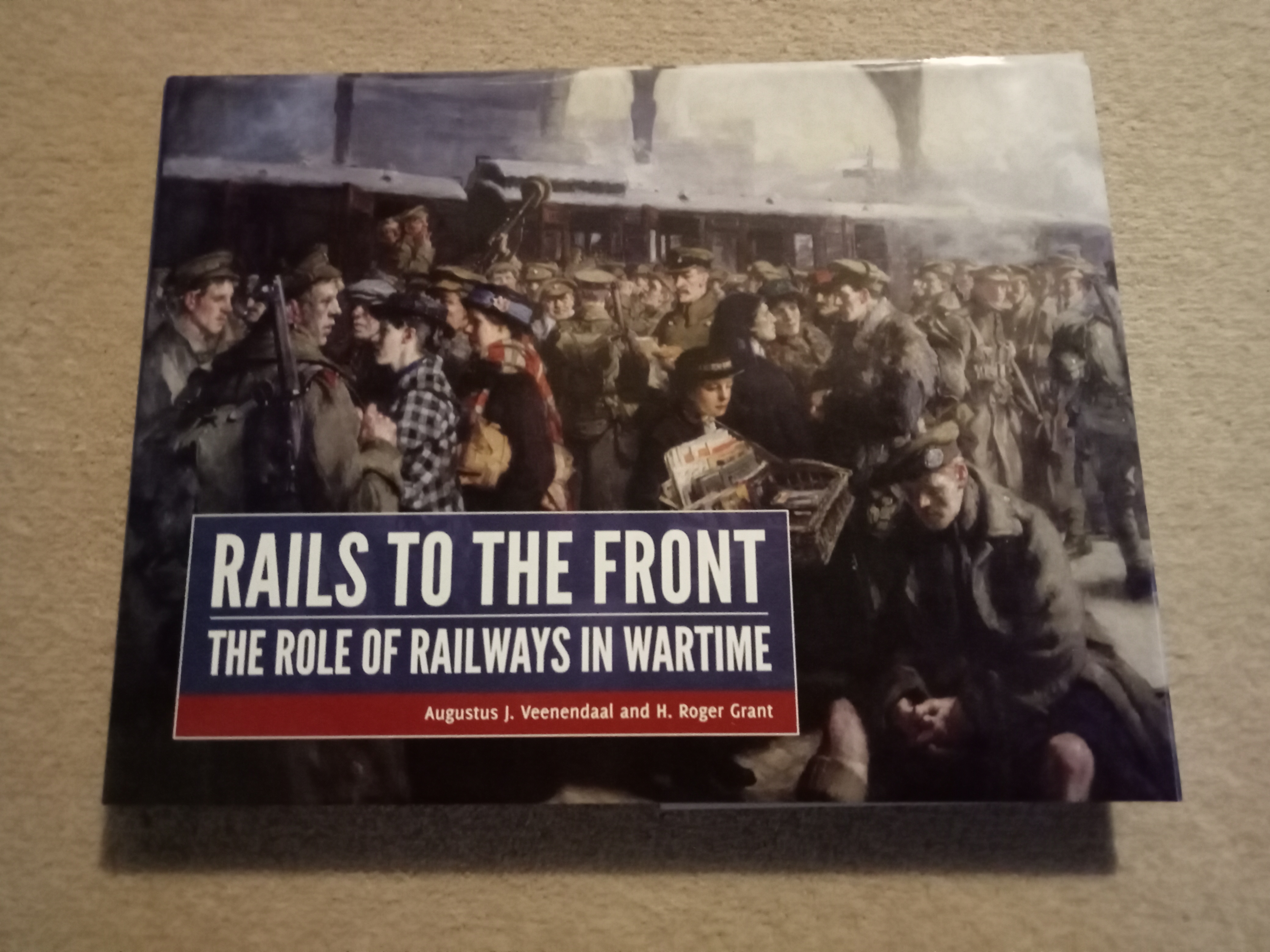
BOOK REVIEW: RAILS TO THE FRONT.

THE ROLE OF RAILWAYS IN WARTIME. 


I found this book on Amazon some time ago reasonably cheaply and have finally got around to reading it. The delay has mainly been caused by the strange shape of the book which is landscape rather than portrait which I find peculiarly disconcerting in a book.

That said the book is very well illustrated and basically covers the use of railways in war from the Crimean War right up to WW2 and into the 1960's where use of railways for military purposes is claimed to have been superseded by road transport. However anyone watching the news from Ukraine over the past year will be only too aware of just how important military use of the railways still is to both sides.

Rather than cover every conflict separately, the book discusses the use of railways more by period with only the major wars meriting a specific chapter. The book is loaded with many excellent photos and although the coverage of any particular conflict is necessarily limited, it does give an excellent overall history of railways in war. 

There is a great deal of useful information in this book which means it should appeal to the reader who is looking for a general history of railways in war and in that respect it is certainly recommended.


Friday, 30 December 2022

BOOK REVIEW: THE GREAT BLUE ARMY WAGON.


 To discover this book recently on Amazon was, for me, like finding the Holy Grail.

This book covers the development and construction of the US Army's standardised 6 mule heavy wagon and 4 mule Escort light wagon from their origins before and after the Civil War respectively to the final versions constructed during the First World War.

The 6 mule wagon was the first to be developed during the 1840-50's. It was a heavy wagon perfectly suited for use  supplying army outposts over very long distances. The specification for this wagon was finalised by the start of the Civil war and most of the wagons seen in Civil war photographs are of this vehicle. It remained in production throughout the second half of the 19th century with few modifications.

The Escort light wagon came about after the war due to the need for a lighter vehicle for use on post and for local short range duties such as escorting troops moving from post to post or going on campaign in more rugged country. This vehicle had became the standard army wagon by the end of the century. On the entry of the USA into the First World War some 30,000 Escort wagons were immediately ordered with about 10,000 being delivered by the end of the war.

The title of the book reflects that throughout the wagon era, until the First World War,  all military vehicles had bright colour schemes. Interiors and running gear was painted Venetian red while the outside was Prussian blue with boldly stenciled US letters on sideboards and white canvas covers. There was never any doubt as to the ownership of US army wagons.

The book provides good detail on the development history of the vehicles, construction methods and materials including full dimensions and improvements made over the years. There are many excellent photos too. There are even paint colour samples and details of standard sized packing boxes designed specifically to maximise  the use of space in wagons. Finally there is some brief information on non standard or locally used specialist vehicles used on some army posts including buggies, forge carts, water tankers and fire engines.

Clearly not a book for everyone by any means but for someone like me who is fascinated by horse drawn logistics, an absolute gold mine of information and a new star in my library destined to become a constant source of reference.


Wednesday, 21 December 2022

BOOK REVIEW: STORMING EAGLES.

 GERMAN AIRBORNE FORCE IN WORLD WAR 11.


Another book I picked up in a seaside book shop on my birthday  in October.

I have no special interest in airborne troops including the German forces however the book was very cheap and seemed well written on a thumb through.

The book gives a highly detailed history of the creation of the German airborne forces including the glider troops and air landing troops, a brief review of all the major actions involving airborne units and details of all the various formations raised during the war, all in a chronological order.

There is a strong recurring theme through out the book about the spectacular fighting spirit of German paratroopers and the fearsome reputation they enjoyed on all fronts right to the last days of the war. All were volunteers and trained to a very high standard which was reflected in regular successes although at a high cost in casualties.

There are a number of short appendix covering weapons, planes and uniforms to complete what has to be the definitive book on German airborne troops  and which I strongly recommended if you are interested in the Fallschirmjaegar.


Saturday, 10 December 2022

BOOK REVIEW: 1983.

THE WORLD AT THE BRINK.


 I bought this book on a visit to the seaside on my birthday. Not the usual subject matter I look for but a quick canter through the pages looked interesting.

The book basically relates world events leading up to the NATO war-games of late 1983 during which the Russians started to believe that NATO was about to launch a full scale nuclear first strike against them. The book gives a clear indication of just how close we came to nuclear war mainly due to the West not realising how paranoid Russia had become at the time.

The book gives a good history of Ronald Reagan coming to power and his strong anti Russian stance, the poor and geriatric leadership in Russia and the increasing weakness of the Russian economy which led to the fall of the USSR a few years later. In effect it gives the history of the final few years of the USSR as it collapsed under the weight of the Cold War which resulted in serious instability in the Russian leadership and a nuclear crisis made worse by the failure of US intelligence services to clearly recognise what was happening in Russia.

This is an exciting read much like a Tom Clancy novel....but real !!!! which of course makes it very scary.
Highly recommended for anyone interested in recent world history and the fall of the USSR.

Wednesday, 30 November 2022

BOOK REVIEW: HARDTACK AND COFFEE.

THE UNWRITTEN STORY OF ARMY LIFE.


Yet another book from my library although I have a feeling I may have reviewed this book before. It is a great book however so another reading/review will not go amiss. This is a first hand account by a Union soldier of the Civil War originally published in 1887.

The author served from 1862 to the end of the war and, as is so often the case, his time in the army was the highlight of his life. However rather than write about the various battles etc in which he participated, he decided to write about ordinary day to day life as a Union soldier. 

This book is divided into chapters on subjects such as enlisting, tents, rations, offences and punishments, a day in camp, foraging, badges and flags, the army mule, hospitals, and so on.  As a result the book gives a fantastic insight into the ordinary activities and life of soldiers. In fact there is really no mention of actual battle at all. The author was determined to make a record of day to day life as he believed that over time the ordinary experiences of military service would be forgotten, which is of course quite true.

This book is now considered among the top ten of first hand histories of the Civil War which is no surprise to me given the extraordinary wealth of detail it contains.  (The author has also written a full unit history of the artillery battery in which he served, which is also highly regarded by historians.)

Highly recommended to anyone interested in the US Civil War and the ordinary day to day experiences of an ordinary soldier.


Thursday, 17 November 2022

BOOK REVIEW: THE WAFFEN SS.

THE THIRD REICH'S MOST INFAMOUS MILITARY ORGANISATION.


 I recently picked this book up in The Works very cheaply. 

Although no fan of the SS generally, I am interested in the Waffen SS, the military arm. There is no doubt that the divisions of the Waffen SS were among the most effective and powerful of Germany's armed forces. The book concentrates on providing a detailed history of the various divisions that were formed during the war, their military service and short profiles of some of the most important leaders of those units. In fact I think it provides the most comprehensive record of Waffen SS units I have ever seen.

No attempt is made to gloss over the atrocities perpetrated by the SS but the focus is far more on the combat history of the SS and in that it is very effective. Overall I recommend this book if you are interested in the combat units of the Waffen SS and their battle histories.


Sunday, 6 November 2022

BOOK REVIEW: ANIMAL MANAGEMENT 1933.


Regular readers of this blog may recall that I mentioned receiving this book as a gift from Mark at the Man Of Tin blog. Mark is aware of my interest in horse drawn logistics and this is an original War Office publication which he no longer wanted, a very generous gift indeed.

The format of the book is the usual War Office style and covers every conceivable element of the care and use of horses and mules in service in the British Army. There are chapters on the structure of the horse and points of particular types and breeds, stable construction and management including grooming, foods and watering, saddles, shoeing, transportation of horses by sea and rail and of course prevention of disease and first aid. In fact everything you could wish to know about the military use of the horse.

Although a reference book and therefore not the easiest read, as a source of information this book is a "bible" of relevant data about horses in military service and I am delighted to have it in my library.


Tuesday, 1 November 2022

BOOK REVIEW: SUPPLYING CUSTER.

 THE POWDER RIVER SUPPLY DEPOT 1876.


Another book from my library, it relates the 1876 US Army campaign against the Indians which culminated in the Battle of The Little Big Horn and Custer's last stand.

The first half of the book details the various expeditions to the Powder River country and the history of the fighting against the plains Indians in the general area including the famous battle at Little Big Horn with an emphasis on logistics. The second half of the book relates in detail the supply arrangements for the campaign of 1876 and in particular the supply depot that was established at Powder River and the archaeological excavations carried out on the site in 1983.

The historical element of the book is first class and gives a clear and detailed analysis of the US Army's activities against the Sioux Indians but the results of the archaeological investigations are really fascinating.  Items found cover the whole range of products of the time even including bottle fragments that were identified as British made beer bottles. Who would have thought that British beer would find its way to the American frontier and in large quantities too.

I accept that this is very much a highly specialised topic but it makes for very interesting reading and gives a great insight into life on the early American frontier especially for the soldiers during the Indian wars.

Highly recommended if you have an interest in this sort of history.


Thursday, 20 October 2022

BOOK REVIEW: WOUNDED.

 FROM BATTLEFIELD TO BLIGHTY 1914-1918.


Another book from my library, this one covers the treatment and transportation of wounded British soldiers during the First World War by means of personal accounts from both soldiers and medical staff.

Each chapter covers the story of either an individual or group of individuals from soldier to nurse, doctor, bearer, orderly or chaplain giving details of what they experienced. There are also  chapters devoted to the ambulance trains and the not well known London Ambulance Column which took wounded soldiers from main line stations to the many hospitals around the capital.

The various accounts are fascinating and absorbing, it is a hard book to put down. The hardship that both wounded soldiers and medical staff, especially those in France, experienced makes for difficult reading but the constant thread in the book is of selfless service and fortitude, traits that are frequently evidenced in many accounts of WW1 and I believe, reflect the attitudes and perspectives of that generation.

The book is very well written and highly recommended to those interested in this important but often neglected aspect of WW1.


Tuesday, 4 October 2022

BOOK REVIEW: MEETING THE ENEMY.

 THE HUMAN FACE OF THE GREAT WAR.


Yet another book from my library, this one is written by the great WW1 historian Richard Van Emden.

This is an unusual book in that it discusses the human face of the war. It is well known that prior to the war the cultural and social ties between Britain and Germany were very strong. Thousands of Germans lived and worked in Britain and had done for many years. Inter marriage between the two nations was high and there were many "mixed" couples living in both countries in 1914.

The book addresses what happened to those people of both nations who found themselves either in the wrong country on the outbreak of war or , as a result of military operations, found themselves prisoners of war.

There are several astonishing issues discussed in the book including the level of contact on "human" matters that continued throughout the war between the two governments and the harsh treatment of British women who were married to Germans but living in Britain and who were considered as German by the British government.

This is an excellent book covering an poorly known subject but one that is both complex and fascinating and demonstrates beyond doubt that war is far more complex in its impacts that just soldiers fighting one another especially among nations with a close pre war relationship.

A great book and highly recommended.


Wednesday, 28 September 2022

BOOK REVIEW: THE TALE OF A FIELD HOSPITAL.


This book is a reprint of an account written in 1900 by Sir Frederick Treves, a highly regarded surgeon who volunteered for service in the Boer War as a consultant to the British Army Medical Service.

The account details the activities of No.4 Stationary Field Hospital during the three months of the Ladysmith relief expedition in late 1899 and early 1900.  As such it covers the battles of Colenso and Spion Kop from a medical point of view and how No. 4 hospital cared for the majority of the casualties of both actions.

The style of writing is typical of the period and rather wordy at times however there is a great deal of useful information on how a field hospital operated and the conditions behind the lines and there are also a  number of fascinating photos included. There is even a short chapter on the hospital's pet dog including a photo!!

As is to be expected from a book written so soon after the event  there is a lot of patriotic praise for the British soldier and his endurance under difficult circumstances. Strangely however, there is no mention of the medical work performed by the author whatsoever.

Overall an excellent first hand contemporary account, although rather limited in scope, of an interesting aspect of the Boer War.


Thursday, 22 September 2022

BOOK REVIEW: CHARGE TO GLORY !

 A GARLAND OF CAVALRY EXPLOITS.


This is a book from my library acquired some years ago in a second hand book store.

The book relates the story of cavalry  from Marengo to Fondouk in 1943 detailing the significant impact that cavalry had on each of the ten engagements discussed. There is also an opening chapter covering the general history of the cavalry arm through the ages.

The intention of the author is to provide an understanding of the "cavalry spirit" and describe how that "cavalry spirit" sometimes led to bold victory and sometimes to rash defeat.

The ten engagements are discussed at length culminating in a detailed account of the decisive cavalry action for which the battles are particularly known.

The writing style is excellent and the book is addictive reading and highly recommended to anyone interested in the "cavalry spirit" and what that actually meant on the battlefield.


Friday, 2 September 2022

BOOK REVIEW: SO THEY RODE AND FOUGHT.


This is a withdrawn library book picked up a few years ago at a second hand book sale.

The author was an officer of the Indian army who, on partition in 1947, transferred to the Pakistani army and retired as a Major General.

The book details the history of cavalry in Asia with particular emphasis on the cavalry of the Indian army before independence. Every cavalry regiment that ever existed is listed with details of its history. There are also fascinating chapters on life as a cavalryman, the horses and battles all in chronological order.

As a King's Commissioned Indian Officer, the author had a unique perspective on the pre independence Indian army however it is also quite apparent that his views and life as an officer were very similar to British officers.

Overall a good book and very recommended if you are interested in the cavalry of the Indian army before 1947.