Showing posts with label Organisation of the Army. Show all posts

Tuesday, 24 January 2023

ORGANISATION OF THE ARMY.

CAVALRY REGIMENTS.

The primary purpose of the Cavalry regiment is to provide reconnaissance, flank protection and screening of the Army's movements from the enemy. It may also be used for raids behind enemy lines in certain circumstances. The Cavalry regiment consists of 4 Cavalry squadrons and a Headquarters squadron.

The Cavalry squadron comprises two troops each of 8 privates and 2 Corporals under the command of a Lieutenant assisted by a Sergeant. The  squadron is commanded by a Captain assisted by a squadron Sergeant Major. The total strength of a squadron is 26, all of whom are mounted.

The Headquarters squadron, none of whom are mounted,  comprises a Staff troop of 4 privates, a Corporal and a Sergeant, a Medical troop of 8 medics, a medic Corporal, a medic Sergeant, a surgeon Lieutenant with a surgeon Captain in command, a Quartermaster troop with 12 privates, 2 Corporals and a Sergeant with a Lieutenant in command and a Signals troop with 8 signallers, 2 Corporals and a Sergeant with a Lieutenant in command.

The command troop, all of whom are mounted,  has a Lieutenant Colonel as regimental commander with a Major as Adjutant and second in command, a regimental Sergeant major and two standard bearers, one with the national flag and one with the regimental flag. The total strength of the headquarters squadron is 51 giving a total regimental strength of 155, of whom 109 are mounted and 46 are foot soldiers.

The vehicles and equipment of the regiment comprises 6 limbers each towing a light GS trailer with secondary towing of a field kitchen trailer, a water tank trailer, a signals trailer, a medical trailer and two further light GS trailers. Foot soldiers of the Regiment are carried on the various vehicles to ensure the Regiment has full mobility which is also assured by the exclusive use of two wheeled vehicles.

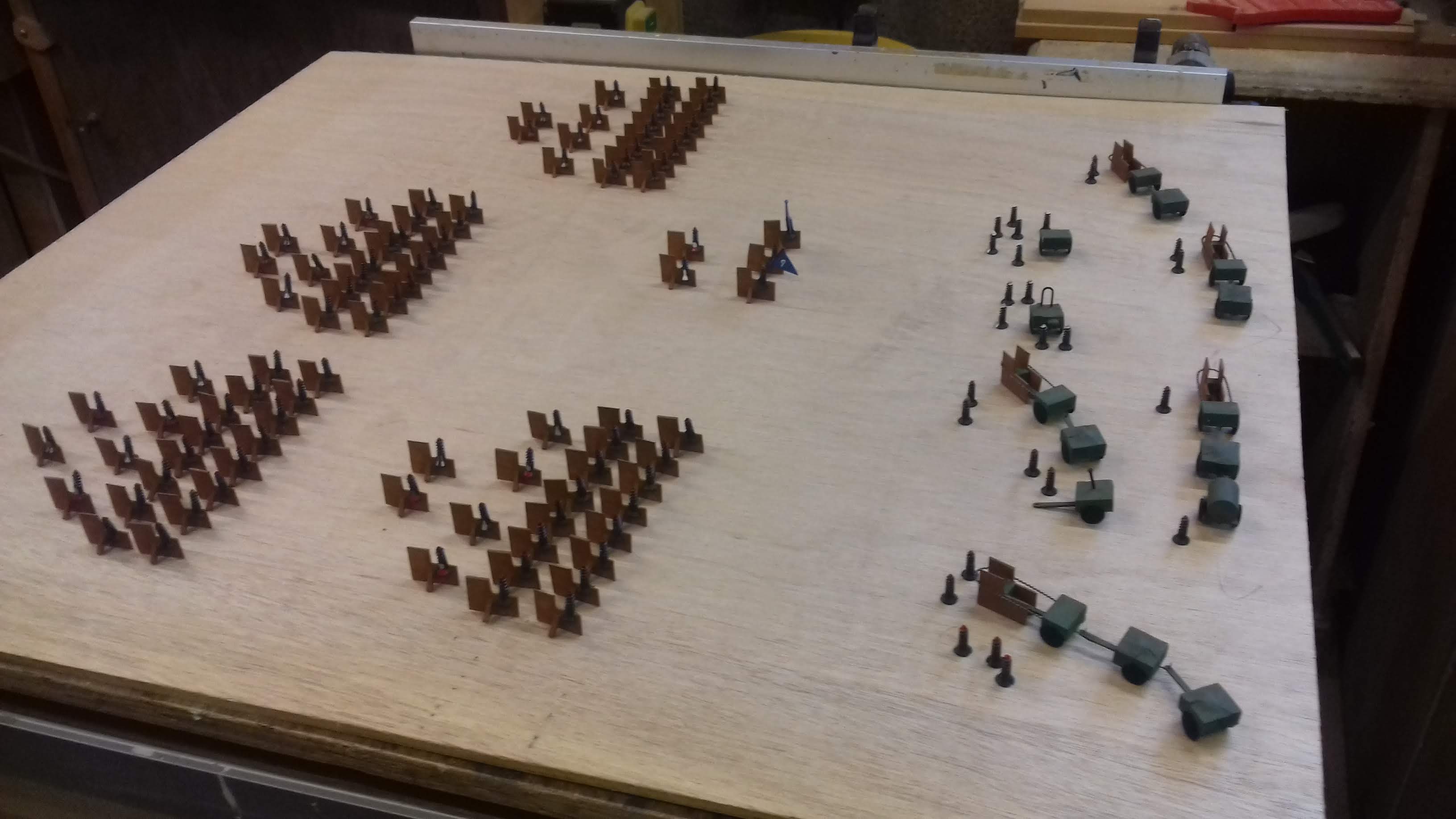
The photo above shows a regiment in parade formation with the combat squadrons on the left and the headquarters squadron on the right in front of the regimental vehicles. **


This photo shows the regiment drawn up ready to advance with regimental wagons to the rear. **

My armies have a total of 24 Cavalry regiments. The arm of service colour for Cavalry is German purple, a shade of burgundy.

** Both photos show the old original regimental structure. New photos will be added ASAP

Friday, 25 November 2022

ORGANISATION OF THE ARMY.

FIELD ARTILLERY BATTALIONS.

Field Artillery battalions have two batteries and a headquarters company.

Each battery consists of  4 guns, 4 caissons, 4 limbers and 2 ammunition wagons with 24 gunners,  4 Corporals, 4 Sergeants  and 2 Lieutenants organised in  two sub sections.  Each limber and ammunition wagon also has two quartermaster drivers giving 12 QM men and 2 Corporals commanded by a QM Lieutenant supported by a QM Sergeant. The battery is commanded by a Captain supported by a battery Sergeant Major. The total strength of a battery is therefore 52.

The headquarters company has a Staff platoon of 4 men and 1 Corporal commanded by a Sergeant, a Medical platoon of 6 medics and 1 Corporal medic commanded by a Surgeon Lieutenant supported by a Sergeant medic and a Signals platoon of 10 Signallers and 2 Corporals commanded by a Lieutenant supported by a Sergeant. The Quartermaster platoon has 10 men and 1 Corporal with a Lieutenant in command supported by a Sergeant. The battalion's total QM contingent is under the overall command of a QM Captain supported by a QM Sergeant Major. The battalion is commanded by a Lieutenant Colonel with a Major as second in command and Adjutant supported by a Battalion Sergeant Major with two standard bearers carrying the national flag and the battalion flag. In addition and reporting direct to the battalion commander is a Fire Control section consisting of a Captain and a Lieutenant who are responsible for coordinating and directing the fire of the battalion. The total strength of the headquarters company is 51 giving a total battalion strength of 155.

Apart from the vehicles in each battery, the battalion also has 5 GS wagons towing a field kitchen, water tank trailer, signals trailer, observation trailer and a medical trailer. 

The following photo shows a battalion in parade formation.


The next photo shows a battalion in combat with the guns in the foreground, battery vehicles behind and battalion wagon lines at the rear.


The arm of service colour is black for Field Artillery. My armies have a scheduled total of 48 Field Artillery battalions and at the time of writing 39 have been constructed.


Friday, 11 November 2022

ORGANISATION OF THE ARMY.

INFANTRY BATTALIONS.


The Infantry battalion consists of 6 Infantry companies, a Heavy Weapons company and a Headquarters company.

The Infantry company comprises three platoons each of 12 privates and two Corporals under the command of a Lieutenant assisted by a Sergeant. The  company is commanded by a Captain assisted by a company Sergeant Major. The total strength of a company is 50.

The Heavy Weapons company comprises two platoons each of 12 privates and two Corporals under the command of a Lieutenant assisted by a Sergeant. The company is commanded by a Captain assisted by a company Sergeant Major. The total strength of the company is 34.

The Headquarters company comprises a Staff platoon of 4 privates, a Corporal and a Sergeant, a Medical platoon of 14 medics, two medic Corporals, 2 medic Sergeants, a surgeon Lieutenant with a surgeon Captain in command. The Quartermaster platoon has 18 privates, 3 Corporals, and a Sergeant with a Lieutenant in command. The Signals platoon has 12 signallers, 2 Corporals and a Sergeant and Lieutenant in command. The command platoon has a Lieutenant Colonel as battalion commander with three Majors, one as Adjutant and second in command and two Majors as wing commanders of three of the Infantry companies, a battalion Sergeant major and two standard bearers, one with the national flag and one with the battalion flag. The total strength of the headquarters company is 73 giving a total battalion strength of 407.

The vehicles and equipment of the battalion comprises 6 GS wagons towing a field kitchen trailer, a water tank trailer, a signals trailer, a medical trailer and two light GS trailers and two limbers, two caissons and two heavy weapons together with an ammunition wagon.


The photo above of a battalion in parade formation shows the Infantry companies on the left with the Heavy Weapons company in the centre and the Headquarters company on the right in front  of the battalion vehicles. 


This photo shows the battalion deployed for an advance with the Heavy Weapons company and command platoon in the centre and the battalion wagon lines at the rear.

My armies have a planned total of 96 Infantry battalions of which 76 have been built at the time of writing. The arm of service colour for Infantry is blue.

Wednesday, 16 March 2022

RANK AND ARM OF SERVICE INSIGNIA.

RANK INSIGNIA.

Readers may have noticed on previous photos that there are coloured stripes on the shank (between the thread and head) of some screws. These colours indicate the rank of the individual. Privates have no insignia. The rank colour combinations are based on four colours, silver, red, white and gold.

Ranks are denoted as follows:

One thin silver stripe equals corporal. 
A thick silver stripe equals sergeant. 
Two thin silver stripes equals sergeant major. 
A thick stripe of half silver and half red equals lieutenant. 
A thick red stripe equals captain. 
A thick stripe of half red and half white equals major. 
A thick white stripe equals  lieutenant colonel. 
A thick stripe of half white and half gold equals full colonel. 
A thick gold stripe equals one star brigadier general. 
Two thin gold stripes equals two star major general. 
Two thin gold stripes with a silver centre stripe equals three star lieutenant  general. 
Two thin gold stripes with a red central stripe equals four star general. 
Lastly two thin gold stripes with a white central stripe equals five star general of the army, the commander in chief.


This photo shows, from left to right, captain, lieutenant, sergeant major and sergeant. These soldiers all have a brown top which indicates they are quartermaster troops.


This photo shows from left to right, three star lieutenant general, two star major general, full colonel and major.  These soldiers have red tops which denotes they are staff troops.

ARM OF SERVICE INSIGNIA.

All soldiers, regardless of rank,  have a coloured top which denotes the arm of service as shown in the photos above. The  colours are as follows:

brown for quartermaster,
red for staff,
blue for infantry, 
black for field artillery, 
sand yellow for pioneers, 
sky blue for heavy weapons, 
purple for cavalry, 
white for medical, 
silver for signals, 
dark green for field police, 
orange for heavy artillery, 
pale green for horse artillery, 
gray for workshop engineers and finally,
gold for veterinary and farriers.


Friday, 25 February 2022

FLAGS.

My army has three types of operational flag. 

The national flag is carried by all battalions and regiments and is oblong, solid blue in colour with a single white star in the first hoist area of the flag. 

Each battalion/regiment also carries a battalion/regimental  flag which is triangular, with a blue field and  the battalion/regiment number in white on the field. The staff is coloured to the arm of service for that particular type of battalion/regiment. In the case of brigade command battalions the main part of the staff is coloured red for command but the top of the staff is coloured to the type of brigade, infantry or cavalry. 

 The third flag is the general's personal flag. These are also triangular with a blue field but the staff is gold and there are small stars across the field, either one, two. three, four or five to represent the general's rank.


This photo shows from right to left, a three star lieutenant general's flag, a two star major general's flag, the battalion flag of 7th army command battalion and lastly the national flag.

The only other flag is the red cross flag which is flown by all ambulance wagons. Other medical vehicles carry a small red cross sign on each side only.

My historic reference for many of the design ideas of my flags is  based to some degree or other on the US army of the Civil war period.


Tuesday, 25 January 2022

ORGANISATION OF THE ARMY.

BASIC PRINCIPLES OF BATTALION ORGANISATION.

There are a number of basic principles that apply to the organisation of all types of battalion in my army as follows:

1. Battalions having all soldiers horsed such as Cavalry and Horse Artillery are called regiments rather than battalions but the basic structures are identical.

2. Each battalion is autonomous and capable of independent operations and has vehicles and equipment accordingly.

3. Each battalion consists of operational companies and a headquarters company which includes platoons of all the necessary supporting services.

4. Battalions are commanded by a Lieutenant Colonel supported by a Battalion Sergeant Major with a Major as adjutant and second in command. The Major also commands the headquarters company.

5. The Lieutenant Colonel, Sergeant Major and Major are all members of the arm of service applicable to the battalion. The only exception is for Medical battalions where  command is exercised by Staff officers.

6. Captains command companies/batteries with a Company Sergeant Major as assistant. Lieutenants command platoons. Sergeants are usually posted on the basis of one for every 12 or so privates. Corporals are posted on the basis of one for every six privates. The only exceptions are in specialist units like Medical, Workshop and Veterinary companies where the ratio of NCOs is usually higher.

7. Medical personnel are allocated on the basis of potential for casualties. Therefore non combat battalions have a smaller complement with a single doctor whereas Infantry battalions have two doctors and sufficient medics to staff both a battalion aid post and give each combat company a dedicated medic.

8. Quartermaster personnel are allocated on the basis of two privates for each wagon, limber or heavy trailer. Quartermaster personnel are responsible for vehicles, driving and welfare of horses, all classes of Battalion supplies with the NCOs doing the cooking on the field kitchen.

9. Staff troops are provided to give  expert resource for battalion administration and are allocated on the basis of the potential amount of administrative work in each particular battalion type. For example Quartermaster and Medical battalions have significantly more Staff troops than Infantry or Artillery battalions.

10. Signals personnel are provided on the basis of potential communications needs. Non combat support battalions therefore tend to have a higher complement than combat units.

11. All battalions have field kitchens and water trailers and, other than Medical battalions, a medical supply trailer. Combat battalions also have light signals trailers.  Non combat support battalions have signals wagons and/or heavy trailers reflecting the heavier communications demand.

12. All battalions have two standard bearers carrying a national flag and the unique battalion flag under the command of the battalion Sergeant Major who also commands the Staff platoon in  combat battalions.


Sunday, 2 January 2022

ORGANISATION OF THE ARMY.

The basic tactical unit of my armies is the battalion. Each battalion is a self supporting unit capable of independent operations and includes such functions as medical, administrative, quartermaster, and signals troops and equipment. There are a number of different battalion types including, Infantry, Field Artillery, Heavy Artillery, Pioneer, Quartermaster, Medical, Field Police, Heavy Weapons, Quartermaster Transport and Command together with Cavalry and Horse Artillery regiments.

The basic structure of a battalion comprises a number of operational companies under the control of a headquarters company. Each company is composed of a number of platoons. As examples, an Infantry battalion has 6 combat companies each with three platoons, a Heavy Weapons company of two platoons and a headquarters company which includes medical, signals , quartermaster and staff platoons. A Quartermaster battalion has two transport companies, each with two platoons, a veterinary company and a workshop company, each with  three platoons and a command company again comprising medical, signals, staff and battalion quartermaster platoons. Battalions vary in size from 131 soldiers for a Horse Artillery regiment to 407 soldiers for an Infantry battalion.

These battalions are organised into what I call brigades but which are the equal of divisions in other armies. I currently have three brigade types, Infantry, Cavalry and Army Command.

An Infantry brigade comprises a Command battalion, 6 Infantry battalions, 3 Field Artillery battalions, one battalion each of Pioneers, Medical and Quartermaster. A Cavalry brigade comprises 6 Cavalry regiments, two Horse Artillery regiments,  Quartermaster and Command battalions . An Army Command brigade, under the direct control of the Army Command battalion, consists of a Field Police battalion, a Heavy Weapons battalion, four Heavy Artillery battalions, a Quartermaster battalion and a Quartermaster Transport battalion. These battalions are used to support the army generally or operations by specific brigades as needed. The exact composition of any brigade can be varied to suit particular mission requirements just by plugging in or out battalions.

Brigades are grouped into armies. Each army has an Army Command battalion, Army Command brigade, four Infantry brigades and a Cavalry brigade with a total of 72 battalions.

I have four display units and each houses one army. Three armies are complete and the fourth is now in course of construction. The strength of each army is a little over 20,000 which with the addition of  Army Group troops gives a total Army Group target strength of just over 82,000.

My references for the organisation of my armies  include the US army of both the Civil war and Vietnam eras both of which were generally battalion based and grouped into brigades. I have also been influenced to some degree by the organisation of the original BEF of 1914.


Wednesday, 31 July 2019

Battalion Organisational Changes

As mentioned in earlier posts I have now revised the structure of all Medical and Command battalions and Cavalry regiments.
 For Cavalry the change is that the number of squadrons within the regiment has been increased from three to four. With Medical battalions the main change is the restructuring of the surgical company. As far as Command battalions are concerned the changes include a reduction in the size of the Signals company and the revision of the Staff company into directorates. In addition I have introduced aides de camp for each General officer.
These changes have now been included in the organisational posts for these units. The total overall  effect is to increase the number of soldiers within the Army group by 740 giving a new authorised strength of 46,542. At the time of writing I have 44,998 soldiers in service.
Other changes are currently under consideration and these will be posted as and when they occur.

Since writing the above several other changes have been introduced including the elimination of Artillery brigades, creation of Army Command brigades and addition of Heavy Weapons companies to each Infantry battalion. This has resulted in an increase in the authorised strength of the armies to just under 52000.

Friday, 10 May 2019

Organisation of Quartermaster Transport Battalions.


The Quartermaster Transport battalion comprises three Quartermaster Transport companies and a Headquarters company. These battalions are part of Army Command brigades under the direct control of Army Command battalions and are used to provide additional supply capability to Brigades as determined by the tactical situation.

Quartermaster Transport companies consist of two platoons each of 4 GS wagons and 4 heavy GS trailers with 16 privates and 2 Sergeants with  a Lieutenant in command. The Company is commanded by a Captain assisted by a Sergeant Major. Each company has a total strength of 40.  The purpose of Transport companies is to move supplies from railhead to supported battalions.

The Headquarters company comprises a Staff platoon of 12 Staff men with 2 Staff Sergeants commanded by a Staff Lieutenant, a Signals platoon of 10 Signallers with a Signals Lieutenant in command supported by a Signals Sergeant, a Medical platoon of 4 Medics commanded by a Surgeon Lieutenant assisted by a Medic Sergeant. The Quartermaster platoon has 14 QM privates with a Sergeant and a Lieutenant in command. The command platoon has a  Lieutenant Colonel as Battalion Commander with a Major as Adjutant and second in command with a battalion Sergeant Major and two standard bearers, one with the national flag and one with the battalion flag. Total strength of the Headquarters company is 54 giving a total battalion strength of 174.

The other vehicles and equipments of the battalion include 3 GS wagons towing a field kitchen, water tank trailer and a medical trailer with 2 House headquarters wagons, a heavy House headquarters trailer and a heavy House signals trailer.


This photo shows the Transport companies at the rear and left front and the Headquarters company on the right front. My armies have a total of 3 Quartermaster Transport battalions on the basis of one for each Army. The arm of service colour for all Quartermaster formations is brown.


Monday, 6 May 2019

Organisation of Heavy Weapons Battalions.

The Heavy Weapons battalion consists of 4 combat companies and a headquarters company.

The Heavy Weapons company comprises two platoons each of 12 privates under the command of a Lieutenant assisted by a Sergeant. The  company is commanded by a Captain assisted by a company Sergeant Major. Each company also has 6 Quartermaster privates with a Sergeant in command . The company is equipped with two heavy machine guns, two caissons, two limbers and an ammunition wagon. The total strength of a company is 37.

The headquarters company comprises a Staff platoon of 4 privates and a Sergeant, a Medical platoon of 10 medics, two medic Sergeants, a surgeon Lieutenant with a surgeon Captain in command. The Quartermaster platoon has 8 privates and a Sergeant with a Lieutenant in command. The whole of the Battalion's Quartermaster contingent is commanded by a Captain assisted by 2 Lieutenants and a Sergeant Major. The Signals platoon has 10 signallers with a Sergeant and Lieutenant in command. The command platoon has a Lieutenant Colonel as battalion commander with a Major as Adjutant and second in command, a battalion Sergeant major and two standard bearers, one with the national flag and one with the battalion flag. The total strength of the headquarters company is 50 giving a total battalion strength of 198..

The vehicles and equipment of the battalion comprises 4 GS wagons towing a field kitchen trailer, a water tank trailer, a signals trailer and  a medical trailer.

The photo shows the Heavy Weapons companies on the left with the headquarters company on the right in front of the battalion vehicles. There is one Heavy Weapons battalion for each Army which forms part of the Army Command Brigade. There are a total of 3 such battalions in my army. The arm of service colour for Heavy Weapons is light blue.


Sunday, 24 March 2019

Organisation of Horse Artillery Regiments.


The Horse artillery regiment provides direct artillery support to Cavalry regiments and consists of two batteries and a headquarters squadron.

Each battery consists of  3 guns, 3 caissons and 3 limbers together with  2 ammunition limbers each towing two ammunition caissons with 12 gunners and 3 mounted Sergeants with a mounted Captain in command supported by a mounted Lieutenant and mounted battery Sergeant Major. Each limber  has two quartermaster drivers giving 10 QM men commanded by a mounted QM Lieutenant supported by a QM Sergeant. The total strength of a battery is therefore 30 of which 7 are mounted.

The headquarters squadron has a Staff troop of 2 men commanded by a Sergeant, a Medical troop of 4 medics with a Surgeon Lieutenant supported by a Medic Sergeant and a Signals troop of 6 Signallers commanded by a Sergeant. The Quartermaster troop has 10 men with a Sergeant in command. The regiment's total QM contingent is under the overall command of a mounted QM Captain. The command troop, all of whom are mounted, has a Lieutenant Colonel as Regimental commander with a Major as second in command and Adjutant supported by a regimental Sergeant Major with two standard bearers carrying the national flag and the regimental flag. In addition, and reporting direct to the regimental commander, is a Fire Control section consisting of a mounted Captain and a Lieutenant, who are responsible for coordinating and directing the fire of the regiment. The total strength of the headquarters company is 35 of whom 8 are mounted, giving a total battalion strength of 95 of whom 22 are mounted. The foot soldiers are carried on the various regimental vehicles to ensure full mobility which is supported by the exclusive use of two wheeled vehicles only.

Apart from the vehicles in each battery, the regiment  also has 5 limbers each towing a light GS trailer with secondary towing of  a field kitchen, water tank trailer, signals trailer, observation trailer and a medical trailer.


The photo shows the guns on the left with gun crews in front,  ammunition vehicles in the centre with the command group in front and supporting vehicles on the right with the headquarters squadron in front.

The arm of service colour is pale green for Horse artillery. My armies have a total of 6 Horse artillery regiments.


Friday, 22 February 2019

Organisation of Medical Battalions.


The Medical battalion comprises a Surgical company, an Ambulance company and a Headquarters company.

The Surgical company consist of 2 operating/ICU  platoons each with a House bodied wagon equipped as an operating theatre with a Heavy House trailer equipped as an ICU and 2 minor injury and laboratory platoons each with a House bodied wagon equipped as a minor injury treatment centre and a Heavy House trailer, one equipped as an X ray unit and the other as a laboratory and blood transfusion centre.

 Each Surgical platoon is commanded by a Surgeon Captain,  with a Surgeon Lieutenant,  3 Medic Sergeants and 6 Medics. Each treatment platoon is commanded by a Surgeon Captain with 2 Surgeon Lieutenants, 4 Medic Sergeants and 8 Medics. The X ray and blood transfusion/laboratory units are staffed jointly  by a Surgeon Captain and 2 Surgeon Lieutenants. The Surgical company is commanded by a Surgeon Major assisted by a Medic Sergeant Major.
The company has 16 QM drivers under the command of a QM Lieutenant assisted by a QM sergeant. The company has a total strength of 75.  The purpose of the Surgical company is to provide sufficient treatment to wounded soldiers to stabilise them so they can be evacuated to railhead and onwards to base hospitals.

The Ambulance company has 2 platoons each of 4 ambulances with 8 QM drivers under the command of a QM sergeant and 8 Medics under the command of a Medic Sergeant. The company is commanded by a QM Lieutenant supported by a Medical Lieutenant.  Total strength of the company is 38. These companies provide transport of wounded soldiers from Battalion Aid posts to Medical battalions. Transport of wounded soldiers to railhead is carried out by returning empty QM Transport companies.

The Headquarters company comprises a Staff platoon of 12 Staff men with 2 Staff Sergeants commanded by a Staff Lieutenant, a Signals platoon of 10 Signallers with a Signals Lieutenant in command supported by a Signals Sergeant. The Quartermaster platoon has 28  drivers with a QM Lieutenant in command supported by a QM Sergeant.  All QM staff of the Battalion are under the overall command of a QM Captain  supported by a Sergeant Major. The command platoon has a Staff Lieutenant Colonel as Battalion Commander with a Staff Major as Adjutant and second in command with a battalion Staff Sergeant Major and two standard bearers, one with the national flag and one with the battalion flag. Medical battalions are the only battalions where command is not held by officers of that arm of service. Medical officers are deemed "specialist" and are therefore ranked no higher than Major. Total strength of the Headquarters company is  64 giving a total battalion strength of 177.

The other vehicles and equipments of the battalion include 6 GS wagons towing a field kitchen, water tank trailer and 4 Heavy GS trailers for medical supplies. There are 2 House headquarters wagons and a Heavy House headquarters trailer with a Heavy House Signals trailer. Medical battalion staff also maintain Graves Registration facilities for supported battalions.


This photo shows from left to right the surgical company with medical staff in front, the command vehicles, GS vehicles and ambulances with QM, Signals and Staff in front.  My armies have a total of 12 Medical battalions on the basis of one for each Infantry Brigade.. The arm of service colour for Medical is white.

Monday, 11 February 2019

Organisation of Field Police Battalions.

Each Army has a Field Police battalion  as part of the Army Command brigade. These battalions provide security to the Army Command battalion together with traffic control, POW management  and conventional policing functions within the Army.

Each battalion has a command company and 5 Field Police companies, one of which is mounted and structured as Cavalry.

The Field Police company consists of 3 platoons each of 12 Police led by a Lieutenant assisted by a Sergeant. The 3 platoons in a company are commanded by a Captain supported by a company Sergeant Major. The strength of a company is 44.

The mounted  squadron (company) consists of two troops (platoons) each of 8 Police with a Lieutenant in command assisted by a Sergeant. The two troops (platoons) in the squadron (company) are commanded by a Captain assisted by a Sergeant Major. The strength of the Squadron (company) is 22.

The Headquarters company comprises a Staff platoon of 4 privates and a Sergeant, a Medical platoon of 12 medics, two medic Sergeants, a surgeon Lieutenant with a surgeon Captain in command. The Quartermaster platoon has 8 privates and a  Sergeant with a Lieutenant in command. The Signals platoon has 10 signallers with a Sergeant and Lieutenant in command. The command platoon has a Lieutenant Colonel as battalion commander with a Major as Adjutant and second in command , a battalion Sergeant Major and two standard bearers, one with the national flag and one with the battalion flag. The total strength of the headquarters company is 48 giving a total battalion strength of 246.

The vehicles and equipment of the battalion comprises 4 GS wagons towing a field kitchen trailer, a water tank trailer, a signals trailer and a medical trailer.


The photo shows the Field Police companies on the left with the mounted squadron in the centre and the headquarters company on the right in front of the battalion vehicles. My armies have a total of 3 Field Police battalions. The arm of service colour for Field Police is dark green.

Saturday, 19 January 2019

Organisation of Command Battalions.

These battalions provide command and control over the various larger army formations. There are three types of Command battalion. These are Brigade, Army and Army Group. All are similar in terms of manpower and equipment differing only in the number and level of the Generals in command.

Each Command battalion consists of a Command platoon, a Staff company , a Signals company, a Quartermaster company, a  Medical platoon and a Field Police company.

In Brigade Command battalions the Command platoon has a two star Major General in command with two one star Brigadier Generals as joint second in command. The provision of two Brigadier Generals enables the formation of task forces for specific operations requiring more than one or two battalions but less than the full strength of the Brigade.  In Army Command battalions the commanding General is a three star Lieutenant General with a two star Major General as second in command. The Army Group battalion has a four star General in command with a three star Lieutenant General as second in command. Each General has a Staff Captain and a Staff Lieutenant as aides and a standard bearer with his personal flag. Details of Generals flags are in the post on Flags. In addition there is a National flag bearer and a Battalion flag bearer who are commanded by a Command Sergeant Major. Total strength of the Command platoon is either 15 for Brigade battalions or 11  for Army and Army Group battalions.

Apart from the above all other elements of the various Command battalions are the same. The Staff company consists of three directorates covering Operations, Logistics and Administration/Personnel. The Operations directorate is commanded by a full Colonel with 3 Majors, 3 Captains, 3 Lieutenants, 3 Sergeants and 18 Staff men. The Logistics directorate is commanded by a full Colonel with 2 Majors, 2 Captains, 2 Lieutenants,  2 Sergeants and 12 Staff men. The Administration/Personnel directorate is commanded by a Major with 2 Captains, 2 Lieutenants, 2 Sergeants and 12 Staff men.
 The total strength of the company is 71. The Command company has 6 House office wagons and 6 heavy House office trailers.

The Signals company is command by a Captain with a Sergeant Major in support with 3 Lieutenants, 6 Sergeants and 24 Signallers. The company has two House Signals wagons and two heavy House Signals trailers. Total strength of the company is 35.

The Field Police company is tasked with providing security to the Command battalion, traffic control, POW management and general policing as needed. The company is commanded by a Captain with a Sergeant Major in support, 3 Lieutenants, 3 Sergeants and 36 Field Police. Total strength of the company is 44.

The Quartermaster company has a Captain in command with a Sergeant Major in support and 3 Lieutenants, 4 Sergeants and 40 QM drivers. In addition there is a Medical platoon consisting of a Surgeon Lieutenant, Medic Sergeant and 4 Medics. Total strength of the company including the Medical platoon is 55. The company has 4 GS wagons towing a field kitchen, Medical trailer, water tank trailer and a light GS trailer.

Total strength of a Brigade Command battalion is 220 and Army and Army Group Command battalions are 216 strong. Cavalry Command battalions have a number of  mounted personnel including all Generals, General's flag bearers and several staff officers and men.

Within the whole army there are 18 Brigade Command battalions, 3 Army Command battalions and one Army Group Command battalion.

The photo below shows a Brigade Command battalion with the House office and Signals wagons on the left with the Command platoon in front. In the centre are the Signals, Staff and Police companies and the Medical platoon. On the right are the GS wagons and utility trailers with the QM company in front.


Friday, 11 January 2019

The Remuda

Remuda is a Spanish word meaning a horse herd suitable for remounts. In the context of my armies I have a Remuda in each Quartermaster battalion to provide spare horses for the other battalions served by that Quartermaster battalion. The Remuda is part of the Veterinary company establishment.


The photo above shows a Remuda assembled and primed ready for final painting. Construction is based on 10 horses with a bar passing through each row of five horses and glued into a square section beam with a twisted cable and "towing" eye to enable attachment to a Veterinary company wagon. The construction is similar to that used for Cavalry horses.
I admit the arrangement may appear odd but it is the best way I have found, so far, to represent the availability of a herd of remounts which I consider essential to the overall importance I attach to the army having a full logistical capability.


This photo shows the six Remudas I recently made to equip the six Quartermaster battalions in the army I am currently constructing. The horses are of course my standard horse brown colour with the "frame" black. I did originally try olive drab, my usual vehicle/equipment colour, but it just did not look quite right. Which ever colour is used the painting of the "frame" is slow and complex as even the small bits between horses are painted.

Sunday, 6 January 2019

Organisation of Quartermaster Battalions.


The Quartermaster battalion comprises two Quartermaster Transport companies, a Veterinary and Farrier company, a Workshop company and a Headquarters company.

Quartermaster Transport companies consist of two platoons each of 4 GS wagons and 4 heavy GS trailers with 16 privates and 2 Sergeants with  a Lieutenant in command. The Company is commanded by a Captain assisted by a Sergeant Major. Each company has a total strength of 40.  The purpose of Transport companies is to move supplies from railhead to supported battalions.

Veterinary and Farrier companies consist of 4 Farrier platoons each with one Forge wagon with a light GS trailer with 4 Farriers, 2 Farrier Sergeants and a Veterinary Lieutenant in command. In addition there is a remount platoon consisting of a remuda of 10 horses with a House veterinary wagon and 4 Farriers, 2 Farrier Sergeants and a Veterinary Lieutenant in command. The whole company is commanded by a Veterinary Captain assisted by  a Sergeant Major and has 10 QM wagon drivers commanded by a QM Lieutenant with  a QM Sergeant as assistant.. Total strength of the company is 49. These companies provide shoeing and veterinary services to supported battalions.

The Workshop company has 4 Workshop platoons each with a House Workshop wagon with a light GS trailer manned by 4 Technicians, 2 Sergeant Technicians and an Engineer Lieutenant in command. The whole company also has a GS wagon and light GS trailer for parts and raw materials, 10 QM wagon drivers with a QM Lieutenant commanding and a Sergeant as assistant.. The company is commanded by an Engineer Captain supported by a Sergeant Major. Total strength of the company is 42. The purpose of the company is to provide repair services for equipment, weapons and vehicles in supported battalions.

The Headquarters company comprises a Staff platoon of 12 Staff men with 2 Staff Sergeants commanded by a Staff Lieutenant, a Signals platoon of 12 Signallers with a Signals Lieutenant in command supported by a Signals Sergeant, a Medical platoon of 6 Medics commanded by a Surgeon Lieutenant assisted by a Medic Sergeant. The Quartermaster platoon has 16 wagon drivers with 1 Sergeant and a Lieutenant in command. All QM staff of the Farrier/Veterinary, Workshop and Headquarters platoons are under the overall command of a QM Captain supported by a Sergeant Major. The command platoon has a  Lieutenant Colonel as Battalion Commander with a Major as Adjutant and second in command with a battalion Sergeant Major and two standard bearers, one with the national flag and one with the battalion flag. Total strength of the Headquarters company is 62 giving a total battalion strength of 233.

The other vehicles and equipments of the battalion include 4 GS wagons towing a field kitchen, water tank trailer, medical trailer and a light GS trailer. There are 2 House headquarters wagons and a heavy House headquarters trailer with a heavy House Signals trailer.


This photo shows the two QM transport companies.


This photo shows the Veterinary/Farrier company on the left with the Workshop company next on the right followed by the remuda and the Headquarters company on the right. My armies have a total of 18 Quartermaster battalions on the basis of one for each Brigade.. The arm of service colour for Quartermasters is brown.

Monday, 10 December 2018

Organisation of Pioneer Battalions.

The Pioneer battalion comprises of 5 Pioneer companies and a Headquarters company.

The Pioneer company consists of 3 platoons each of 12 Pioneers led by a Lieutenant assisted by a Sergeant. The 3 platoons in a company are commanded by a Captain supported by a company Sergeant Major. The strength of a company is 44.

The Headquarters company comprises a Staff platoon of 6 privates and a Sergeant, a Medical platoon of 12 medics, two medic Sergeants, a surgeon Lieutenant with a surgeon Captain in command. The Quartermaster platoon has 14 privates, 2 Sergeants with a Lieutenant in command. The Signals platoon has 10 signallers with a Sergeant and Lieutenant in command. The command platoon has a Lieutenant Colonel as battalion commander with a Major as Adjutant and second in command , a battalion Sergeant Major and two standard bearers, one with the national flag and one with the battalion flag. The total strength of the headquarters company is  57 giving a total battalion strength of  277.

The vehicles and equipment of the battalion comprise 7 GS wagons, 3 light GS trailers, a field kitchen, a water tank trailer, a medical trailer and a signals trailer. Three of the GS wagons with light GS trailers are loaded with a wide range of tools, demolition materials and salvage storage bags. These materials reflect the various roles of the Pioneers which include construction, demolition and battlefield salvage and clearance although the Pioneers also have a substantial combat capability and are routinely assigned the role of Brigade reserve hence the provision of Medical staff to Infantry standards.


The above photo shows the Pioneer companies on the left with the Command company on the right in front of the battalion vehicles. My armies have 12 Pioneer battalions and the arm of service colour is sand yellow.


Friday, 29 June 2018

What does my army comprise today?

At the time of writing my army is 37,000 strong with literally thousands of guns and vehicles. The historic setting is c1900 but I allow myself some latitude, it's my army after all!!! Whilst I do not pretend that woodscrews are accurate scale models I do say they are representations of soldiers and the same applies to my vehicles and equipments. Everything is based on a historic precedent of some sort. While I do not use my army for war gaming, the original magazine article from 1969 did propose such use and that concept is still valid in my view.

This photo shows an infantry battalion of 320 figures in total including infantry, command, medical, signals and quartermaster troops with supporting vehicles comprising 5 general service wagons and towed equipment trailers including field kitchen, water tanker, signals trailer, medical trailer and light cargo trailer. Clearly the horses , based on the original magazine article, are plastic card shaped in a horse like configuration . I only ever use two horses regardless of the vehicle as they are intended to be a representation only. I currently have 47 such battalions.