This weeks update has been written during a brief period of rest while painting the master bathroom and cloakroom !!!!!!! Months of such activity, commissioned by my wife, stretch before me over the coming autumn and winter rather than more pleasant model painting. That said I have this week managed to complete the second of the six Cavalry upgrade batches. This revision provides a fourth squadron for each Cavalry regiment, so six Regiments are now upgraded with 12 left to go. In addition I have built a batch of 30 caissons which will complete the equipment of the artillery battalions in my third army.
I will publish this weeks book report shortly. While I can take photos of the books with my wife's camera phone, I have yet to master the process of moving images into the "cloud" from which I can then add them to this blog !!!! I am currently waiting for her to do the latest upload.
Sunday, 29 September 2019
Friday, 20 September 2019
BOOK REVIEW : THE ZULU WAR JOURNAL.

This is a new book I bought recently in a local antiques centre. The author was a Lieutenant in a British Imperial battalion seconded to the Natal Native Contingent. He was brought up in Natal and spoke Zulu fluently hence his posting.
The book is very interesting in the detail it provides of the first invasion and the aftermath of both Isandalwana and Rorke's Drift. In particular I very much like the descriptions of his preparations to travel to South Africa from England, very much of the period. In that respect there is an interesting section later in the book when the author, with four other officers, went out searching for the missing Zulu King after the battle of Ulundi. Bearing in mind that Zululand was still technically in a state of war with thousands of fully armed Zulu warriors all over the place, these officers went into the wilderness armed with just one rifle and a handful of bullets between them !!!!! At one kraal they visited to seek information on the whereabouts of the King, they were surrounded by thousands of warriors as they interviewed the local Chief. Fortunately for them these particular Zulus had no ill intent.
However this idea of not needing to carry weapons is a strangely Victorian/Edwardian idea. I have read any number of times about officers on the Western Front, literally in the front line, not bothering to carry weapons. On the same theme I have a number of big game hunting books and I have read of Victorian hunters going into the jungle with only three bullets. The idea being that they will probably only get one shot so a second bullet just in case and a third for emergencies. In all cases mentioned, the writers afterwards consistently wish they had been better armed. In think it demonstrates a state of mind, the innate superiority of the British officer/gentleman class perhaps. Personally in any of these situations I would be armed to the teeth, clearly I am not a gentleman !!!!!!
A splendid book and recommended.
The book is very interesting in the detail it provides of the first invasion and the aftermath of both Isandalwana and Rorke's Drift. In particular I very much like the descriptions of his preparations to travel to South Africa from England, very much of the period. In that respect there is an interesting section later in the book when the author, with four other officers, went out searching for the missing Zulu King after the battle of Ulundi. Bearing in mind that Zululand was still technically in a state of war with thousands of fully armed Zulu warriors all over the place, these officers went into the wilderness armed with just one rifle and a handful of bullets between them !!!!! At one kraal they visited to seek information on the whereabouts of the King, they were surrounded by thousands of warriors as they interviewed the local Chief. Fortunately for them these particular Zulus had no ill intent.
However this idea of not needing to carry weapons is a strangely Victorian/Edwardian idea. I have read any number of times about officers on the Western Front, literally in the front line, not bothering to carry weapons. On the same theme I have a number of big game hunting books and I have read of Victorian hunters going into the jungle with only three bullets. The idea being that they will probably only get one shot so a second bullet just in case and a third for emergencies. In all cases mentioned, the writers afterwards consistently wish they had been better armed. In think it demonstrates a state of mind, the innate superiority of the British officer/gentleman class perhaps. Personally in any of these situations I would be armed to the teeth, clearly I am not a gentleman !!!!!!
A splendid book and recommended.
UPDATE.
Once again I have had a busy domestic week with little time for modelling. All I have managed to do is to complete and issue the 34 Heavy Signals and Command trailers and partially paint the second batch of three new Cavalry squadrons. With me starting next week on preparation of the bathrooms ready for the plumber to rebuild them, I don't expect the next few weeks to be any more productive especially as my wife has scheduled me to start decorating most of the house over the coming months.
If you like the book reviews I am doing each week, please let me know. I always try to draw some lesson or conclusion from each book, please let me know what you think of those conclusions especially if you don't like them !!!!!!!
If you like the book reviews I am doing each week, please let me know. I always try to draw some lesson or conclusion from each book, please let me know what you think of those conclusions especially if you don't like them !!!!!!!
Saturday, 14 September 2019
BOOK REVIEW : RETREAT FROM GETTYSBURG.
This week I have re - read one of my favourite books.

This book is a masterpiece of historical research and is one of the very best on my favourite subject of 19th century logistics. The author describes in amazing detail the retreat of Lee's army after the battle of Gettysburg. For those who may not be familiar with the aftermath of the battle I will just say that the primary reason for Lee's invasion of the North, which culminated in the famous battle, was to forage for supplies in the rich countryside of Pennsylvania. At the time, Virginia, where most of the action had taken place during the first years of the Civil war, was exhausted of supplies and Lee's army was desperate for food, fodder and general supplies. The campaign was therefore undertaken to collect the means to continue the war. In that objective Lee was very successful. During the retreat, Lee's army was proceeded by over 3000 wagon loads of looted supplies together with thousands of cattle, sheep, pigs and horses taken by means of systematic foraging by the Army of Northern Virginia. There is no doubt that these supplies enabled the Confederacy to continue the War into 1864.
The book gives graphic descriptions of these trains of wagons moving south, bearing in mind they were accompanied by yet more thousands of supply, ordnance and ambulance wagons. Just consider if you can, the state of the roads with the dung of over 25,000 horses spread over them let alone all the looted cattle, sheep and pigs!!!! The average horse produces more than 30 to 40 pounds of dung per day, just imagine the following troops marching through that, not something any book ever addresses but a reality to the soldiers of the 19th century.
The book also covers the slow and cautious advance of the Federal army as it sought to follow up its victory at Gettysburg and bring Lee's army to battle in a effort to stop a successful retreat back to Virginia, in which of course it failed. At the time Lincoln was highly critical of Meade, the Union commander, for that slow advance. However Meade acted perfectly in a military sense and Lincoln's criticism demonstrates clearly a total lack of understanding of military logistics, something often seen with political leaders throughout history. Meade's Federal army was at the time exhausted after the battle and also desperately short of supplies and ammunition as his supply trains had not caught up with the earlier rapid advance of the army to the Gettysburg battlefield. In addition, Meade was initially unsure of the exact route Lee was taking in retreat.
Political leaders without military skills only see little flags on maps and are oblivious to the realities of actually fighting an army. In WW2 Hitler demonstrated regularly such a lack of understanding. He even went so far as to stop the production of spare parts in favour of building new tanks and created new divisions from the limited available manpower rather than reinforcing existing formations just so that he could have more flags on the map. That many of these flags representing divisions often had merely 500 soldiers and 5 tanks interested him only when they predictably failed to achieve the tasks set for them.
Taking that one more step leads me to wargamimg practise today. I do not pretend to be a wargaming guru but I have seen rules that determine supply situations and troop moral on the basis of a throw of the dice. How can that possibly reflect the real thing?? Every General in history knows that logistics are 90% of fighting a battle or campaign. No tactical manoeuvre plan survives contact with the enemy but having sufficient ammunition, food and fodder or fuel is absolutely critical to success. No campaign has ever been won by an army that is starving or without ammunition or does not have fodder or fuel to manoeuvre. Does anyone disagree, please let me know, such a discussion would be very welcome please.
This weeks update is brief because I have only had a little modelling time. This is due to pressure of domestic activities including planning work for the complete refurbishment of our three bathrooms. Of course that has led to demands for new flooring and repainting of most of the house. Now it seems to be leading to a new kitchen, the theory being that we may as well do it all together and get the mess over and done all in one go !!!!!!!!!! My wife's theory, not mine, I hasten to add. In addition, my Mum's flat has now been sold so we need to complete clearance over the coming weeks.
Anyway, this week I have only managed to complete construction of the 34 Command and Signals heavy house trailers as well as another three squadrons of Cavalry. I hope, in the coming week, to get these all painted, unless of course I have to look at more catalogues of toilets and sinks !!!!!!!
Anyway, this week I have only managed to complete construction of the 34 Command and Signals heavy house trailers as well as another three squadrons of Cavalry. I hope, in the coming week, to get these all painted, unless of course I have to look at more catalogues of toilets and sinks !!!!!!!
Friday, 6 September 2019
BOOKS.
THE ARMY OF ROBERT. E. LEE
This weeks book is a re-read from my library. A good basic book clearly describing the Army of Northern Virginia with some interesting pen pictures of the most prominent Confederate Generals too.Quite a lot of detail on organisation and structure without the usual over attention to the various battles and campaigns that normally attend this type of book. I have never understood why books purporting to address the organisation etc of a military unit seem to also try to cover all the battles and campaigns of that unit. Those are usually far better dealt with in other books specifically written on those matters.
Some may not know that Arlington National Cemetery is actually on the former estate of Robert E Lee very near Washington DC. The estate was seized by the Federal government early in the war and originally used to bury the Northern dead from the opening battles of the war.

THE ARMY OF ROBERT. E. LEE
This weeks book is a re-read from my library. A good basic book clearly describing the Army of Northern Virginia with some interesting pen pictures of the most prominent Confederate Generals too.Quite a lot of detail on organisation and structure without the usual over attention to the various battles and campaigns that normally attend this type of book. I have never understood why books purporting to address the organisation etc of a military unit seem to also try to cover all the battles and campaigns of that unit. Those are usually far better dealt with in other books specifically written on those matters.
Some may not know that Arlington National Cemetery is actually on the former estate of Robert E Lee very near Washington DC. The estate was seized by the Federal government early in the war and originally used to bury the Northern dead from the opening battles of the war.

This week has been rather short of modelling time due to a busy domestic agenda. My youngest daughter has been visiting this week and I have also been busy with ongoing tasks relating to my Mums flat which has just been sold, rather quicker than anticipated actually. In consequence I have had to restart contents clearing activities, which, on the advice of the estate agents, had been on hold to make the property look more homely for prospective buyers.
That said I did manage to spend almost three hours shelving the 500 plus soldiers recently repainted for the 19 Command battalions together with the 34 command and signals vehicles also completed last week. I have also made an early start on construction of the next batch of three Cavalry squadrons and have even prepared the bodies for 34 heavy Command and Signals trailers to go with the vehicles mentioned above.
That said I did manage to spend almost three hours shelving the 500 plus soldiers recently repainted for the 19 Command battalions together with the 34 command and signals vehicles also completed last week. I have also made an early start on construction of the next batch of three Cavalry squadrons and have even prepared the bodies for 34 heavy Command and Signals trailers to go with the vehicles mentioned above.
Monday, 2 September 2019
BOOKS.
THE LOGISTICS OF MOBILIZING AND SUPPLYING THE UNION ARMY DURING THE INITIAL STAGES OF THE CIVIL WAR
This week I have read two books. That is not to say I have increased my read speed as one of the books is quite small.


THE LOGISTICS OF MOBILIZING AND SUPPLYING THE UNION ARMY DURING THE INITIAL STAGES OF THE CIVIL WAR
This week I have read two books. That is not to say I have increased my read speed as one of the books is quite small.

This book was written as a thesis by an unnamed student and published by one of the many American Civil War research groups. The title caught my eye scrolling through Amazon a couple of years ago. Having read it again my conclusion remains " good effort but not much original material". The book is a typical thesis in that there is a great deal of repetition, summarising and conclusions, all targeted on the methodology rather than the actual material. The content is all based on secondary rather than primary sources. It also only really addresses two areas, namely recruitment and provision of small arms. That said its interesting but could have been so much more.
My second read this week is more interesting.
A SUBALTERNS ODYSSEY
A SUBALTERNS ODYSSEY

This is another autobiography by an artillery Lieutenant in World war One. The author served from 1915 until badly wounded in 1917. There is a lot of interesting material about the daily demands on subalterns in artillery batteries including some unusually horrific descriptions of the results of German counter battery fire. The author survived his injuries and went on to serve throughout the 1920s and again during World War Two. This is clearly a case of a soldier who not only coped well with the horrors of war but actually, according to his son's foreword, " I have no doubt he enjoyed the war."
Finally, as you may have noticed from elsewhere in my blog, I have a passion for numbers, that being the case, I have just counted the number of books I have, 703 so far. Of those about 180 are on the First World War, almost 70 on WW2 and over 60 on the Vietnam war. I have about 40 on big game hunting, mainly man eater hunting including all the books written by the famous Jim Corbett. The rest of my library comprises books about the US Civil War, Indian Mutiny, Boar War, Napoleonic Wars, both land and sea, The Crimea, Victorian engineering and social history with a smattering of woodworking books and assorted odds and ends. My tastes cannot be described as broad !!!!!!!!!
I have enjoyed a reasonable week of "play" time I am pleased to say. During the week I have finished the batch of 34 Command and Signals wagons. I have also completed the repainting of a little over 500 Command battalion soldiers to enable the revised structure of the 19 various Command battalions. In addition I have made an early start on another three Cavalry squadrons and have collected up the soldiers in the 12 Medical battalions that require repainting to enact the changes in those battalions. There are also another 132 new soldiers needed to complete that particular reorganisation. I also finally managed to complete and publish the post on construction of forge wagons, I hope that is of interest.
The next big decision I am facing is whether to maintain my dedicated Heavy Weapons battalions or issue a company of those weapons to each and every infantry battalion and convert the Heavy weapons battalions to line infantry. If I enact the change it will result in a large increase in the overall number of heavy weapons but I will clearly lose the ability to concentrate heavy weapons on the battlefield. Over the years my solo wargaming has consistently supported the concentration of heavy weapons in dedicated battalions so I have to carefully consider this matter to ensure I end up with the best tactical structure for the army.
Any views and comments would be welcome please.
The next big decision I am facing is whether to maintain my dedicated Heavy Weapons battalions or issue a company of those weapons to each and every infantry battalion and convert the Heavy weapons battalions to line infantry. If I enact the change it will result in a large increase in the overall number of heavy weapons but I will clearly lose the ability to concentrate heavy weapons on the battlefield. Over the years my solo wargaming has consistently supported the concentration of heavy weapons in dedicated battalions so I have to carefully consider this matter to ensure I end up with the best tactical structure for the army.
Any views and comments would be welcome please.
Wednesday, 28 August 2019
FORGE WAGONS.


The photo below shows the whole batch of 24 vehicles with all plastic and metal parts primed. If there are any gaps between the lockers, I fill them with Milliput, file smooth when dry and prime these areas too.


Here is the whole batch fully painted with horses and harness wire fitted. In case it is not clear in the photo below, I paint the chimneys black both inside and out. For the methods of manufacturing and painting of horses and the fitting of harness wire see my posts on horses and GS wagon construction..


When I first started building my Army my standard supply vehicle was a covered wagon. These were made using bits of wire to create the hoops over which was glued tissue paper to give the covered wagon look. Over the years my army was in storage, most of these fragile tissue tilts got damaged. In addition I realised that covered wagons were just too awkward to build in any quantity hence the GS wagon that I now use. However I was left with a number of covered wagons. These became my first Forge wagons as shown below.

The rear part of the tilt was removed and a chimney added. The remainder of the tilt was repaired with more tissue and lots of super glue, its amazing how strong tissue becomes when soaked in super glue!!!!!!! These old converted vehicles bear a striking resemblance to the Vorratswagon.
Within the whole army group I have a total of 72 forge wagons of both old and new versions.
Forge wagons in my Army are allocated to the Veterinary/Farrier companies of Quartermaster battalions. Each company has four of these wagons which tow a light GS trailer carrying fuel supplies. The principles of operation are that Veterinary/Farrier platoons travel to all the Battalions supported by that particular Quartermaster battalion to "service" the horses of those units.
The historic reference for these vehicles is the German Vorratswagon 96 n/A of World War One as shown in the pictures below.


My vehicles are based on 5mm balsa slabs to my standard size of 30 x 15 mm. I cut two such slabs for each wagon. The second slab is cut into three parts, one of 15 x 15 and two of 15 x 10 all as shown on the left side of the photo below. These parts are then glued together to create a forward storage locker for raw materials with two side lockers for tools etc as shown in the centre of the photo below. I then file the ends of the side lockers to give a rounded profile, add a chimney made from a piece of plastic straw (or environmentally friendly paper straw!!!!) , a shaft with horse mounting block, wheels and towing hook. These operations are clearly shown from top to bottom on the right side of the photo below.

The photo below shows the whole batch of 24 vehicles with all plastic and metal parts primed. If there are any gaps between the lockers, I fill them with Milliput, file smooth when dry and prime these areas too.

This next photo shows the batch of vehicles painted olive drab.


Finally a close up of a single vehicle which hopefully will clarify any lingering construction questions.


The rear part of the tilt was removed and a chimney added. The remainder of the tilt was repaired with more tissue and lots of super glue, its amazing how strong tissue becomes when soaked in super glue!!!!!!! These old converted vehicles bear a striking resemblance to the Vorratswagon.
Within the whole army group I have a total of 72 forge wagons of both old and new versions.
Friday, 23 August 2019
BOOKS.
THE GERMAN ARMY HANDBOOK OF 1918
This week I have read a new book found in a second hand book shop during a recent visit to the seaside.

THE GERMAN ARMY HANDBOOK OF 1918
This week I have read a new book found in a second hand book shop during a recent visit to the seaside.
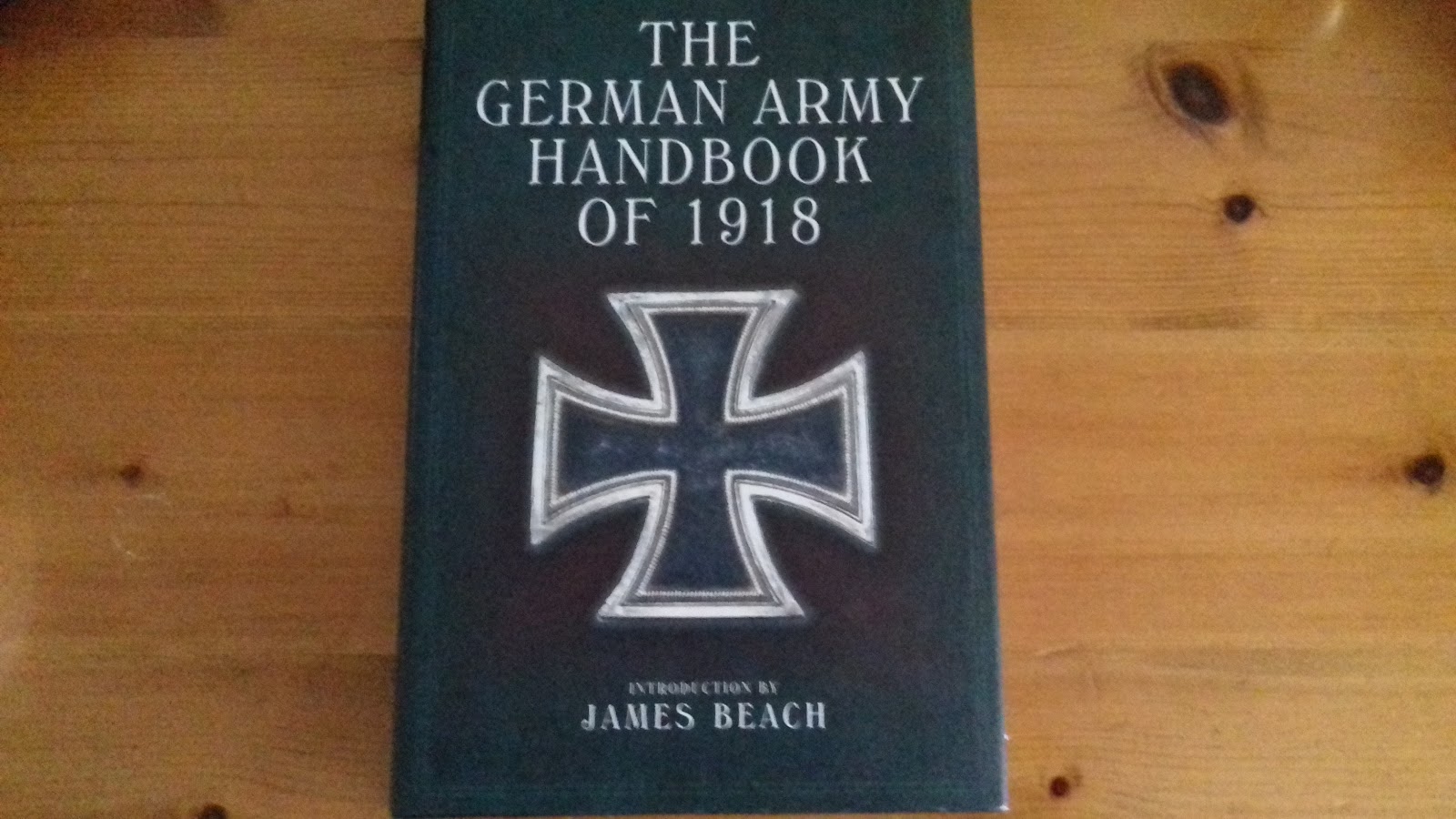
Based on the British War Office handbook of April 1918, this is a gold mine of useful and interesting information. The level of detail is extraordinary. Strangely this bookshop also had a copy of a reproduction of the 1913 edition. Although both books were the same original price, in the same "as new" condition and virtually the same size, the 1913 version was three times more expensive. The bookshop owner could only refer me to the prices quoted on line, which he followed, with no other practical explanation of the price difference. As the content of both books was clearly very similar I elected to purchase the cheaper version. I have to say, the bookshop in question had one of the best collections of military books I have seen in a long time. I may have to go back one day !!!!!
I like these old War Office publications very much. I have a number of them including reproductions of the 1914 Field Service Pocket Book, The Employment of Machine Guns 1918 and the Field Service Manual for Infantry Battalions 1914. I also own an original Field Service Pocket Book from 1932 and an original Royal Army Medical Corps Training manual from 1911. All have splendid levels of intricate detail.
I am pleased to report that, as predicted, I have enjoyed more modelling play time this week. As a result I have been able to half varnish the 500+ soldiers required for the Command battalions upgrade. In addition the 34 office and signals wagons have now been painted olive drab and the horses for these vehicles have also been "browned" in my standard horse colour. Finally I have completed the first batch of three Cavalry squadrons for my Cavalry regiments upgrade. Only another 15 squadrons to go !!!!!!

I am still working on the post about forge wagons that I mentioned back in May. The vehicles themselves were finished and issued months ago but other matters intervened to delay the "how to make" post. Anyway, its finally almost done so I expect to publish shortly. I am pleased to say I have now had my first couple of comments. As a result it was suggested to me that I remove the moderation setting to enable comments to be added to the blog instantaneously. This I have now done. I hope it generates more comments please.
Monday, 19 August 2019
BOOKS.
SALUTE OF GUNS
I have just re-read a book from my library that I have had for some time.

This is the story of a Lieutenant in the Royal Artillery in World War One. The book is not the best from a military history perspective in that it is very literary, the author became a reporter at the Manchester Evening Post after the war and the book is full of dreamy descriptions of sun rises etc. There is however, a lot of interesting stuff about day to day experiences but the main focus is on the authors two nervous breakdowns during the war.
I have read other autobiographies where the author has had a breakdown or suffered PTSD as a result of their experiences. I have also got books describing similar experiences where the author has apparently sailed through a war and come out it seems, almost untouched by the horrors they suffered. It makes me wonder why some are so traumatised and others not. It is impossible to be sure as , I am pleased to say, I have not had any traumatic war experiences and additionally, I am not a psychiatrist. However I think it comes down to the personality of the individual. It seems to me , from what I can gather of the personalities of the various authors, that those with a strong intellectual leaning are much more likely to suffer than those who are more matter of fact. I do believe that the greater a man's imagination, the more likely he is to suffer PTSD.
Anyone got any thoughts on this issue ?????
SALUTE OF GUNS
I have just re-read a book from my library that I have had for some time.

This is the story of a Lieutenant in the Royal Artillery in World War One. The book is not the best from a military history perspective in that it is very literary, the author became a reporter at the Manchester Evening Post after the war and the book is full of dreamy descriptions of sun rises etc. There is however, a lot of interesting stuff about day to day experiences but the main focus is on the authors two nervous breakdowns during the war.
I have read other autobiographies where the author has had a breakdown or suffered PTSD as a result of their experiences. I have also got books describing similar experiences where the author has apparently sailed through a war and come out it seems, almost untouched by the horrors they suffered. It makes me wonder why some are so traumatised and others not. It is impossible to be sure as , I am pleased to say, I have not had any traumatic war experiences and additionally, I am not a psychiatrist. However I think it comes down to the personality of the individual. It seems to me , from what I can gather of the personalities of the various authors, that those with a strong intellectual leaning are much more likely to suffer than those who are more matter of fact. I do believe that the greater a man's imagination, the more likely he is to suffer PTSD.
Anyone got any thoughts on this issue ?????
After a busy domestic week I have not managed to get much modelling time. In fact I have made no progress at all with the things I posted last time as work in progress!!!!! What little time I did manage at the work station was spent implementing the changes to Command battalions previously mentioned. For some reason or other I decided not to carry on with the several jobs on the bench but instead decided to collect the 300 odd soldiers currently with Command battalions that required repainting, which together with another 200 new soldiers, actually represents the organisational changes. I have managed to carry out most of the repainting, which was around changing arm of service and rank colours. I now have about 500+ soldiers to varnish !!!!!!! That's what comes of deciding to make changes that affect 19 battalions !!!!! I hope to get more "play" time later this week at which time I hope to make some progress with the other outstanding tasks.
In the meantime I see I am still getting a lot of visitors to my blog yet no one seems willing to leave a comment on what they see or read. I am at a loss to explain this, please let me know what you think of my ramblings, good bad or ugly, I really would appreciate some feedback please.
In the meantime I see I am still getting a lot of visitors to my blog yet no one seems willing to leave a comment on what they see or read. I am at a loss to explain this, please let me know what you think of my ramblings, good bad or ugly, I really would appreciate some feedback please.
Friday, 9 August 2019
Although I have had little time recently to model I have managed some progress. The Quartermaster Transport battalion has been completed. This is the last battalion to complete the Army Group at this time other than three Command battalions that are on hold pending the organisational changes mentioned in previous posts. With completion of this battalion the Army Group now numbers 45,172.


The photo above shows two of the three transport companies with just 5 more GS wagons needed to complete the equipment.

This photo shows the third Transport company on the left with the headquarters company on the right.
Other tasks currently in hand include the building of a batch of 34 office wagons to complete the equipment of Command battalions.


This batch includes a number of signals vehicles which can be seen on the top row equipped with paperclip aerials. These vehicles now await painting in olive drab. The horses for these vehicles are made and primed on one side.

These horses are waiting to be painted "horse" brown after which they will be glued on the painted side to the wagons. I find the painted side gives a good key for the glue. The rest of the horse is then primed and "browned".
Finally I am well advanced with the first batch of three new Cavalry squadrons also mentioned in a previous post.

These 66 new Cavalrymen are complete apart from the "browning" of the horses.
BOOKS.
PANZER ACE
This is the first post I have made covering the books I am reading. I intend to do more posts in the future on what I think are interesting books that I acquire or am re-reading. I am fortunate enough to have a very extensive library covering all sorts of military subjects although with an emphasis on the subjects that particularly interest me including 19th century warfare, World War 1, horse drawn military vehicles and logistics of all periods. To start the ball rolling I have to mention the book I am currently reading, which typically is not from those areas !!!!!!!!!!!

PANZER ACE
This is the first post I have made covering the books I am reading. I intend to do more posts in the future on what I think are interesting books that I acquire or am re-reading. I am fortunate enough to have a very extensive library covering all sorts of military subjects although with an emphasis on the subjects that particularly interest me including 19th century warfare, World War 1, horse drawn military vehicles and logistics of all periods. To start the ball rolling I have to mention the book I am currently reading, which typically is not from those areas !!!!!!!!!!!

This is a newly published book, face value £25, which I picked up in The Works for £4. I often ;look at the books in this shop as they are so cheap. They seem to bring out a new batch of books every three or so months and often include subjects I find of interest but for which I may not be willing to pay the full price. This particular book is one of the best I have read recently. The author survived the war to become a General in the Bundeswehr and includes some amazing photos and descriptions of day to day service life with many references to the vehicles within his unit. These vehicles will be familiar to the WW2 German army enthusiast but to read about the daily use of these vehicles is very interesting indeed.
Wednesday, 31 July 2019
Battalion Organisational Changes
As mentioned in earlier posts I have now revised the structure of all Medical and Command battalions and Cavalry regiments.
For Cavalry the change is that the number of squadrons within the regiment has been increased from three to four. With Medical battalions the main change is the restructuring of the surgical company. As far as Command battalions are concerned the changes include a reduction in the size of the Signals company and the revision of the Staff company into directorates. In addition I have introduced aides de camp for each General officer.
These changes have now been included in the organisational posts for these units. The total overall effect is to increase the number of soldiers within the Army group by 740 giving a new authorised strength of 46,542. At the time of writing I have 44,998 soldiers in service.
Other changes are currently under consideration and these will be posted as and when they occur.
Since writing the above several other changes have been introduced including the elimination of Artillery brigades, creation of Army Command brigades and addition of Heavy Weapons companies to each Infantry battalion. This has resulted in an increase in the authorised strength of the armies to just under 52000.
As mentioned in earlier posts I have now revised the structure of all Medical and Command battalions and Cavalry regiments.
For Cavalry the change is that the number of squadrons within the regiment has been increased from three to four. With Medical battalions the main change is the restructuring of the surgical company. As far as Command battalions are concerned the changes include a reduction in the size of the Signals company and the revision of the Staff company into directorates. In addition I have introduced aides de camp for each General officer.
These changes have now been included in the organisational posts for these units. The total overall effect is to increase the number of soldiers within the Army group by 740 giving a new authorised strength of 46,542. At the time of writing I have 44,998 soldiers in service.
Other changes are currently under consideration and these will be posted as and when they occur.
Since writing the above several other changes have been introduced including the elimination of Artillery brigades, creation of Army Command brigades and addition of Heavy Weapons companies to each Infantry battalion. This has resulted in an increase in the authorised strength of the armies to just under 52000.
Tuesday, 30 July 2019
Although work continues at my Mums flat I have had some modelling time so thought I would give an update on my activities. I still can't find the time to do much blogging but I hope to get some more articles written and published in a few weeks time.
The Medical battalion has been completed and I have almost finished the Quartermaster Transport battalion which is the last battalion to complete my army at this time. I have in fact now started to implement some of the organisational changes previously referred to. The first changes to be actioned include adding an extra squadron to each of my 18 Cavalry regiments. At present there are three squadrons in each regiment. This is being increased to four and I have constructed the first batch of three new squadrons and am about to start painting these 66 new cavalrymen. I will revise the organisational post for Cavalry regiments to reflect this change shortly. In addition I have changed the structure of Command battalions to provide for each general to have a personal staff and to increase the number of staff soldiers while reducing the number of signals personnel. This revision will be made to the organisational post on Command battalions shortly but broadly speaking involves the creation of about 180 new soldiers across 19 Command battalions and repainting of about 200 existing soldiers. In terms of equipment activity I am presently building 34 new house bodied wagons to equip all command battalions with extra vehicles to facilitate the new additions to the command structures.
On other fronts, I mentioned I would take my old schoolboy stamp collections to a dealer for valuation and possible sale. I did this but found my collections quite worthless. Basically the stamps I collected, back in the 60s, have no more value today than back then if not less, and they were cheap then otherwise I could not have afforded them.My albums are apparently classic schoolboy collections of attractive but cheap stamps, all looks but no value. They have therefore gone back into the loft for the next generation, maybe they will have better luck in 30 ( that's me being optimistic ) or so years time.
Much more pleasing is that I have sold my Peter Laing figures to a collector, in fact some of them are going to Mark at Manoftin which is good news as he is a great fan of these figures. I still have some French Napoleonic cavalry, which I thought had found a new home but not anymore. I may well put these on ebay in what would be my first foray on this medium. If I proceed I will report on my experiences.
The other thing of possible interest is that I am thinking of attending a wargaming convention next year to display some of my army. Not to actually wargame but just to show them and perhaps generate some interest in the concept of screw soldiers. If anyone has a view on this idea, or anything else of course, please do leave a comment, I would greatly value your views on all matters.
The Medical battalion has been completed and I have almost finished the Quartermaster Transport battalion which is the last battalion to complete my army at this time. I have in fact now started to implement some of the organisational changes previously referred to. The first changes to be actioned include adding an extra squadron to each of my 18 Cavalry regiments. At present there are three squadrons in each regiment. This is being increased to four and I have constructed the first batch of three new squadrons and am about to start painting these 66 new cavalrymen. I will revise the organisational post for Cavalry regiments to reflect this change shortly. In addition I have changed the structure of Command battalions to provide for each general to have a personal staff and to increase the number of staff soldiers while reducing the number of signals personnel. This revision will be made to the organisational post on Command battalions shortly but broadly speaking involves the creation of about 180 new soldiers across 19 Command battalions and repainting of about 200 existing soldiers. In terms of equipment activity I am presently building 34 new house bodied wagons to equip all command battalions with extra vehicles to facilitate the new additions to the command structures.
On other fronts, I mentioned I would take my old schoolboy stamp collections to a dealer for valuation and possible sale. I did this but found my collections quite worthless. Basically the stamps I collected, back in the 60s, have no more value today than back then if not less, and they were cheap then otherwise I could not have afforded them.My albums are apparently classic schoolboy collections of attractive but cheap stamps, all looks but no value. They have therefore gone back into the loft for the next generation, maybe they will have better luck in 30 ( that's me being optimistic ) or so years time.
Much more pleasing is that I have sold my Peter Laing figures to a collector, in fact some of them are going to Mark at Manoftin which is good news as he is a great fan of these figures. I still have some French Napoleonic cavalry, which I thought had found a new home but not anymore. I may well put these on ebay in what would be my first foray on this medium. If I proceed I will report on my experiences.
The other thing of possible interest is that I am thinking of attending a wargaming convention next year to display some of my army. Not to actually wargame but just to show them and perhaps generate some interest in the concept of screw soldiers. If anyone has a view on this idea, or anything else of course, please do leave a comment, I would greatly value your views on all matters.
Saturday, 20 July 2019
I'M BACK !!!!!!!
Well about as much back as I can be at this time. The past several weeks have been hard to say the least. Most of the paperwork resulting from my Mum's passing is now either done or ongoing. The priority at present is the heart breaking task of clearing her flat so as to be able to sell it perhaps later this year. As usual my wife is my rock and is doing the things I can't emotionally cope with like sorting clothes and bagging them for charity. Its quite extraordinary how much stuff one person can accumulate in a lifetime. Something I have realised is that no matter how much we value or even treasure items and objects, that value does not travel through the generations in a lot of cases. Of course there are things of my Mum's that will be kept both by me and my daughters but there are many things that we just really don't want to keep although I know my Mum treasured them. Even if we did choose to pack them away in my loft for the next ten or twenty years my children or grandchildren will not value them because they just don't have any attachment to them so what's the point.
This situation has made me realise it is now time to get rid of some of the stuff I have accumulated over the years. Its going to be interesting enough for my girls to inherit 45000+ screw soldiers let alone a heap of other useless stuff. That said, I recently sold my plastic models, both made and unmade, that I last worked on in the 1960s. A guy came over and to my surprise took the lot and paid me well for the privilege. Last week I took my collection of Matchbox vehicles, also from the 1950s and 60s to a local specialist old toy shop and he also bought them all at a handsome price. I plan to take my stamp albums to a dealer over the next few weeks to see if they are of interest. I also found a batch of mostly Peter Laing metal figures and am now in negotiation with a collector to move them on too.
Although I am spending a couple of days each week working at my Mum's flat, I have found some time to model. In fact it has been quite therapeutic. Since my last update I have completed the last Pioneer battalion and both Heavy Artillery battalions. I have also almost completed the last Medical battalion which leaves only a QM transport battalion to complete the army. As I have mentioned before, I have a large number of potential organisational changes to implement that I I have dreamt up over the last year or so. Some of these are quite substantial and will involve a lot of work. I will publish details at some time in the future.
To close this update I have to mention Mark of Manoftinblog.wordpress.com with whom I have recently corresponded by e mail. Like me he takes great pleasure in using regular household items to make interesting and useful supplements for his models. I strongly recommend his blog as a source of stimulating ideas and thoughts.
Well about as much back as I can be at this time. The past several weeks have been hard to say the least. Most of the paperwork resulting from my Mum's passing is now either done or ongoing. The priority at present is the heart breaking task of clearing her flat so as to be able to sell it perhaps later this year. As usual my wife is my rock and is doing the things I can't emotionally cope with like sorting clothes and bagging them for charity. Its quite extraordinary how much stuff one person can accumulate in a lifetime. Something I have realised is that no matter how much we value or even treasure items and objects, that value does not travel through the generations in a lot of cases. Of course there are things of my Mum's that will be kept both by me and my daughters but there are many things that we just really don't want to keep although I know my Mum treasured them. Even if we did choose to pack them away in my loft for the next ten or twenty years my children or grandchildren will not value them because they just don't have any attachment to them so what's the point.
This situation has made me realise it is now time to get rid of some of the stuff I have accumulated over the years. Its going to be interesting enough for my girls to inherit 45000+ screw soldiers let alone a heap of other useless stuff. That said, I recently sold my plastic models, both made and unmade, that I last worked on in the 1960s. A guy came over and to my surprise took the lot and paid me well for the privilege. Last week I took my collection of Matchbox vehicles, also from the 1950s and 60s to a local specialist old toy shop and he also bought them all at a handsome price. I plan to take my stamp albums to a dealer over the next few weeks to see if they are of interest. I also found a batch of mostly Peter Laing metal figures and am now in negotiation with a collector to move them on too.
Although I am spending a couple of days each week working at my Mum's flat, I have found some time to model. In fact it has been quite therapeutic. Since my last update I have completed the last Pioneer battalion and both Heavy Artillery battalions. I have also almost completed the last Medical battalion which leaves only a QM transport battalion to complete the army. As I have mentioned before, I have a large number of potential organisational changes to implement that I I have dreamt up over the last year or so. Some of these are quite substantial and will involve a lot of work. I will publish details at some time in the future.
To close this update I have to mention Mark of Manoftinblog.wordpress.com with whom I have recently corresponded by e mail. Like me he takes great pleasure in using regular household items to make interesting and useful supplements for his models. I strongly recommend his blog as a source of stimulating ideas and thoughts.
Tuesday, 4 June 2019
My Mum passed away last night so clearly I will have a vast amount of things to do over the coming weeks or even months. I do not expect to get much if any modelling time let alone time to blog. I will endeavour to pick up the threads of this blog at some time in the hopefully not too distant future.
Subscribe to:
Posts (Atom)