Thursday, 17 November 2022

BOOK REVIEW: THE WAFFEN SS.

THE THIRD REICH'S MOST INFAMOUS MILITARY ORGANISATION.


 I recently picked this book up in The Works very cheaply. 

Although no fan of the SS generally, I am interested in the Waffen SS, the military arm. There is no doubt that the divisions of the Waffen SS were among the most effective and powerful of Germany's armed forces. The book concentrates on providing a detailed history of the various divisions that were formed during the war, their military service and short profiles of some of the most important leaders of those units. In fact I think it provides the most comprehensive record of Waffen SS units I have ever seen.

No attempt is made to gloss over the atrocities perpetrated by the SS but the focus is far more on the combat history of the SS and in that it is very effective. Overall I recommend this book if you are interested in the combat units of the Waffen SS and their battle histories.


Friday, 11 November 2022

ORGANISATION OF THE ARMY.

INFANTRY BATTALIONS.


The Infantry battalion consists of 6 Infantry companies, a Heavy Weapons company and a Headquarters company.

The Infantry company comprises three platoons each of 12 privates and two Corporals under the command of a Lieutenant assisted by a Sergeant. The  company is commanded by a Captain assisted by a company Sergeant Major. The total strength of a company is 50.

The Heavy Weapons company comprises two platoons each of 12 privates and two Corporals under the command of a Lieutenant assisted by a Sergeant. The company is commanded by a Captain assisted by a company Sergeant Major. The total strength of the company is 34.

The Headquarters company comprises a Staff platoon of 4 privates, a Corporal and a Sergeant, a Medical platoon of 14 medics, two medic Corporals, 2 medic Sergeants, a surgeon Lieutenant with a surgeon Captain in command. The Quartermaster platoon has 18 privates, 3 Corporals, and a Sergeant with a Lieutenant in command. The Signals platoon has 12 signallers, 2 Corporals and a Sergeant and Lieutenant in command. The command platoon has a Lieutenant Colonel as battalion commander with three Majors, one as Adjutant and second in command and two Majors as wing commanders of three of the Infantry companies, a battalion Sergeant major and two standard bearers, one with the national flag and one with the battalion flag. The total strength of the headquarters company is 73 giving a total battalion strength of 407.

The vehicles and equipment of the battalion comprises 6 GS wagons towing a field kitchen trailer, a water tank trailer, a signals trailer, a medical trailer and two light GS trailers and two limbers, two caissons and two heavy weapons together with an ammunition wagon.


The photo above of a battalion in parade formation shows the Infantry companies on the left with the Heavy Weapons company in the centre and the Headquarters company on the right in front  of the battalion vehicles. 


This photo shows the battalion deployed for an advance with the Heavy Weapons company and command platoon in the centre and the battalion wagon lines at the rear.

My armies have a planned total of 96 Infantry battalions of which 76 have been built at the time of writing. The arm of service colour for Infantry is blue.

Sunday, 6 November 2022

BOOK REVIEW: ANIMAL MANAGEMENT 1933.


Regular readers of this blog may recall that I mentioned receiving this book as a gift from Mark at the Man Of Tin blog. Mark is aware of my interest in horse drawn logistics and this is an original War Office publication which he no longer wanted, a very generous gift indeed.

The format of the book is the usual War Office style and covers every conceivable element of the care and use of horses and mules in service in the British Army. There are chapters on the structure of the horse and points of particular types and breeds, stable construction and management including grooming, foods and watering, saddles, shoeing, transportation of horses by sea and rail and of course prevention of disease and first aid. In fact everything you could wish to know about the military use of the horse.

Although a reference book and therefore not the easiest read, as a source of information this book is a "bible" of relevant data about horses in military service and I am delighted to have it in my library.


Tuesday, 1 November 2022

BOOK REVIEW: SUPPLYING CUSTER.

 THE POWDER RIVER SUPPLY DEPOT 1876.


Another book from my library, it relates the 1876 US Army campaign against the Indians which culminated in the Battle of The Little Big Horn and Custer's last stand.

The first half of the book details the various expeditions to the Powder River country and the history of the fighting against the plains Indians in the general area including the famous battle at Little Big Horn with an emphasis on logistics. The second half of the book relates in detail the supply arrangements for the campaign of 1876 and in particular the supply depot that was established at Powder River and the archaeological excavations carried out on the site in 1983.

The historical element of the book is first class and gives a clear and detailed analysis of the US Army's activities against the Sioux Indians but the results of the archaeological investigations are really fascinating.  Items found cover the whole range of products of the time even including bottle fragments that were identified as British made beer bottles. Who would have thought that British beer would find its way to the American frontier and in large quantities too.

I accept that this is very much a highly specialised topic but it makes for very interesting reading and gives a great insight into life on the early American frontier especially for the soldiers during the Indian wars.

Highly recommended if you have an interest in this sort of history.


Wednesday, 26 October 2022

IMAGI-NATIONS. PART 47

 PREPARATIONS FOR THE INVASION OF CHINA.


Following the signing of the treaty between the UNION, Britain and India in Spring 1891 preparations commenced to prepare for the invasion of China by the UNION from northern India. In May a British ship arrived in Miami with a group of British government officials and a number of civil and railway engineers. They were met by the UNION India Survey Group. This comprised a number of UNION government officers together with UNION railway engineers and a large group of UNION army logistics officers, veterinary officers and a company of Field Police to provide security. All UNION army personnel were out of uniform. The group also included a number of vehicles and equipment provided by the UNION army to enable the survey group to travel extensively within India without recourse to local transport.

The joint survey team arrived in Bombay early in June and were immediately joined by a number of Indian government officials, army officers and local engineers. The combined group immediately started to survey the docks in Bombay to determine what construction would be needed to meet the UNION army's requirements  both in terms of dock facilities, railway marshaling yards and storage facilities. The group then traveled slowly north towards the Chinese frontier surveying the route of  the new railway lines.  On arrival at the border region the survey group determined the location and facilities needed to provide railhead facilities. At the same time, some of the UNION army personnel remained in Bombay to survey and determine what resources may be available in India to meet logistical requirements including food , fodder and local horses.

By August the surveys had been completed and the group returned to Bombay where discussions commenced on the construction needed and a programme was developed for implementation by the Indian government assisted by British engineers. Early in October the UNION members of the survey group returned to Miami.

The plan developed was quickly ratified by all the participating governments and construction commenced in mid October 1891. The plan provided for no additional docks in Bombay as the existing facilities were deemed adequate. However a very large area of land beside the docks was secured to provide a base for the UNION army. The storage, troop transit, medical and administrative facilities and railway marshalling areas commenced construction in late October. At the same time construction commenced on additional railway lines following the existing lines to the border with China. Land for three railheads on the border was secured and construction also commenced on those facilities.

All construction was scheduled to be completed by the end of 1892. In the meantime the UNION army began preparing plans and timetables for the deployment of 8 UNION armies to India together with vast quantities of munitions, food, fodder and other essential stores. Around this time it was also decided that a new army would be formed. The 11th Reserve army would be created to join 10th Reserve army to provide security for the UNION while the bulk of the regular army was deployed to India. Both reserve armies would be called up in good time to allow for intensive re-training before the regular army deployed.

Discussions also took place to ensure the British could provide sufficient shipping. To meet the anticipated requirements it was agreed that only ships of 10,000 tons or more and capable of at least 20 knots would be used. To ensure sufficient capacity the British laid down a number of new ships for delivery by the end of 1892. The deployment plans developed allowed for the accumulation in Bombay and at the railheads of a three month stock of all supplies before the main body of UNION troops began to arrive. To preserve as much secrecy as possible the UNION troops would be deployed to India in the shortest possible time. Also to avoid China becoming suspicious, the construction efforts were publicly announced as a major British investment to provide the infrastructure needed to develop northern India.

By October 1892 construction and associated planning by all parties was well advanced and proceeding to timetable.

Thursday, 20 October 2022

BOOK REVIEW: WOUNDED.

 FROM BATTLEFIELD TO BLIGHTY 1914-1918.


Another book from my library, this one covers the treatment and transportation of wounded British soldiers during the First World War by means of personal accounts from both soldiers and medical staff.

Each chapter covers the story of either an individual or group of individuals from soldier to nurse, doctor, bearer, orderly or chaplain giving details of what they experienced. There are also  chapters devoted to the ambulance trains and the not well known London Ambulance Column which took wounded soldiers from main line stations to the many hospitals around the capital.

The various accounts are fascinating and absorbing, it is a hard book to put down. The hardship that both wounded soldiers and medical staff, especially those in France, experienced makes for difficult reading but the constant thread in the book is of selfless service and fortitude, traits that are frequently evidenced in many accounts of WW1 and I believe, reflect the attitudes and perspectives of that generation.

The book is very well written and highly recommended to those interested in this important but often neglected aspect of WW1.


Saturday, 15 October 2022

UPDATE.

Well my 70th birthday is now almost a distant memory.....short term memory loss  being a symptom of advancing age I am told...except I can't recall who said that !!!!!!!

I had a great day anyway. We went to Llandudno on the north coast of Wales for the day. About the closest seaside to us and a round trip of 190 miles...that's the cost of living in the middle of the UK !!!!  That said my car delivered another amazing result of 51 mpg on "A" roads at an average speed of 50 mph.


We parked on the sea front to the right of the photo and walked all the way down to the pier which can be seen as a pale line at the foot of the hill which is called The Great Orme. Walked to the end of the pier, watched some fishermen for a while then back and on into town which is on the left of the photo. As can be seen, the day was perfect, blue sky, flat sea, warm and sunny which for this time of year was unusual. 

Although not quite as dramatic as Johnathon Freitag's adventures with moose, we too had a wildlife encounter. We bought ice creams in a parlour, I finished mine inside but my wife was still eating hers when we left the shop. Just outside a seagull landed on her head and tried to seize the ice cream cone from her hand. She screamed and I turned in time to see it launch back into the air. Fortunately neither my wife or the ice cream were injured in any way. My wife was more stunned by the sheer weight of the gull on her head than anything else. That it should try to grab the cone was no surprise as that sort of thing happens all the time but to land on her head was a bit extreme but has provided an interesting dinner conversation anecdote !!!!  On the way home we stopped at a favourite local gastro pub for dinner.

As it was a special birthday the "celebrations" continued on Friday. We drove to our local National Trust property for a walk around the 1,000 acre estate. We first visited the estate on my birthday in 1998 so it seemed appropriate to go on Friday. In those early days the estate attracted 20,000 visitors a year, now it has over 400,000 a year. We now tend to visit only in autumn and winter when it is not quite so busy.


This is the house, Attingham, built around 1760. The park has a large deer herd and the rut is on at present. The often means bucks are holed up in the woods but none were seen on this trip. In fact all we saw was a large group grazing far away in the distance.


Another view of the house from the deer park on the way to the woods. Although we have some fine autumn colours in our local trees the park trees are still mostly green however the leaves are falling and carpeted the path in the woods as seen below.


As we neared the river bridge a squirrel ran across the path in front of us, another wildlife encounter !!!!!

Again we had lunch in a nearby pub before heading home. Today we met friends for an "eat all you can" breakfast at a pub outside Dudley where we all used to work together. An early start but a great way to spend the morning.  Tomorrow, Sunday, we are having lunch with my daughter at yet another local pub which will be four days on the trot eating out, almost a record !!!!!  No doubt the bathroom scales will have something to say about that when next visited.

Overall a good and extended birthday which kind of makes up for being so old......well maybe not !!!!!!


Tuesday, 11 October 2022

UPDATE.

 As  Autumn has now arrived I am hoping for some more modelling time. As mentioned before I have done very little this Summer, there always seems to have been something else to do. That said I have this week just managed to complete the battalion of Heavy Artillery that has been on the bench for at least three or more months. The Cavalry regiment still has some way to go but I have finally started the priming of the horses. Once that's done the top coat can be applied and they will be completed too. I have also managed to draft the next article in my Imagi-Nations series which I hope to publish next week.

Finally for this brief update, I am, at this point in time, less than two days away from Three Score Years and Ten......I really cannot quite grasp that I have become so old.....the inner me is at most only 15 or so....some would say more like 7   !!!!!!  Of course the body says otherwise as does the mirror  and with children in their forties the evidence is overwhelming that I really am old !!!!!!   With the number of meals booked with friends and family over the rest of the week, I think the bathroom scales may well also be sending a message soon !!!!!

No doubt like everyone else reaching this milestone, I wonder where the time has gone. The years seem to be rolling by with greater speed than ever and I still have well over 20,000 screws to paint !!!!!

Tuesday, 4 October 2022

BOOK REVIEW: MEETING THE ENEMY.

 THE HUMAN FACE OF THE GREAT WAR.


Yet another book from my library, this one is written by the great WW1 historian Richard Van Emden.

This is an unusual book in that it discusses the human face of the war. It is well known that prior to the war the cultural and social ties between Britain and Germany were very strong. Thousands of Germans lived and worked in Britain and had done for many years. Inter marriage between the two nations was high and there were many "mixed" couples living in both countries in 1914.

The book addresses what happened to those people of both nations who found themselves either in the wrong country on the outbreak of war or , as a result of military operations, found themselves prisoners of war.

There are several astonishing issues discussed in the book including the level of contact on "human" matters that continued throughout the war between the two governments and the harsh treatment of British women who were married to Germans but living in Britain and who were considered as German by the British government.

This is an excellent book covering an poorly known subject but one that is both complex and fascinating and demonstrates beyond doubt that war is far more complex in its impacts that just soldiers fighting one another especially among nations with a close pre war relationship.

A great book and highly recommended.


Thursday, 29 September 2022

UPDATE.

 A MOST WELCOME GIFT.


Knowing of my interest in horse drawn logistics,  Mark at Man of Tin blog recently contacted me to offer me a book about British Army horses that was now surplus to his requirements. I gratefully accepted and the book arrived today.

WOW....the book is an original official War Office publication from 1933. I had expected a reprint perhaps rather than such a valuable original. Just a brief thumb though reveals a wealth of information on the British Army's horse management policies and practices that will be so useful to me.

I cannot express my thanks enough to Mark for his generosity and this most welcome addition to my library. Naturally I will publish a full review of the book once I have fully digested it.

Thanks Mark !!!!!

Wednesday, 28 September 2022

BOOK REVIEW: THE TALE OF A FIELD HOSPITAL.


This book is a reprint of an account written in 1900 by Sir Frederick Treves, a highly regarded surgeon who volunteered for service in the Boer War as a consultant to the British Army Medical Service.

The account details the activities of No.4 Stationary Field Hospital during the three months of the Ladysmith relief expedition in late 1899 and early 1900.  As such it covers the battles of Colenso and Spion Kop from a medical point of view and how No. 4 hospital cared for the majority of the casualties of both actions.

The style of writing is typical of the period and rather wordy at times however there is a great deal of useful information on how a field hospital operated and the conditions behind the lines and there are also a  number of fascinating photos included. There is even a short chapter on the hospital's pet dog including a photo!!

As is to be expected from a book written so soon after the event  there is a lot of patriotic praise for the British soldier and his endurance under difficult circumstances. Strangely however, there is no mention of the medical work performed by the author whatsoever.

Overall an excellent first hand contemporary account, although rather limited in scope, of an interesting aspect of the Boer War.


Thursday, 22 September 2022

BOOK REVIEW: CHARGE TO GLORY !

 A GARLAND OF CAVALRY EXPLOITS.


This is a book from my library acquired some years ago in a second hand book store.

The book relates the story of cavalry  from Marengo to Fondouk in 1943 detailing the significant impact that cavalry had on each of the ten engagements discussed. There is also an opening chapter covering the general history of the cavalry arm through the ages.

The intention of the author is to provide an understanding of the "cavalry spirit" and describe how that "cavalry spirit" sometimes led to bold victory and sometimes to rash defeat.

The ten engagements are discussed at length culminating in a detailed account of the decisive cavalry action for which the battles are particularly known.

The writing style is excellent and the book is addictive reading and highly recommended to anyone interested in the "cavalry spirit" and what that actually meant on the battlefield.


Sunday, 18 September 2022

UPDATE.

CAMPAIGN WARGAMES SHOW. 


Following my visit to COLOURS last week I yesterday visited CAMPAIGN at Milton Keynes.

There was quite a difference between the two shows in that CAMPAIGN is in an open square in the middle of the Milton Keynes shopping Centre and was frankly poor in comparison to COlOURS. There were only about 4 or 5 traders although there were a lot of gaming tables. However when I arrived about 1pm not a single game was in progress and many of them had not even set up.

After lunch and some shopping with my wife who came along with me, we returned to the show around 4pm in time to see most of the games either packing up or gone. Overall very disappointing and not worth the 200 mile round trip or the £10 parking charge, that said we did have a very nice lunch.

While I can recommend COLOURS I cannot do the same for CAMPAIGN based on what I saw, or more rightly, did not see !!!!  I think that concludes my visits to wargame shows certainly for this year. Will I go again next year.....I really do not know yet.

On another note, my post about COLOURS last week has had not a single view by any reader, am I wasting my time writing posts, of course not as I do it for my own pleasure and if others like it great, if not, so be it.

Sunday, 11 September 2022

UPDATE.

COLOURS WARGAMES SHOW. 


Yesterday I attended my first ever wargames show at Newbury. 

The round trip was 270 miles almost all of which was on motorway or dual carriageway but amazingly my car delivered 49.1 mpg, I guess having 9 gears helped along with the extraordinary technology in the vehicle but still a great result from a big heavy petrol car with a larger than average engine.

I spent a good couple of hours going around the huge number of trade stands and inspected the wargames closely. My conclusion is that I am not a wargamer.... the games were interesting but not to my taste. I did like the trade stands and spent a lot of time checking out the many books on offer. However I found nothing to buy.

Steve Johnson, in his report on the show, said that it was more like a trade show with some wargames tacked on and I agree with that assessment. Nevertheless I am pleased I went and I am currently planning to visit the CAMPAIGN show in Milton Keynes next week.

On the modelling front, once again I have virtually nothing to report. Since my last update all I have done is complete the arm of service and rank insignia of a cavalry regiment and a heavy artillery battalion, maybe two hours of work at most. The long summer and continuing reasonable weather have left little time for modelling. I am almost looking forward to the nights drawing in with rain and cold so I can get back into painting and building my armies.


Friday, 2 September 2022

BOOK REVIEW: SO THEY RODE AND FOUGHT.


This is a withdrawn library book picked up a few years ago at a second hand book sale.

The author was an officer of the Indian army who, on partition in 1947, transferred to the Pakistani army and retired as a Major General.

The book details the history of cavalry in Asia with particular emphasis on the cavalry of the Indian army before independence. Every cavalry regiment that ever existed is listed with details of its history. There are also fascinating chapters on life as a cavalryman, the horses and battles all in chronological order.

As a King's Commissioned Indian Officer, the author had a unique perspective on the pre independence Indian army however it is also quite apparent that his views and life as an officer were very similar to British officers.

Overall a good book and very recommended if you are interested in the cavalry of the Indian army before 1947.


Thursday, 25 August 2022

WARGAMING 19TH CENTURY LOGISTICS.

A Challenge for Wargamers ????

I have always been very interested in military logistics especially during the second half of the 19th century when army commanders began to face the almost insuperable problems created by the simultaneous use of railways and horse drawn wagons. The huge increase in the size of armies during this period, encouraged by the availability of railways to both move and supply these armies at the strategic level, created enormous problems for generals because the tactical transport system at this time still remained the horse drawn wagon. Although these difficulties probably reached a peak in the early days of WW1 during the German advance into France and Belgium, they had been building ever since railways first came into substantial military use during the US civil war.


About 300 Union supply wagons at Brandy Station, just one supply column.


Interestingly the armies of Imperial France, wholly dependant on the horse drawn wagon, still managed to reach Moscow in 1812, further than the Wehrmacht in 1941, despite that army's considerable railway and motor vehicle resources. I am very well aware of the relative size of the forces involved and the issues the Germans faced in Russia in 1941/2 in supplying their forces adequately and that recourse was made to horse drawn transport to a very substantial degree. Nevertheless the Germans did possess a huge number of motor vehicles and enjoyed an enormous railway supply capacity up to the Polish frontier, far greater in fact than was actually needed. Napoleon however had nothing other than horse drawn wagons to bring supplies from his bases in central Germany. Despite the ultimate failure of the French invasion and the desperate nature of the retreat, the simple fact that they did get as far as Moscow at all surely says something about the inherent strength of a horse based logistic system.

Another example from this period is that of Mercer's horse artillery battery at Waterloo. After his heavy action at Quatre-Bras the day before, Mercer's battery was out of ammunition. He was advised that a resupply could be found on the road to Brussels. He sent a wagon train overnight to search for this ammunition. They were fortunate enough to find the ammunition, and some most welcome food,  and returned next morning not long before the battle commenced. I am left to speculate on the outcome of the battle if that resupply had not taken place. Without ammunition, Mercer's battery would not have been able to participate and the French cavalry charges, which they played a large role in defeating, might have been successful. Could Napoleon have thus won the battle before the Prussians appeared later in the day?

During the US civil war the battle of Gettysburg gives a wonderful illustration of the capabilities of the horse drawn wagon . One of General Lee 's objectives for the invasion of Pennsylvania, was to "requisition" as much material and supplies as possible. During the retreat from Gettysburg Lee had some 3000 wagon loads of "requisitioned" supplies and materials preceding his withdrawing combat forces. In fact the quantities captured enabled Lee to supply his Army of Virginia for the best part of another year. This poses the question as to whether the war could have ended a year earlier if the Union cavalry had been more focused on recapturing or destroying these supplies during the retreat.

This battle also raises another example of the issues faced by commanders in the horse based supply era. Prior to Pickett's charge, Lee had commanded his artillery to bombard the Union position. Unfortunately the supplies of artillery ammunition immediately available provided for a somewhat limited barrage. The reserve ammunition was still many miles to the rear, basically due to faulty logistical management. Consequently Pickett's charge took place after  far less damage had been inflicted on the Union forces than Lee planned. The charge of course failed, would it have failed if the reserve ammunition had been readily available, now that is a question.

There are other examples of logistical issues dramatically impacting military operations in these years. No one can read the history of the Zulu war without noting the amount of time, energy and resource that Lord Chelmsford devoted to securing enough transport to supply the British advance into Zululand. As a result the British army had plenty of supplies, especially ammunition, readily to hand. Nevertheless the battle of Isandhlwana was lost for two reasons. Firstly the tactical error of  deploying the British infantry companies too far in advance of the camp, up to 1000 yards in some cases, thereby making resupply of ammunition virtually impossible. Secondly the logistical failure whereby British army supply practise at the time only permitted the opening of one ammunition box at a time, an error that Chelmsford subsequently corrected during the battle of Ulundi when boxes of ammunition were opened throughout the British positions before the action even started.

These logistical matters fascinate me and lead me to conclude that the capabilities of a horse drawn supply system were far better than is commonly supposed provided the supplies being moved were restricted to rations and basic ammunition loads etc.  Of course during this period many campaigns were carried out using only the ammunition supplies actually carried with the armies. Resupply from base other than for rations or artillery ammunition did not regularly arise before WW1. Even then the railways ensured vast quantities of supplies could be brought forward and problems only arose if armies advanced so fast that the horse drawn transport could not keep up in a timely fashion. For example, every offensive on the Eastern front in WW1, by either side, eventually fizzled out, not because of enemy resistance but through lack of supplies.

As is no doubt clear to the reader of this blog, to ensure they do not run short of supplies or essential supporting resources, my armies have a very substantial logistical capability. Certainly  far more  than other modellers of this era may think appropriate given that supply units are not  glamorous compared to cavalry or even infantry. 


A Woodscrew Miniature Army Quartermaster battalion, just one of 24 such units, drawn up waiting for the order to advance.


With that in mind I wonder how much notice wargamers take of logistical matters, including  resupply from base, when fighting 19th century battles, not much would be my guess. In fact I believe that most wargamers do not pay much attention to whether their troops have sufficient ammunition or food to actually fight a battle or especially a campaign.  Additionally, how many wargamers consider such vital logistical matters such as remounts or forge wagons to shoe cavalry or even fodder to feed horses. Given the examples listed above are wargaming rules realistic in respect of logistics when it is commonly understood that warfare is 90% logistics and 10% tactics ??


Friday, 19 August 2022

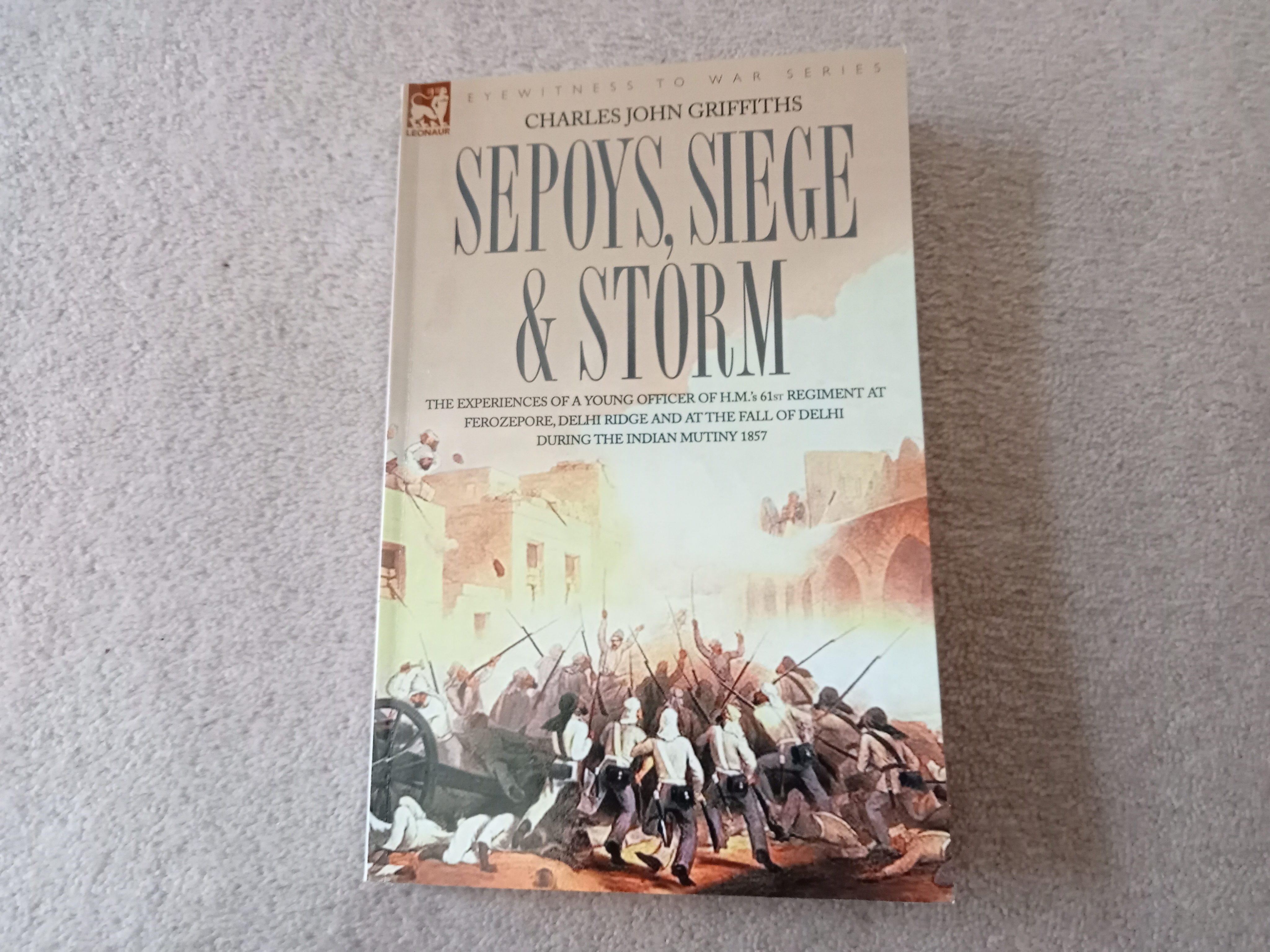
BOOK REVIEW: SEPOYS, SIEGE & STORM.

 THE EXPERIENCES OF A YOUNG OFFICER OF H.M.'s 61st REGIMENT AT FEROZEPORE, DELHI RIDGE AND AT THE FALL OF DELHI DURING THE INDIAN MUTINY 1857.


Yet another book from my library, this is a reprint of a volume originally published sometime around 1890 as far as I can tell. The book only covers a period of about one year. The author served in India from 1852 and was invalided home early in 1858 as a result of debilitation caused by the conditions suffered by the besieging army at Delhi.

The book gives great detail on the initial outbreak of the Mutiny at Ferozepore where the author was stationed and where his Regiment inexplicably remained for several months before being sent to Delhi. The siege and assaults on Delhi are covered in great detail including the very poor conditions. 

A whole chapter of the book covers the work of collecting the riches of the city by the Prize Agents and the very tardy payment of prize money which was clearly quite a priority for the author and many of his comrades.

An excellent book and highly recommended as a first hand account of the Siege of Delhi during the Indian Mutiny.


Friday, 12 August 2022

BOOK REVIEW: THIS BUSINESS OF WAR.

 Recollections of a Civil War Quartermaster.


Another book from my library. Although the book includes a full account of the authors war service it also details a great deal about  this man's fascinating life and origins having been written as a sort of autobiography for his children and grandchildren. The book was eventually published in 1913 just four years before his death at 94.

William Le Duc, whose father was a French immigrant, was a successful lawyer and businessman prior to the war. Wishing to serve the Union on the outbreak of war but having no military experience he asked how he could best serve and was told by a friend to apply for a quartermaster post where his business experience and skills would be most useful. This he did and was appointed a Captain Quartermaster.

He served throughout the war finishing as a Brigadier General. There is a great deal of useful information about the activities of a quartermaster but one of the most interesting aspects of the book is that the author knew many of the leading Union generals prior to the war, in fact he went to school with Sherman. His analysis of these various generals is fascinating and instructive. 

Overall a highly recommended book not only for the information about quartermaster activities but also in recording the very interesting life of a businessman in the 1840's and 50's and after the war when he served four years as Commissioner of Agriculture in President Hayes cabinet.


Saturday, 6 August 2022

IMAGI-NATIONS. PART 46

 THE STRATEGIC SITUATION AFTER THE SECOND SINO-UNION WAR.


In Spring of 1890 the UNION Army High Command put forward a radical proposal to the President of the UNION and his Cabinet. The proposition was to use the port of Miami as a base and ship the bulk of the UNION army to Bombay in India and from there to launch an invasion of China. From the Indian border to Peking and Shanghai, the major manufacturing cities of China, was around 1000 miles, considerably less than the 6000 miles from the UNION's border with China to those cities. The intention of the invasion would be to destroy  Chinese arms production for at least a generation and destroy as much as possible of  the Chinese army.

The initial reaction of the President and his senior colleagues was to see the plan as ridiculous. However they agreed to a presentation by the Army commander and his senior officers. In that presentation the Cabinet was reminded that India was a British colony and the British and Indian governments had experienced many years of difficulties with China along the common border. Northern India was not heavily populated and the Chinese had long believed that the border should be pushed south to give China more land for their ever growing population. This had resulted in several Chinese incursions into Indian territory and a number of skirmishes between the opposing militaries. It was the opinion of the UNION army's senior officers that the British and Indian governments could be favorably disposed to assisting the UNION in launching an invasion if only to relieve for many years the pressure on their northern border.

The army presentation then moved to reiterating that The Second Sino-Union war had been a close run thing and the Chinese army had proven to have become very formidable. It was inconceivable that China would not seek to attack the UNION in the future just as soon as they felt strong enough, therefore the UNION must launch a preemptive strike to destroy the growing threat that China presented. Invasion from the UNION was impractical given the distances involved but logistically an invasion via India was possible. Indeed the Army command suggested the British might be especially supportive because it was only by using the British merchant fleet that the transport to and ongoing supply of the UNION army in India could be achieved and that would be very profitable for the British.

The presentation then moved to a general discussion of the strategic situation in Tian. Following the invasion of Iran some few years before the Arab countries were now fully focused on resolving the future government of their countries following the rise to power of military officers rather than the religious leaders who prevailed prior to the war. It was expected that this internal conflict would continue for many years which meant there was no threat towards Mexico for the foreseeable future. 

Following the defeat of Germany and Russia earlier in the year the Russians were not considered to be a threat as they had been pushed out of Ukraine and the bridges over the Volga river had been destroyed. UNION and Ukrainian troops guarded the river and could easily foil any bridge building effort although given the recent strategic thinking of Russia, it was highly unlikely they would ever consider attacking the UNION without an ally. That ally had previously been Germany but following the UNION annexation of the Rhineland and destruction of the bridges over the Rhine any future threat from Germany was impractical and therefore considered very low risk indeed.

Overall the only realistic threat to the UNION for the foreseeable future came from China therefore it would be strategically prudent to incur the risks of an invasion of China from India if the British and Indian governments agreed. It was understood that much construction work would be needed not only in Miami but certainly in Bombay and from there to the Chinese border to support an invasion but again such work would be very profitable for Britain and India. After much debate the President agreed the plan was practical and strategically sensible and it was resolved that the British should be approached informally to understand the likely reaction to such an extraordinary proposition.

As expected the initial British reaction was astonishment but after some discussion and consideration they began to appreciate the concept was actually attractive. The whole enterprise would be very profitable to the British, would provide huge investment in India and would entail little actual risk for the British. Whatever the outcome of the actual invasion, the Chinese would be seriously weakened and the threat to India would diminish for some time. In addition, supporting the UNION would cement ties with Britain and perhaps provide for some UNION military support against China if required at some later date.

In the Spring of 1891 a secret treaty was signed between the UNION, British and Indian governments to allow the UNION to launch an invasion of China from India and for all parties to cooperatively construct the logistical facilities necessary to support such an operation. A special clause also committed the British to provide all the shipping necessary to transport and maintain a UNION army in India of up to 800,000 troops for a period of not less than five years. Detailed planning for the expedition could now commence.

FOOTNOTE:  Readers should remember that the timeline of Tian is 130 years behind Earth. Therefore the year 1891 in Tian is 2021 on Earth. Future published articles will therefore be more or less in real time rather than historical time and will likely relate the events of the previous month(s). I hope this is understandable.


Tuesday, 2 August 2022

UPDATE.

 Since my last update a few weeks ago I regret to say I have done no modelling whatsoever !!!!! So what have I been up to...well as usual, I really can not say !!!! Going out on day trips, shopping, gardening and other essential chores have occupied most of my time. I guess it is just that time of year.

However I do have one thing to report. Readers may recall my purchase of a couple of new air guns last year. These have been great fun and have been used in the garden as they are only about 60% of the maximum power allowed in this country. That said I have often wished for a full power rifle.  Such a gun is not safe in the garden and the nearest ranges, over 25 miles in opposite directions, are expensive and one is only open at weekends.

However recently a new small range opened only 10 minutes from home and it is very inexpensive. So early last week I visited said range and found it to be perfect for me. In addition, being only small, I could book the whole thing for a couple of hours for only £5. Here was something to think seriously about !!!!

Perhaps not surprisingly by the end of last week I was the proud owner of a brand new air gun !!!! 


The gun is an AIR ARMS (British made) S510TR Tactical with an ELEMENT scope. My existing guns are all traditional wood stock etc so the tactical look appealed as something different. The gun is as powerful as is allowed under British gun laws and is a PCP powered 10 shot repeater.

Yesterday I took it to the range for the first time. The gunshop who sold it to me fitted the scope and zeroed it in at 10 meters on their inhouse range. On my range I started shooting at 30 meters and after only a few minor tweeks of the scope, found myself shooting very tight groups  to 40 meters. The gun is superb quality. The scope is good too but a bit unforgiving in respect of you have to look very squarely down the sight to get an clear view. However after an hour or so I got the hang of it. I had a great couple of hours and fired over 100 pellets.


The shooting shed, plenty of space for up to four shooters but each booking is exclusive which suits me. At least I know I will not get shot in the rear when I go mess with the targets !!!!


There are actually a wide variety of targets down range but most cannot been seen in this photo. I was shooting at those furthest away, around 40 meters.

I am sure many will not see the appeal of this or any gun but it amuses me and I am in the fortunate position of being able to indulge myself to some extent. In fact I have already booked the range again for Wednesday afternoon!!!!