Monday, 29 November 2021

BOOK REVIEW : GERMANY ASCENDANT.

 THE EASTERN FRONT 1915.


This is the second in the series of four books I recently purchased covering the war on the Eastern Front 1914-1921. Once again a well written and exhaustively researched book with huge detail.

1915 started with terrible battles in the Carpathian mountains which more or less completed the destruction of the kuk (Austrian-Hungarian army) which had started in 1914. Neither side made any progress other than to increase the already vast casualty lists. During the summer the Germans launched an offensive, partially to stop the total collapse of the kuk but also to push the Russians back thereby reducing the pressure on the Eastern front so they could concentrate on the West. The offensive was very successful and resulted in the capture of most of Poland.

Later in the year the Germans and kuk launched an invasion of Serbia which resulted in the occupation of that country and the escape of the Serbian army to Corfu. The year ended with Germany returning troops to the West, the Russians and kuk exhausted and suffering from almost 2 million casualties each.

Generally speaking we all know of the dreadful losses on the Western front but these books show that the casualties in the East were at least as great if not larger. The conditions were brutal given the weather and terrain especially in the mountains. Although the Germans mounted a very successful campaign, advancing many miles over the summer, it was still necessary for them to halt every 70 or so miles in order to bring up further supplies. Each stop gave the Russians time to build more defenses which then had to be overcome. 

As well as covering the fighting this book also goes into great detail about the politics, economics and strategies of the various nations which really adds to the overall value of this excellent and highly recommend series of books.


Tuesday, 23 November 2021

UPDATE.

 I have managed a reasonable amount of modelling time the past couple of weeks and have now completed upgrade 45 of 49. In fact number 46 is three parts done too. With so little left to do to bring the armies up to full strength I will soon be constructing the "production lists" for the new fourth army. I will share some figures from those lists when they are finished.

On another matter, my armies use what I call "house bodied" wagons and heavy trailers in a variety of configurations. These include office, medical, signals and workshop  vehicles. I have always "imagined" some of these vehicles to be fitted with tent like awnings that can be "unrolled" so as to provide additional weatherproof working space. Over the years I have experimented with a number of structures to try to represent these awnings but nothing has been satisfactory....till now !!!!

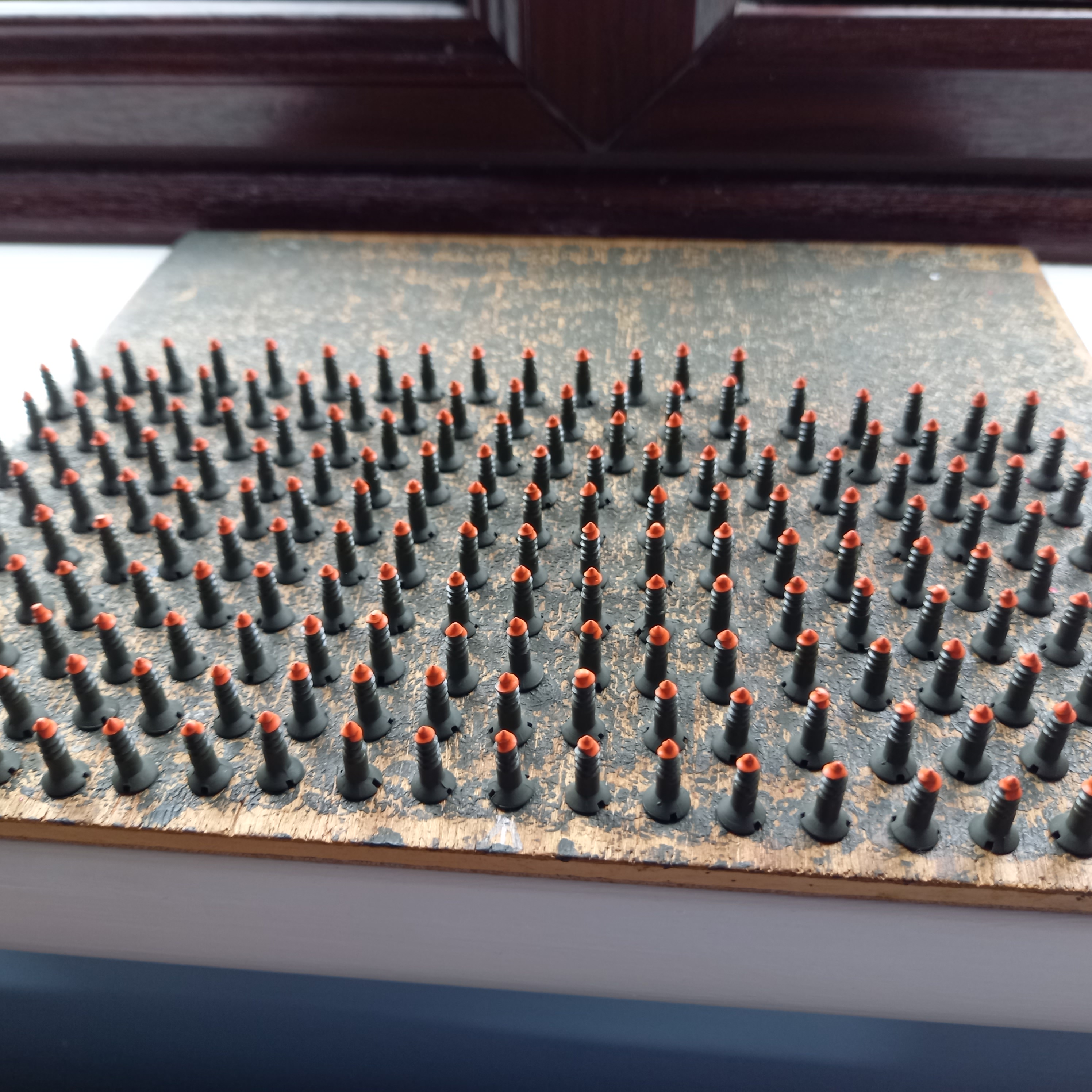
When looking in my workshop drawers for some wall plugs recently, I came across some  old plastic "rawlplug" strips. These are about 12 inches long (300mm) and can be cut to length for use with extra long screws. They come in different colour coded thicknesses. After a bit of thought I cut up a strip, filled the central screw pilot hole with filler and fitted the pieces to a couple of wagons. The result is below.


I used the "red" thickness. These strips are not often seen in shops nowadays but are readily available online and are not expensive. I hope the picture is clear enough to see the painted strips on the wagon roof. I think this is the best way of representing rolled up awnings that I have found yet. However, before undertaking the task of retro fitting a few hundred wagons, I would appreciate readers views on this idea, does it look right ????

As some of you will know Archduke Piccolo has been wargaming a campaign based on my Imagi-Nations series. The battle reports are really good and the next installment is due shortly. I encourage all to visit his blog.


Wednesday, 17 November 2021

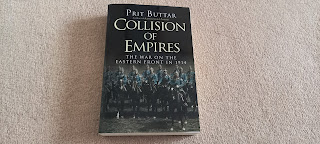
BOOK REVIEW: COLLISION OF EMPIRES.

THE WAR ON THE EASTERN FRONT IN 1914.


 Sometime ago I reviewed a book from my library about the Eastern Front during WW1.  As a result I decided I needed to learn more about these fascinating campaigns. After some research I found a series of four books written  by Prit Buttar, who is a distinguished British based historian of the Eastern Front in both wars. This is the first of that set of books and covers the fighting in 1914.

The book is very well written and seriously well researched. Although it focuses on the actual battles it also covers the leading personalities and the political and economic situations in the three main protagonists, Germany, Russia and Austria-Hungary. The see-saw nature of the fighting, the dreadful loss of life and the terrible ground conditions are also discussed in depth.

It is clear that the fighting of 1914 broke the back of the kuk ( Austria-Hungary) army. A rather fragile force to start with, it never quite recovered from the huge casualties it sustained in those first few months. In fact I had not realised just how heavy the casualty lists were. We are all clear as to the size of the loss on the Western Front but in fact those on the Eastern Front were equally large and in fact, the number of prisoners, on all sides,  was much greater than in the West.

Although there was significant trench fighting it was on a much lower level than in the West. The distances involved meant there was always a flank that could be turned. Logistic issues also played a major role particularly in the offense where it proved impossible for an advance to go further than about 70 miles beyond railhead without a substantial pause for the railhead to move forward. In fact the Eastern campaign was always a war of maneuver similar to the first few months of 1914 in the West.

Overall an excellent book about a comparatively unknown campaign and highly recommended if you want to know about the Eastern Front in WW1.

Friday, 12 November 2021

UPDATE.

 With the advent of winter fast approaching I am getting a bit more time for modelling. In that respect I have now completed 43 upgrades out of the total of 49. The strength of the armies has now reached 59,040 with a target of 60,278.

Within the upgrades there has been only one that required more vehicles and equipment. This was the addition of an extra company to the three Heavy Weapons battalions. Each new company required two limbers, caissons and heavy machine guns and an ammunition wagon. These vehicles have been constructed as seen below. In addition, while issuing mounted corporals to the Field Police battalions a week or so ago, I found that one battalion was short of a GS wagon. I have no idea how that happened but a new wagon was constructed at the same time and can be seen on the top right of the photo.

It has occured to me that some of my readers may never have seen all my very old posts. As some of these, in my humble opinion, are interesting, it occurred to me to update and re-publish some of those posts. The first one was on Artillery Observation Wagons which I posted a few days ago. Over the coming weeks and months I will also be re-publishing and updating those posts relating to the organisational structure of my armies. Many changes have taken place since the original posts were drafted so I get to kill two birds with one stone.

Finally I feel I must share an interesting experience. Apart from starting this blog to share my armies with others, I have long wondered about exhibiting my soldiers at a wargame show. I sought advice on this idea and it was suggested to me that instead I should offer an article to one of the mainstream wargame magazines. Thinking this a good idea I sent a draft, with photos, to Miniature Wargames magazine.

The response included the words " pretty bonkers".  So maybe not such a good idea after all then !!!!   

I think  I will just stick to the blog from now on !!!!


Monday, 8 November 2021

BOOK REVIEW: SURGEON WITH THE KAISER'S ARMY.


This is a super book. I found it while trawling on Amazon for new publications. It is edited by the authors grandson having been originally written in the early 1960's.

The author was a medical student when he was drafted into the German army early in 1914. As a fully trained soldier by the outbreak of war he served on the Western Front before his regiment was transferred to the Russian front. Soon after going into battle during the German offensive in November 1914 he was wounded. By that time he had been selected for officer training. During his convalescence it was noted that he had been a medical student so he was commissioned as a Lieutenant in the Medical corp.

Despite not having completed his medical training he served the rest of the war as an army doctor on the Western Front. His experiences over the next few years are a fascinating, extraordinary and very illuminating record of Germany at war. Throughout the book he discusses the war from the German perspective and provides a very different view of the war, its origins and its progress from that we may be used to reading.

After the war he returned to university to complete his medical training and became a highly qualified and successful  doctor. However as a Jew he found the rise of the Nazi's intolerable and became an outspoken critic of Hitler. He left Germany and came to England  in 1933 following a tip off that the Gestapo were on their way to arrest him.

He continued his career as a Harley Street surgeon and served in the British army during the Second World War running a military hospital with the rank of Colonel.

This is without doubt one of the best books I have read for a long time. It is very well written and describes not only a fascinating war record but also gives a refreshing general view of the war from a German perspective. Highly recommended.

Wednesday, 3 November 2021

ARTILLERY OBSERVATION WAGON.

Sometime ago I was reading a book where a German artillery officer of early 1914 described using the "observation wagon " to locate British troops. I know the practice of British artillery officers was to use an up turned limber to see further but had not seen reference to a specialised  observation wagon. Such a vehicle sounded very suitable for my army. 

After some research I  found photos of such a vehicle in German service in WW2 but the photo showed the vehicle in the travelling mode. After more digging I at last found a photo of a vehicle from WW1 actually in use showing clearly a telescopic ladder mounted on top of a box like two wheeled trailer. 


I decided to provide my artillery battalions with this equipment. As a basis my standard box trailer was clearly  perfect.  I also use this vehicle as a base for field kitchens, signals and medical trailers and ammunition caissons. Each is distinguished by means of an addition such as a smoke stack, aerial , red cross or spare wheel. The obvious requirement for an observation wagon would be a ladder mounted horizontally in a travelling position. Next question, where to source ladders ?? especially over 40, that being the number of artillery battalions I have in service. I knew I could get ladders from a model railway shop but at what cost ??

I concluded I needed some sort of mesh which could be cut up into suitable scale ladders. Nothing obvious came to mind so I just started looking. A few days later during a visit to Poundland I spotted a pack of two fly swotters for a pound. This looked like my raw material. On getting home I attacked the swots with my modelling knife and soon enough had produced some 118 perfect ladders. After attaching  to a wagon body and painting this is the result.


Since then I have built many of these vehicles which now equip all 42 of my field and horse artillery battalions and regiments.

Saturday, 30 October 2021

UPDATE.

 The past couple of weeks have been very exciting for me because Ion Dowman of the Archduke Piccolo blog decided to wargame a scenario from my Imagi-Nations series. After considerable correspondence we agreed an approach and he has now fought two battles from the campaign outlined in Part 44 of my posts. The battle reports are on Ion's blog and readers are recommended to have a look at these exciting and well written reports. 

Apart from narrating the history of the Union in my articles, I have consistently tried to provide wargaming scenarios ranging from Cavalry actions to infantry skirmishes as well as major battles and campaigns. To see someone actually using these scenarios is very pleasing to me.

Apart from the fun of seeing my ideas actually played out I have received some additional visitors to my blog. So welcome to my new followers, I sincerely hope you continue to enjoy my efforts. In that regard this post is the 300th since I started the blog in June 2018.

On the modelling front I have at last completed the final mounted upgrade.

This upgrade provided corporals for Horse Artillery Regiments and the mounted squadrons of the Field Police battalions. I now have a total of 2,226 mounted soldiers. Of course most are in the 18 Cavalry Regiments but Horse Artillery Regiments and Field Police battalions account for 264 of the total.

 As a reminder of what one of my Cavalry Regiments looks like, below is a photo of the 9th. Based on my Imagi-Nations articles this is from a scene during the fighting in Ukraine when Union Cavalry were raiding the Russian lines of communications. To protect the railways, the Russians had built a series of blockhouses. In this particular case Union Horse Artillery have taken a block house under fire and 9th Cavalry stands ready to ride down any escaping Russians. Once the Russian position has been destroyed, the Union Cavalry Brigade can ride on to attack the railway.

If anyone else wishes to utilise my Imagi-Nations articles for a wargame please let me know, I will do all I can to assist.


Wednesday, 27 October 2021

BOOK REVIEW: WILLIAM PITT THE YOUNGER.


My mother in law was giving this book to a charity shop before my wife spotted it in a box and thought I might be interested which of course I was.

William Pitt the elder was quite an influential person in his day but his son was even more so. He dominated Parliament for most of his adult life after becoming Prime Minister at only 24, a feat never likely to be repeated.  Clearly a highly intelligent workaholic and indeed almost certainly an alcoholic 
too, this man literally worked himself to death at the age of 47.

He led the nation through some of the most turbulent times as the Industrial Revolution impacted the lives of so many people, often not in a good way, and of course during the first half of the war with France.  Even out of office his policy of prosecuting the war with France by subsidising continental allies was continued by his successors.

Like many other great public figures,  Pitt was a very clever and complex man with significant personality flaws who possessed the ability to induce hatred among his enemies and adulation in his supporters. He lived for politics only and one can only wonder what he may have achieved if he had taken more care of his health.

Well researched and well written, if somewhat heavy at times, this is a good book on an extraordinary person. If you are interested in the man, the politics of the time or the political response to the French Revolution and the early years of the war , this is the book for you.


Saturday, 23 October 2021

WOODWORKING PROJECT. PART 6.

 This is the final part of this series of posts. Following completion of the construction process, the next task was to cut the 85 shelves. These are made from the same quarter inch (6mm) melamine faced MDF as the back panel. Each shelf is about 12 by 6 inch (300mm by 150mm). Once cut the leading edge is faced with a strip of black insulating tape to hide the "raw" edge. I have investigated the use of solid plastic edging but the cost is quite prohibitive so £1 for a single roll of tape is a bargain and also easily replaceable if damaged at any time. That said it is also a very time consuming and fiddly task.


Having made the shelves the next step was to manhandle the unit upstairs and install it underneath the existing unit which had been propped up on a couple of temporary legs since the bookcase that originally supported it had been removed. This task called for reinforcements and my youngest daughter Laraine was drafted together with my wife. My all female task force performed very well and while they held the original unit, I removed the temporary legs and put the new unit in place. The old unit was gently lowered about half an inch, lined up and the two units screwed together.


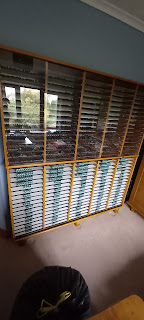
I then attached the units to the wall at the top with rubber connectors. This will allow the units to sink into the carpet over the next few months without pulling the fixings out of the wall. After say Christmas I will remove those temporary fixings and put in something more substantial. The shelves were then wiped clean and installed as seen above.


To help with the settlement issue, and to provide a better storage solution, I then loaded the shelves with boxes of unpainted screws. These will of course be removed, treated and painted over time as the new army is constructed. The final element was the new doors which were delivered yesterday and installed.


The photo above shows the whole unit. Once I have finished upgrading the existing armies, maybe in the new year, I will commence construction of my new 4th army which should take me 5 or 6 years at least to complete. I hope this series of articles has been of interest.


Tuesday, 19 October 2021

UPDATE.

 Some readers will recall in my last update I lamented the demise of my trusty tin of very old silver paint. Following that post my wife flippantly suggested I put some nail varnish cleaner into the paint. Well thought I, that's an idea. The active ingredient of nail varnish cleaner being acetone it might work and I have nothing to lose. I have some pure acetone in the workshop so I tipped away most of the "thinners" liquid in the top of the tin and replaced it with an equal amount of acetone. Hey presto, the paint mixed up perfectly. Now a week later, I have reopened the tin, mixed it easily and used it very successfully. The only slight issue is that it dries even quicker than before but that is not a problem as I only paint very small areas mainly rank insignia.


So my very old tin of paint has come back from the dead. Now another thought occurs to me. I use Humbrol paints and a long term issue with some of the gloss paints especially red, is that after a short time they turn to jelly. No amount of thinners seems to solve the problem so that tin gets thrown out and another is purchased. I have seen this problem raised by other modelers too. I now wonder if acetone would work. I will try it and report back just as soon as another tin goes to jelly. Pure acetone can be purchased in chemist shops although many do not carry it, if you want some just shop around.

On the modelling front, once again I have made only limited progress over the past couple of weeks due to social commitments and working on my new modelling unit. However the final upgrade batch of mounted troops now only requires the horses to be painted to be complete.  In addition upgrade number 38 has been finished this morning and I am working on upgrade 39 this afternoon.

On another matter I have been engaged  recently in a substantial correspondence with Ion of the Archduke Piccolo blog. Ion has decided to wargame a campaign based on scenarios in my Imagi-Nations Part 44 post. I am delighted he has decided to do this and have been providing background information and offering insights into the strategic thinking of the combatants. The first battle has been fought and I have seen the initial battle report. Ion plans to publish the reports on his excellent blog in the coming days and weeks. I strongly recommend reading his reports which are always very exciting.


Friday, 15 October 2021

BOOK REVIEW: MARKED FOR DEATH.

THE FIRST WAR IN THE AIR.


 Trawling through my library for a new book to read I came across this book. I must admit I have no recollection of ever reading it or even when I may have bought it, in fact it was a totally new book to me !!!!! Clearly old age must be creeping up on me and impacting my memory at the very least....now where was I .....oh yes.

This book discusses the air war from 1914 to 1918 in a very interesting way. It does not go into much detail about planes, pilots or battles etc but in a loose chronological way covers  major topics like "why biplanes", "making the flying man", "how they lived", "parachutes and fatalism", and of course many other matters. This means the book is very readable, exciting and interesting more like a novel than a history book. 

The simple message that comes across clearly is that early aviators, especially those in the various military's, were true pioneers and generally lived short lives and met violent unpleasant deaths. The wonder for us is that there were so many of them willing to take unbelievable risks just to advance knowledge of flying and serve their countries at the same time. The author reminds us that it is impossible today to fully understand the attitudes of 100 years ago  just as much as they would not understand much of our beliefs today.

Overall an excellent book and very well written on a fascinating subject, but still a puzzle why I have not read this before now !!!!!!

Monday, 11 October 2021

WOODWORKING PROJECT. PART 5.


The next task was to apply stain to the unit and then two coats of lacquer with a very light sanding between coats. The result is shown below.


 Having completed the woodworking aspects of the build I next turned to fitting out. The first task was to install the 170 shelf supports.  This material comes in 2 metre lengths and had to be cut up in 170 equal lengths on the mitre saw. Each piece then required two holes for screws. The pile of supports is shown below.


The task of fitting these supports is laborious. It actually took about six hours. As I am right handed it is only practical to do the right hand side of each upright, unless you have universal joints in the elbows or can grow a third hand of course. Therefore once all the right side supports are done, the whole unit had to be turned around  and the rest fitted through the open back. I learned the hard way not to fit the back panel first !!!!


The method of fitting the supports involves using a spacer that I made for a previous unit, its much easier than measuring for each and every support. The spacer is clamped in position, the support offered up and pilot holes drilled into the wood. Two screws are then installed. I use half inch roundhead screws which are not readily available. The standard size is three eighths but I find these are just a bit too long. Sometimes the screws meet with those installed on the other side of the timber. The half inch screws only overlap by three millimetres so just push past each other. The longer three eighths screws overlap by over  six millimetres and can be hard to drive in satisfactorily. The spacer can be seen in the photo below.


Finally all 170 shelf supports were fitted and the back panel was cut to size and pinned into the groove around the back edges of the unit. It is also pinned to the backs of the central uprights. The very last job was to cut and glue in the door tracks and the unit was finished as seen below.


The next and last post will cover actual installation of the new unit and making of the shelves themselves.


Thursday, 7 October 2021

UPDATE.

 Over the past couple of weeks most of my free time has been spent on the woodworking project about which I will do another update over the next few days. On the modelling front I have only managed to complete one more upgrade, number 37, which means the armies have reached 58,239 strong.

The final mounted upgrade has progressed a bit in that the soldiers have been mounted on their horses and painted. The next task is to under coat and top coat the horses as seen below.

When I first started modelling back in the early sixties, limited pocket money meant I used any paint I could lay hands on. This included a pot of heat proof silver paint I found under the kitchen sink. In fact I have continued to use that silver paint right up to the present day !!!! Yes that paint has lasted almost 60 years !!!!! and it is still only half empty. I have noticed however over the past month or so that the paint was settling out very quickly during use and becoming harder and harder to stir back to life. I regret to say I think this old faithful has now finally reached the end of its life.


I have sourced a new pot of Humbrol silver paint and have retired this old pot. However, being a bit sentimental , I cannot quite bring myself to part with that old pot of paint, at least not yet. I have put it into the back of the cupboard for the time being. I think it remarkable that a pot of paint could last quite so long, it has given very good service for so many years.


Friday, 1 October 2021

IMAGI-NATIONS. PART 44

THE CHINESE MOVE SOUTH.


 Since its defeat by the UNION in 1870 and the loss of its southern territories the Chinese government had used every means to rebuild their army in order to recover the lost land and defeat the hated UNION. With Chinese industry only able to produce simple small arms and old fashioned muzzle loading artillery the government had sought to purchase modern weapons from other countries. This proved  impossible with no European country being either able or willing to supply weapons. The Germans and Russians, past suppliers of weapons to China, were heavily engaged on building up their own armies and neither Britain or France had any enthusiasm for a rearmed China. However by 1888 the Chinese army had at last been rearmed, although not to modern standards, and many thousands of soldiers had been recruited and given various levels of training.

 The attacks by Germany and Russia on the UNION had come as a surprise to the Chinese and they had watched carefully as the UNION fought for its life. As the battle raged with Germany the Chinese decided now was as good a time as ever to recover their lost territory. The UNION army was fully deployed against Germany and Russia and could have no troops left to defend southern China and in any case would they bother to defend a vast tract of empty land that clearly they had no intention of colonising anyway. The decision made, the Chinese army began the long trek towards Harbin to concentrate for a move south. 

Over the following months the Chinese army moved slowly south from Harbin towards the border with the UNION. The Chinese were well aware that UNION cavalry patrolled the empty spaces of southern China. However they were confident that those patrols did not venture more than a hundred miles or more north of the border especially now as UNION forces were so heavily engaged fighting Germany and Russia there could be few spare troops available for such activities. By the summer of 1889 the Chinese army had advanced to within 120 miles of the border. The railway south from Harbin was being rebuilt and settlers from all over China were being encouraged to repopulate the vast spaces of the south.

On 26th June a UNION cavalry patrol, at the end of its loop through the empty lands of southern China , had spotted a dust cloud a few miles north. On investigation the UNION patrol was astonished to find large numbers of Chinese troops camped with signs of heavy movement further north. The Chinese were clearly returning to their southern lands, and in force. The patrol immediately reported its findings to Command and continued to monitor the Chinese.

By this time China had realised that the UNION had triumphed over Germany and Russia and was fearful of the UNION reaction to discovery of their move south. However they felt that with the huge army they now possessed and with the UNION probably exhausted after the wars with Germany and Russia they could perhaps withstand a battle with the UNION army sufficient to negotiate some sort of peace that would enable them to recover their lost lands. It all depended on defeating any UNION force sent against them so as to give them a position of strength from which to negotiate.

The discovery of the Chinese advance was very unwelcome news to the UNION government. The armies were exhausted and still in positions in Germany and Ukraine. The only UNION troops near China were units of 10th Reserve army. There were three infantry brigades, the cavalry brigade and the army command brigade either on the border or in Denver. These troops were ordered to concentrate on the border and then to move into China and engage the Chinese. Their instructions were to hold the Chinese advance until reinforcements arrived from the UNION armies still in the German Rhineland. 

On 7th July the units of 10th Reserve army,  totaling about 55,000 strong, crossed the border into China and advanced north. A few days later on 11th July the UNION forces were drawn up ready for battle only a few miles south of the advancing Chinese. The Chinese now knew for sure they had been discovered and determined to inflict the heaviest possible defeat on the UNION forces in front of them so as to achieve the strong negotiating position they thought they would need to secure the return of their southern lands.


Sunday, 26 September 2021

WOODWORKING PROJECT. PART 4.

A few days ago I cut all the various panels to final dimensions. I then sprayed water on all the parts and left to dry overnight. This has the effect of raising the grain so when  sanded the timber has a very smooth finish which will not raise again when I apply the stain. After sanding I  routed all the  various grooves. 


This included a groove on the back edge of the top, bottom and end pieces to take the back panel while on the top and bottom parts I cut channels at the front edges for the sliding door track. These grooves can be clearly seen below. Also visible is the rounding over of the front edge of the bottom rail, just for decorative purposes.


The photo below shows the five feet together with mounting blocks. Due to the narrowness of the whole unit, it is not possible to have feet at every corner so I am mounting them in a line along the front edge so the unit will sit against the wall to which it will be attached. The mounting blocks are to raise the overall height of the unit so the bottom rail sits above the skirting board to avoid an unsightly gap and to keep the unit level.


Today I carried out the basic assembly of the display unit. As can be seen the central dividers sit back from the front edge to allow for the sliding door track.


The next two photos show small pieces of the door track located within the channels which I used to verify the channels were cut to the correct depths.


Having the track set into the top and bottom rails allows for the maximum use of the internal space and also just looks better too.


The photo below shows the feet mounted on the blocks. The blocks will be glued and pinned underneath the bottom rail later. It is easier to work on the unit without the feet as having a single row of feet makes the unit unstable during the finishing process. 


The next job will be some final sanding then application of stain and lacquer and fitting of the shelf supports and back panel.


Wednesday, 22 September 2021

BOOK REVIEW: RIDING WITH NEW YORK CAVALRY.

Two Accounts Of The American Civil War By A Union Army Officer.

Part 1: Three Years In The Federal Cavalry.

Part 2. The Capture, Prison-Pen And Escape.


 I recently found this book on Amazon while trawling for anything of interest. The book was originally published in two volumes in 1865 and 1870. Interestingly part 2 was published first . This was caused by the author wishing to publicise the appalling treatment he and other Federal prisoners received in Confederate prisons. The second volume followed five years later to complete the story of the author's war service.

This reprint combines both volumes and is a very good read. Although, as usual with American writers of this period, it is full of flowery language and wistful descriptions of sunrises and such like, it is still a good record of life and battle in the Civil War. The author joined up in 1861 as a private soldier and was promoted through the ranks until being commissioned shortly before capture in 1864. As a cavalryman he describes his experiences vividly although , as is to be expected, defeats are mentioned only in passing while victories receive a great deal of attention. The author especially writes with great delight of the destruction caused to Southern property and military supplies during cavalry raids he took part in.

However the majority of the book covers imprisonment. The conditions were seriously bad even with allowance for the South's undoubted food shortages by the later stages of the war. The author seems to quite forget about the destruction Union cavalry inflicted on the South and complains bitterly about shortages of virtually everything while a prisoner. Eventually he escaped and spent 28 days on the run before finally arriving back in the Federal lines. Each and every day of that escape is covered in great detail. As the author says repeatedly, his escape was wholly down to the assistance he received from slaves. It seems that with the plantation owners and other white staff away fighting, the remaining slaves just seemed to carry on with their work but without the usual levels of supervision. This enabled them to give a great deal of help to escaping Federal soldiers which they provided very willingly including  sharing food from very meager supplies.

Overall a very good book which teaches a great deal especially about life as a prisoner of the Confederacy as well as some excellent descriptions of cavalry engagements.

Thursday, 16 September 2021

UPDATE.

 Due to the amount of time I am spending on my woodworking project I have had little time for modelling this past couple of weeks. Since my last update on 22 August I have only completed 3 more upgrades adding some 447 soldiers to the colours and much of the work was of course done before that update was published.

Work currently in hand includes the final upgrade of mounted troops. These are corporals for the six Horse Artillery Regiments and the mounted squadrons of the three Field Police battalions. The horses are complete and now await the soldiers. 


As can be seen the soldiers have had their slots deepened to allow mounting on the horse after which painting can commence. 


Also in hand is the upgrade to increase the size of gun crews in Heavy Artillery battalions. These are finished apart from the final coat of varnish. The orange heads denote the Heavy Artillery arm of service colour.


Sunday, 12 September 2021

WOODWORKING PROJECT. PART 3.

 As mentioned a while ago, I have been waiting for some time for my timber yard to obtain the quarter inch thick white melamine faced MDF sheets needed for the back panel and shelves of my new display unit. I am pleased to report these sheets have now been delivered cut to my specified sizes. 


My workshop is just too small to be able to easily handle 8 by 4 sheets so I get the timber yard to break the sheets down to manageable sizes which I can then cut to final dimensions. Also seen in the photo are the two 16 foot and one 6 foot long planks which will provide the actual frame of the display unit. In the past I have always used factory made sheets of 8 by 2 foot pine and cut the various parts from them. However as previously mentioned these panels are next to impossible to obtain at the present time so I opted to buy regular planks which I can cut/join together to make  the components. It is not a good idea to use very broad planks of solid timber to make anything as they are prone to warping and twisting. The factory made panels I usually use are made of strips of wood only two inches wide. I have found that when I make panels the best size of plank to use is about 4 to 5 inches.


The machine I use to make panels is the biscuit joiner. This cuts slots in the edge of timber planks into which are glued biscuits of beech as seen in the plastic box above.


Shown here is a slot full of glue into which the biscuit is inserted. The edge of the plank is then glued together with the exposed part of the biscuit and the next plank laid on top.


Once all the planks are attached together the whole thing is clamped up and left to dry overnight.


The reason for the central clamp being located on the other side is to stop the boards bowing out under the clamping pressure of the outer clamps.


Shown above are the top and bottom panels which I made a few days ago. You can actually see the three planks they are made from on the panel to the rear. The colour variation will disappear during sanding after which they will be cut to final size. The two panels I made today will each be cut in half to form two of the central uprights of the display unit. The other two will be made from the shelves of the redundant bookcase which I need to dismantle shortly. I see no point in wasting perfectly good timber if it can be easily reused.

Just as a reminder of what I am making , below is a photo of an existing display unit above the bookcase that will shortly be removed and re-purposed. The new unit will be located where the bookcase now resides. Each of my three existing display units is about 5.5 feet long, 2.5 feet high, 8 inches deep including decorative overhangs and has 80 shelves which give 40 square feet of shelf which accommodates a complete army of c.20,000.


The next posting will cover cutting panels to size, routing of door track and back panel groves and re-use of the redundant bookcase.

Tuesday, 7 September 2021

BOOK REVIEW: WAR ESTABLISHMENTS.

Part 1.  Expeditionary Force.  1914.


This is a new purchase of a facsimile reprint of the January 1914 original publication. The content is basically over 270 pages of tables showing the officers, men, horses, vehicles, guns and equipment scheduled for every type of unit within a potential expeditionary force. 

As such it is not really a book for reading but rather a perfect reference source for the structural composition of the British army of 1914 as sent to France. So if you want to know, for example, how many shovels and pickaxes an 18 pounder battery carried,  or how many bicycles were in an R.E. field company this is the book for you !!!!!  

A highly recommended book for those interested in this sort of information.

By the way, the answers are 30, 18  and 33 respectively !!!!!!  

Friday, 3 September 2021

UPDATE.

 Something of a continuing surprise to me is that my updates seem to attract more "views" than many of my other posts.  I also notice in reading other peoples blogs that non-modelling/wargaming posts also seem to attract more comments than I might have expected. I admit I too often find these non- modelling/wargaming posts more interesting as they bring the writers to life somehow. I guess we all like to read a bit about other peoples normal day to day lives.

With that in mind I thought I would comment on my rather frequent book reviews. I have always been an avid reader. I inherited my love of books from my mother and grandmother who were also keen readers. I am pleased to say that my two daughters also have that gene and read a lot. Indeed my youngest daughter, during her school days, often had three books on the go at any one time. One downstairs, one in her jacket pocket for daytime use and another on the bedside cabinet.

All of the books I review have been read by me within the previous week or ten days. I "consume" at least one book per week and often two. I estimate I buy at least 25 to 30 books each year. I almost always get Amazon vouchers for books at birthday, Christmas and even Fathers day. My library is close to 800 strong now. I very rarely part with a book once bought and tend to re-read each book every few years.  I have several very old first editions including my oldest book dated 1855.

My range of interests is somewhat limited as you might expect given my lifelong interest in military history. However the major topics represented in my library include; big game hunting and wildlife in general, Victorian engineering and building, history of the US, history of India,  history of Rome and of course military matters such as, the Napoleonic wars, US Civil War, Indian Mutiny and all other wars in the 19th century, First and Second World Wars and Vietnam.  One of my favorite topics is logistics especially during the pre-mechanised era. I have a lot of books on horse drawn logistics and always get very excited when something new comes along. 

I also have quite a few woodworking books as that has been my other hobby since the age of about 12.      I have made much of the furniture in the house as well as all the bookcases and modelling units. Other members of the family also have examples of my efforts.

Sources for books include  Helion and Naval and Military both of which offer many interesting titles. I also check out second hand bookshops on our travels although I often find they can be very overpriced. I admit on several occasions I have got my wife to photograph a book of interest which I have subsequently bought from Amazon a lot cheaper. I find antique shops and centres can have interesting books available and strangely at good prices. I guess they are seen as "extras" to the main items for sale. National Trust secondhand bookshops are another useful source. I have also found The Works stock good books at very reasonable prices although it can be hit and miss as to what is available at any one time. I regularly trawl Amazon especially for new re-published "facsimile" copies of old books. Finally of course book fairs can be good sources especially the local village versions if one can be found.

Space for books is an endless issue. My wife has a considerable number of cookery books which she constantly adds too so we are always short of shelf space. Even with the new free standing double sided bookcase I recently built there are still piles of books scattered around. Another bookcase somewhere will be needed in the near future for sure.

I hope this has been of interest to readers. If anyone has any good ideas for creating extra shelf space for books please let me know.