Monday, 30 November 2020

BOOK REVIEW: FIELD GUNS IN FRANCE.


 This is a book from my library. It was written by a regular army officer who went to France in 1915 in command of an 18 lb field gun battery. He remained in command of various batteries throughout the war before being gassed in summer 1918.

The author had an unusual attitude to war which meant his chief pleasure was to "snipe" German troops in the front lines with his battery. His view was that the more Germans he killed the better. It was almost like a form of sport, scoring as many hits as possible. In fact he actually kept a "game book" of German soldiers he personally killed. A rather cold blooded approach some may think but I guess he was just being perhaps more honest about his role as a professional soldier than usual.

Overall a good book with lots of interesting details about life in a gun battery from the perspective of the commanding officer.

Saturday, 28 November 2020

UPDATE.

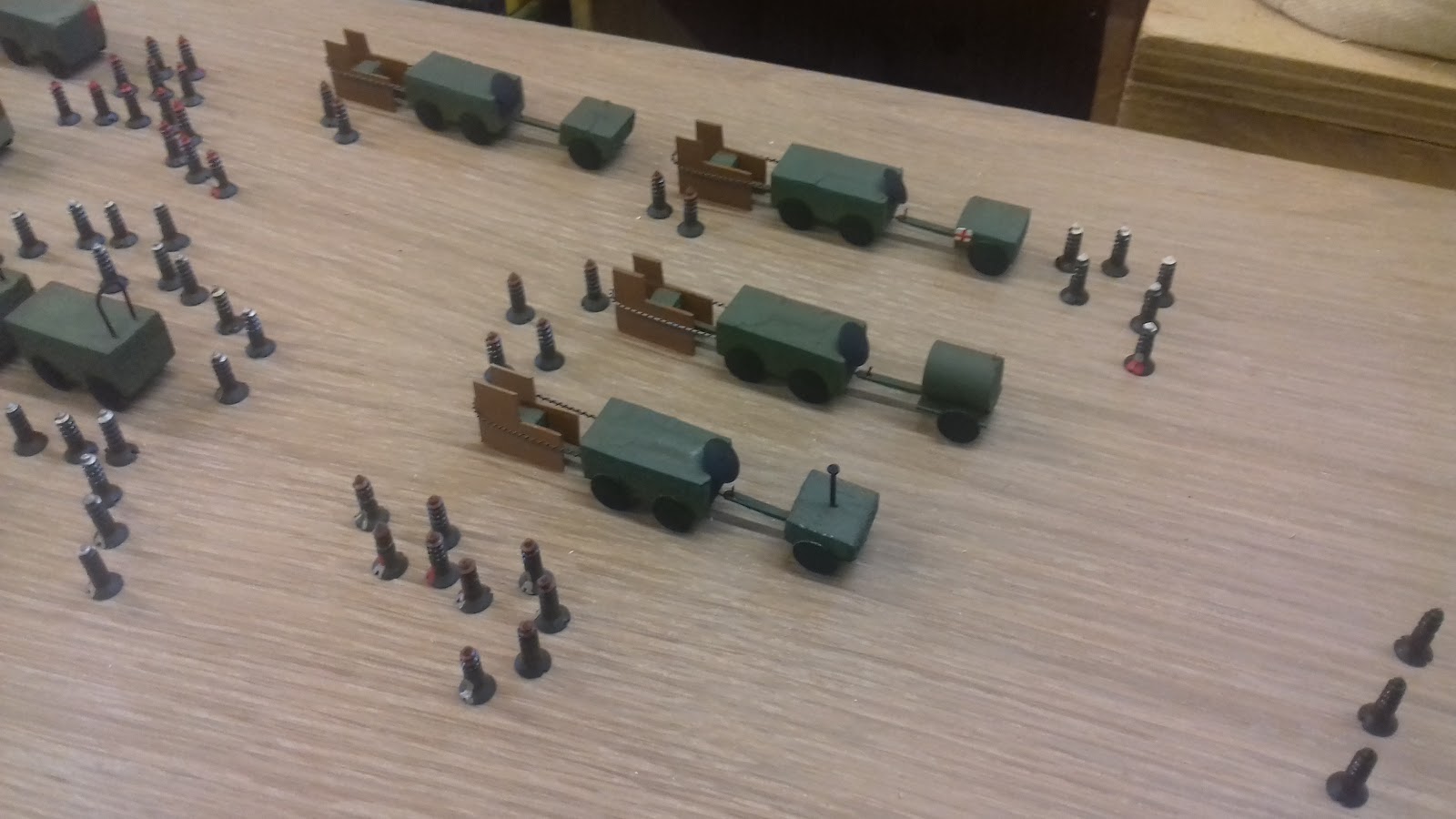
Well once again not much to report this week. For some reason we seen to have been very busy doing walks and shopping, which is strange as most shops are shut !!!!! As a result I again have not had much modelling time. The artillery observation wagons have been built and initial priming has been done. I have also applied the uniform colour to the final heavy weapons companies needed to complete the upgrading of my infantry battalions. The cavalry upgrade remains unfinished.

I have today however drafted three more chapters of my Imagi-nations saga as well as six more book reviews so after a long day at the computer screen I now have square eyes !!!!!! If you read last weeks update please let me have your comments on the little video we did, was it of interest and would others be worthwhile ?????

Wednesday, 25 November 2020

IMAGI-NATIONS. PART 29.

 A LONG PERIOD OF PEACE.


From 1876 till 1884 the UNION was at peace. The economy boomed and living standards rose with each passing year. The only conflict was in Mexico where rebels continued to make sporadic raids on isolated settlements near the border with Iran. UNION troops maintained anti terrorist operations in these areas occasionally catching gangs of mainly Iranian fighters which usually resulted in a short fight with no prisoners.

During this period the UNION army had completed a number of organisational changes to bring the army to the structure we find today. This included the creation of heavy weapons companies in all infantry battalions with just one heavy weapons battalion being retained in each army under Army Command direct control. In addition artillery brigades had been abolished. The field artillery battalions had been allocated to infantry brigades while the heavy artillery battalions had been retained as Army Command controlled units. War experience had resulted in the design, construction and issue of new artillery guns and rifles and several vehicle types had also been either replaced or upgraded during these years. Another innovation was the creation of the 10th Reserve Army. Previously  reservists had only been used to replace casualties but with the years of peace the number of reservists available had increased to the extent that sufficient surplus men were available to man a whole army. Although this army would only be called up in a serious situation, all the weapons, equipment and vehicles for the whole army were manufactured and put into a huge store at Rock Island Arsenal.

The port of Miami had grown considerably over the years as more and more British merchant ships called. In July 1882 British warships also started using the port as a base of operations. A large timber trade operated using Canadian wood brought south by train for export to Australia. In addition Mexican coal was imported by train to Miami for the use of British ships. Although the UNION only earned railway transport fees they were happy to support the Mexican and Canadian economies. It had long been UNION policy that UNION made products and raw materials would never be exported for strategic reasons. However the emergence of the UNION into the wider TIAN community created demands for trade that that were best met by facilitating trade between the UNION'S various allies and friends.

In that respect the question of trade with Ukraine had also been addressed. The people of Ukraine had long requested the establishment of trading links with the UNION. They said that transport routes to Russia from the Ukrainian population centres around Kiev were far more difficult than the routes to the UNION. Although the UNION had refused, under the terms of the peace with Russia, to build a railway between Richmond and Kiev, they had cooperated in developing the road between those two cities to the highest possible standards. As a result Ukrainian food products, iron ore and coal was regularly transported by wagon to Richmond with usually either British or Mexican products making the return journey. Much of these Ukrainian materials ended up as supplies for British ships in Miami. 

The Russians had indicated their extreme unhappiness with these developments but were quite unable to offer any alternative. However the Russian government was convinced that this growing trade would over time lead to a move by the UNION to annex Ukraine. This concern was exacerbated in March 1883 by the establishment of a UNION sponsored and staffed agricultural school in Kiev following requests by the Ukrainian government. The Russians were fearful of UNION military strength but realised that if they ever wanted to recover Ukraine or at the least preserve an independent buffer state they would have to consider another war, perhaps an ally could be found to help in making this idea more palatable.

In China the government had , following the war, engaged in rebuilding their armies. Chinese industry was even more under developed than in Russia so like that nation, it was very hard to construct sufficient weapons to equip the army. However the Chinese burned with a hatred of the UNION and saw the recovery of their devastated southern territory as an essential goal, and the sooner the better.

Germany had been able to rebuild their army more quickly than China and Russia but realised that they had to become much stronger to take on the UNION army again if they ever wanted to recover what they saw as their stolen lands in the west of the old Federation. To that end conscription had been expanded to create over the years a huge pool of trained manpower. It would soon be time to test this new German army.

In the Arab countries north of Mexico the religious fundamentalism pervasive in those nations had become ever more extreme over the years and had focused on the UNION as the arch enemy. This was mainly due to the UNION's success in thwarting Arab efforts to subvert Mexico. With no real industry the Arabs had historically bought weapons from China. However the Chinese  had nothing to spare after the war as everything they could produce was being used to re-arm themselves. Britain, France and even Germany still refused to sell the Arabs weapons, however Russia saw an opportunity to at least cause difficulties for the UNION so in 1880 started supplying weapons, ammunition and explosives  to the Arabs in large quantities,  at the expense of arming their own troops. These munitions were shipped to  Mombasa in Africa and taken by caravan into the Arab countries, a slow journey meaning it took some years to accumulate a sufficient stockpile.

By early 1885 the Arabs were ready to initiate a Holy war in Mexico.

Sunday, 22 November 2020

UPDATE.

I did not do an update last week, just too busy although I am not sure what with !!!!! I have managed some modelling time but not too much. I did complete the batch of ammunition wagons but the cavalry upgrade is still outstanding. However I have started construction of a batch of artillery observation wagons.

 As an experiment I have included below a short video my wife made which I hope will be of interest. It has been a real struggle to get the video small enough to fit on blogger. If this is of interest I may do more just to keep the blog fresh and give another dimension to my posts. Please let me have your comments.


Saturday, 21 November 2020

BOOK REVIEW : FLAK 88. OWNERS WORKSHOP MANUAL.


 As I have mentioned before I often buy books in The Works as they are so cheap. I have seen this book before but dismissed it as a gimmick and not a serious book. However on my last visit I actually picked up the book and had a look. prompted by the fact that, like so many others I made lots of the Airfix 88 gun kits as a boy. Was I surprised !!!! The book is excellent.

Most of the content is based on post war US Army analysis and inspection of the gun using captured examples. Also used are translations of the original technical manuals. The result is a highly detailed examination of this very important and hugely successful weapon. There is a good history of the gun's development, it's tactical use and the development of the 88 from its original anti aircraft role into a tank buster  and use in tanks like the Tiger and Panther.

The technical chapters are fascinating including even the daily maintenance tasks required of the crew.  The gun was a typical example of German engineering, superbly made but probably too complex and therefore expensive and hard to make in quantity, a problem affecting the majority of German military vehicles and equipment through out the war.

Other interesting items include the fact that the vast majority of these guns were used as flak to protect German cities and factories during the war. Not surprising when you consider that's what the gun was designed for, however its use as an anti tank gun is so well known that you would be forgiven for thinking they were common on the battlefield which was not the case at all. It was only in the last few months of the war that flak batteries were sent to the eastern front to stem the Russian advances. Unfortunately by then the crews were not trained in anti tank warfare and both guns and crews did not survive long against the Russians.

Overall an excellent book on a super weapon and highly recommended to students of German military equipment.

Tuesday, 17 November 2020

BOOK REVIEW : RUSSIAN SOLDIER VERSUS JAPANESE SOLDER.


 This book caught my eye on a recent visit to Waterstones. I do not buy new books in regular bookshops usually as they are too expensive. However this one was on offer.  

I have several books on this conflict and although the general narrative on the war is ok it stops well before the end of the war, missing out entirely for example, the battle of Mukden, the largest land battle ever at the time. However the purpose of the book is to describe the actual soldiers so I guess that is understandable to some extent.

The book covers well not only the training and equipment of the infantry on both sides but also the social conditions of the two nations and its effect on the personal characteristics of the soldiers. However once again the remit of the title is rigidly enforced with very little on the artillery for example. 

Overall an interesting book but certainly not a good history of the war and useful only if you are particularly interested in the soldiers themselves, in other words you get exactly what it says in the title.

Saturday, 14 November 2020

BOOK REVIEW : 1915. THE DEATH OF INNOCENCE.


 Another book from my library. As most readers will be aware this is by Lyn MacDonald who is I think the best author of First World War books. I have all her published books and they not only give a good general history but the human element illustrated by the use of personal experiences and diaries of those who were there is exceptional.

This book covers a strange year and the sub title is very apt. 1915 was the bridge between the original expectations of war in 1914 and the brutal conditions that applied from 1916 onwards. Every battle in 1915 was expected to bring about a breakthrough and a return to open warfare. By the end of the year strategy had changed to a war of attrition and successes measured in yards of ground gained.

As with all of this authors books, this is a very good read and is highly recommend.

Wednesday, 11 November 2020

IMAGI-NATIONS. PART 28

 THE AFTERMATH OF THE WAR FOR THE FEDERATION.


Following the defeat of Germany and the armistice on 11th November 1875 the UNION had secured full control of the whole of the Federation. Exhausted UNION forces were strung out along the border with Germany while the supply services rushed to provide temporary accommodation for the troops to shelter during the oncoming winter. In Seattle UNION troops took over the old German barracks amid a sullen and angry largely German civilian population. In the east UNION armies were camped in and around Boston although in that city they were greeted as the bringers of freedom.

Having learned how difficult it was to campaign without adequate railways in the vastness of the Federation the UNION gave a very high priority throughout the winter to railway construction. This had continued on the lines to Seattle and Boston with completion of both in March. Immediately reconstruction of the line between those two cities commenced. 

During the winter the UNION encouraged the Federation's existing civilian authorities to continue with normal activities. In the Boston area this policy worked well and involved the continuation of regular railway commerce with Canada. Around Seattle the usual services with Germany had ceased and complaints were frequent to UNION military command that various goods were becoming scarce and with the German markets for local food stuffs closed the economy was failing. Although UNION quartermasters purchased large quantities of goods the economic problems added to the tensions with the civilian population and caused frequent riots in the city which the UNION army had to suppress in the absence of an adequate police force, many of whom, being German, had fled with the retreating German army. However the use of UNION troops to reestablish order tended to exacerbate the whole situation.

Over the winter the UNION government grappled with the question of to what extent the army should be enlarged especially in light of how much the army had been strained to meet the demands of fighting such a strong enemy as Germany while maintaining sufficient forces to deter Russia and China. It was decided to create two new armies. 9th army would be located at a new base called  Fort Fetterman near Seattle and Fort Benning outside Boston would accommodate the new 8th army. Additionally the Government gave much thought as to how to incorporate the Federation into the UNION given the hostile population around Seattle. The conclusion was that the peace and stability of the UNION could not be maintained with such an antagonistic people within the country. It was decided to initiate a policy of ethnic cleansing as the only way of securing long term peace and security.

In Spring 1876 construction of the two new army bases commenced. The UNION armies then in the Federation were returned to their bases after absences of a year or more and 5th army from Fort Bridger near Tucson was moved to the Federation. One brigade was based in Boston while the bulk of the army moved to encampments near the German border with one brigade  stationed in Seattle to maintain law and order. 

The ethnic cleansing policy decided on by the government was based on the principle of encouraging the disaffected population around Seattle to return to Germany by using economic incentives rather than force. Accordingly it was proclaimed that the UNION government would purchase at market rates plus ten percent all the property of those who wished to move to Germany together with a lump sum payment in gold for each person who wished to move. Free transportation would also be provided. The British secured the agreement of the Germans mainly on the basis of the wealth that the returning settlers would bring with them to Germany. In addition an agreement was secured by the British with Canada for them to accept any Federation citizens who would prefer to move to that country in exchange for UNION agreement to the establishment of a Canadian embassy in Rio Diego next door to the new British embassy.  As a result of negotiations with local authorities in Seattle the property purchase premium was increased to 20%. 

The uptake of these generous terms was far greater than the UNION government expected. All together some 28% of the population of the Federation accepted the offer. This compared favorably with the independence referendum where 27% had voted against joining the UNION. During the rest of 1876 over half a million people moved mainly to Germany using trains to the border but with a large percentage going to Canada by through train to Vancouver. 

By early 1877 Seattle had become almost a ghost town with only a few inhabitants left. The UNION government now encouraged UNION citizens to move north by selling the properties it had purchased at knock down prices. At the same time UNION citizenship was granted automatically to all former citizens of the Federation from 1st January and recruitment to the UNION army was opened to these new citizens. In order to provide the large number of officers and NCO's for the new armies, soldiers currently serving in the existing armies who were marked qualified  were offered promotions into the new armies. With almost a quarter of suitable young men already opting to serve in the army it was not until late 1878 that the new armies were at full establishment. Army commanders were pleased to note that volunteers from the old Federation had come forward at a similar rate to their comrades from the south. Those volunteers however had been posted to armies south of the border just to be on the safe side.

By early 1878 the population of the old Federation had almost returned to its original number as a result of migration from the south. UNION federal buildings had been established in both Seattle and Boston bringing government services to those places. The UNION marshal service had recruited local police forces in both cities and provided suitable training.The railways connecting Seattle to Chicago and Boston to Lincoln as well as the line between Seattle and Boston had all been completed. Local trade between Boston and Canada by rail had continued although at a reduced level due to UNION made products now becoming available in Boston. In Seattle trade was developing via the new railway to the south as the new population established itself. A military railhead had been built using the old German railway from Seattle to Cologne about 40 miles from the German border in case of a need for a military campaign against Germany in the future and UNION cavalry were patrolling the border with Germany without incident.

In the far south the British sponsored port construction in Miami had been completed and British ships had started to call on the long voyages to and from Australia bringing new income and employment opportunities. It had been found necessary to secure the city to ensure British sailors remained in their prescribed areas only and the marshal service had established a strong presence to police those restrictions. The new British and Canadian embassies had been opened and although their diplomats worked under considerable restrictions as to travelling within the UNION a new trading opportunity had been identified for the export of Canadian timber to Australia via UNION railways to Miami. 

In Mexico anti terrorist operations continued but at a much lower level than in previous years. In Ukraine UNION cavalry continued to patrol towards the Russian border and south to Kiev occasionally sighting Russian patrols on the same mission. Ukrainian traders in Kiev regularly petitioned to trade with the UNION saying it was too far to use Russian markets, a question that would need to be addressed soon. On the border with China UNION cavalry patrolled far into the south of that country without incident with no sign of any Chinese attempt to reclaim the border lands.

Overall the UNION was enjoying another period of considerable economic growth and prosperity while an ever more powerful army guarded the nation against its many enemies.


Sunday, 8 November 2020

UPDATE.

 I am pleased to report that this past week I have managed a reasonable amount of modelling time now the work in the house has been completed. I have a couple of small jobs left that I will do this coming week.

On the modelling front I have today completed the final infantry battalion. The batch of ammunition wagons is almost finished and the final cavalry upgrade is close to being done too. In fact I only have about 800 soldiers left to paint and about 60 wagons and trailers to build before the last of my three armies is finished. The site for another display unit for a fourth army has been identified and once I have my wife's agreement I can start construction in the workshop. It will also require me to build a new bookcase  to replace an existing unit to make the space needed but nothing I can't do over the next few months.

Today has been very quiet in the house as my wife is on a sponsored 11 hour silence for the Poppy Appeal. As I write she has done over 5 hours since starting at 11am. Normally she is a Poppy seller  but as collecting has been cancelled by the virus she decided to try to raise some money by being silent for 11 hours. Now many of you will think how good is that !!!!!!! but of course like most things it has a downside too. I have also ended up being silent all day !!!!!!! I of course could talk to her but I have been afraid to in case she forgets and answers !!!!!!!

Anyway its been an interesting day. Just in case anyone thinks this is a worthwhile cause and wants to support us please go to Just Giving and look for Tina Adams, poppy appeal silence.

Thursday, 5 November 2020

BOOK REVIEW : DOUGLAS HAIG. WAR DIARIES AND LETTERS.


 I am not sure why I choose to re-read this particular book from my library, however it is very interesting. As you might expect of any book about Haig it attempts to analyse the man to determine if he was a good general or a "donkey leading lions". This author is clearly of the former persuasion.

As ever the truth is somewhere in the middle. Haig was clearly as good a general as any in the British Army at the time and a good deal better than many. The author tries to show that Haig did his best by using his diaries and letters to show that he was thoughtful and caring of the soldiers lives. His strategies were clearly thought through and represented the best military thinking available within the training and experience of the era. Generals on both sides were faced with totally new military challenges. Although it can be said that the Russo-Japanese war of 1904-5 offered a good insight into the conditions that would apply to conflict early in the century, the fact is that it would have taken an exceptionally foresighted general to not only recognise what was going to happen but to create a better strategy than those actually used by Haig and his generals.

The book also clearly illustrates the impact of politicians, especially Lloyd George, on the conduct of the war. There can be no doubt that he was responsible indirectly for many British casualties because of his interference in military matters. That he thought he had a better understanding of military matters than his generals is without doubt. Unfortunately Haig was not equipped intellectually to handle a politician of Lloyd Georges abilities, neither was Robertson for that matter.

A good book that shows Haig , I think, did his best. Whether that was good enough is another matter. I have always thought that the biggest loss to the British Army in 1914 was the death of Greirson. If he had lived I believe he would have become GOC of the BEF and it is fascinating to speculate on how he would have commanded. I wish there was a book about that man as from what I have read, he was very gifted.


Saturday, 31 October 2020

UPDATE.

 At last I am able to give a weekly update that includes some progress on the modelling front. This past week I have managed a few hours at the workbench for the first time since late August. I  have made some progress on the final cavalry upgrade by giving the troopers a coat of varnish. Two steps are left to complete this batch, that is to prime and then paint the horses. The last infantry battalion upgrade has also started,  about half of the 300 plus soldiers involved have received their first coat of uniform colour. Apart from all that I have also managed to build a batch of 36 ammunition wagons to completion. These are to equip the new heavy weapons companies in infantry battalions. In addition all the priming has also been done to the wheels and horses.

I hope the latest Imagi-Nations post has been of interest. There certainly seems to have been a lot of interest in the last Battle Photo Shoot. If there are any ideas for further shoots please let me know. 

Readers may be interested to know that during early October my blog received it's 5000th viewing. Thank you very much to all for your support and interest. A blog about using woodscrews as model soldiers has got to be of limited interest at first sight but I am pleased to see that so many people have been prepared to actually take the time to read my writings, thank you.

Thursday, 29 October 2020

IMAGI-NATIONS : PART 27

A BLOODY BATTLE WITH THE GERMANS IN THE WAR FOR THE FEDERATION.


By mid September 1875 UNION forces had moved to within 10 miles of the German positions south west of the border between Germany and the Federation. The Germans had moved 50,000 of their reserves to the front and now numbered 150,000. The UNION 4th, 7th and 2nd armies with a combined strength of 180,000 took up attack positions. At dawn on 19th September UNION artillery opened fire immediately answered by German counter fire. The artillery battle continued all day until dark. Both sides maintained intermittent harassing fire until the early hours of the next morning. At dawn next day the artillery battle recommenced in earnest. Both sides sought to silence the others batteries however the UNION heavy artillery began to prevail. During the course of the day German fire gradually but perceptibly began to weaken. 

At dawn on 21st September UNION infantry, under cover of a heavy rolling artillery barrage began to advance on German positions. German artillery fire , although noticeably reduced, caused heavy casualties among UNION troops but by mid morning they had reached the German positions and ferocious fighting took place for the rest of the day. As night fell both sides took stock, reinforced and resupplied their troops and prepared for fighting to continue next day. During the night UNION heavy artillery continued to fire on known and estimated German artillery positions. Again at dawn UNION infantry resumed their assault. The fighting raged all day. By dusk both sides were exhausted. Although UNION troops had penetrated far into the German defenses they kept coming upon fresh German positions.

UNION generals realised that the Germans were far more adept at construction of defensive positions than the Chinese. In that campaign Chinese troops had been satisfied with no more than a scrape in the ground whereas the Germans built deep trenches with dugouts in the sides of the trenches. This gave the Germans far greater protection from UNION artillery. On the 23rd both sides took a break from fighting to replenish supplies. At dusk UNION artillery opened a heavy bombardment which continued all night. At dawn UNION infantry resumed their assault. As the day progressed UNION forces gradually gained ground against a diminishing German defense. UNION attacks halted as darkness fell although the artillery fire continued throughout the night. Soon after dawn UNION forces resumed the attack. Within a few hours it became clear that German resistance was crumbling. By late afternoon German forces were falling back. Early on the morning of 26th UNION troops resumed their advance to find only German rearguards in action. The bulk of their forces were now in full scale retreat.

Next day UNION generals decided to hold their ground and give the exhausted troops some rest and an opportunity to restock supplies and absorb replacements now coming up from railhead. UNION casualties had been huge. Some 15,500 had been killed and wounded. German dead and wounded found on the battlefield numbered about 14,000 with no doubt more removed by German medical services. It was clear that the UNION forces needed additional troops to maintain the advance so the 5th army less one brigade on duty in Mexico was ordered north to reinforce the UNION army group.

On 1st October UNION forces resumed their advance. Over the next few days the march north continued with only occasional German rearguard actions. Early on the morning of 4th the Germans launched a heavy artillery bombardment on UNION forces. This was followed by a strong infantry assault on the UNION advance guards. The attack caught the UNION by surprise and heavy fighting continued for several hours before the Germans withdrew. Both sides had suffered heavy casualties. Next day the UNION advance continued but with far greater  caution. It was clear that although the Germans had been defeated they still had the ability to inflict damage on the UNION army. By late October UNION forces were almost parallel to Cologne. It was clear to the German high command that their forces around Seattle were in danger of being cut off from Germany. It was decided to withdraw immediately and abandon hopes of retaining Seattle and instead concentrate on the defense of the homeland.

As the UNION army group continued to move north German resistance gradually disappeared. Most of the UNION force turned west to approach the German border leaving only 5th army to continue the advance on Seattle. By the end of October UNION forces were entering Seattle and approaching the German border on a wide front. Messages were received from Germany via Britain that they would consider an armistice. The UNION had no desire to invade Germany and as all of the Federation was now under UNION control there was little benefit to continuing the war especially given the high level of casualties already incurred. Within a few days, using the British as intermediaries, a ceasefire was agreed to take effect on 11th November which respected the existing German border. Both sides now took stock and reflected on the events of the past months.


Sunday, 25 October 2020

BATTLE PHOTO SHOOT: ADVANCING TO BATTLE.

For those who read my IMAGI-NATIONS posts, this Battle Photo Shoot illustrates the advance of UNION forces in pursuit of the French during late June 1875. (See IMAGI-NATIONS Part 25.) Once again my apologies for the lack of suitable background. This scene is set on a board 4 feet by two feet which may give some perspective for the size of the units shown.

The scene depicted in the photographs shows the UNION 161st Infantry battalion advancing north. Moving in the opposite direction is a QM transport company of the 22nd Quartermaster battalion returning to railhead to reload with supplies preceded by an ambulance company of the 17th Medical battalion taking wounded to the field hospital just around the next bend in the road. Pulled over to clear the road is the 17th Infantry Brigade Command battalion.


In the above the Infantry battalion can be seen moving towards the camera with the Transport and Ambulance companies moving away. The command battalion is drawn up in the area to the centre of the board.


Above can be seen the command group of the Infantry battalion.


The infantry companies alongside the transport company.


The heavy weapons and transport wagons of the Infantry beside the Ambulance company.


A close up of the infantry and GS wagons of the transport company.


Above is a close up of the infantry battalions wagon lines showing the medical platoon and signals platoon.


A view of the heavy weapons company following the infantry with GS supply wagons in the background..


The infantry heavy weapons.


A shot of the ambulance company which precedes the transport company.


The Command battalion. Note the perimeter is guarded by a line of field police.


The house bodied office wagons for the staff. If you expand the photo you will see the tactical sign of a red square on the rear of each Command wagon.


The signals wagons.


The Command battalion support and supply wagons.


The actual command group reviewing the passing infantry battalion. The national and battalion flags can be seen together with the Generals flags. The battalion has a Major General in command with two Brigadier Generals as deputies. Each General has a flag with stars denoting his rank, eg. one or two  stars.


A close up of the Field Police perimeter guard.


Another view of the whole Command battalion.


Another view of the Command group reviewing the passing Infantry battalion.


Finally another view of most of the board showing the Field Police security perimeter.

I hope this shoot is of interest. It took a long time to set up and put away but I had a lot of fun seeing over two battalions set up in a battle field scenario rather than just on shelves. 

Just for information, the total number of soldiers seen on the board is 640. To put this in perspective I have over 50,000 soldiers organised in 213 battalions all together.. The infantry battalion alone, marching n columns of three occupies almost six feet of road. Please do let me have comments especially any ideas for future battle photo shoots.

Friday, 23 October 2020

UPDATE.

I am back !!!!!!! After six weeks of bathroom and kitchen refurbishment and a week of painting and clearing up, the house is now back to some form of normal and life can resume including getting some modelling and blogging under way.

We are very pleased with the work that has been done, my wife is however starting to look at the rest of the house now with the comment that the new rooms put the others in the shade somewhat !!!!! maybe next year !!!!!! 

I hope readers are remaining safe with the virus upsurge, I think we are in for a tough winter but I hope a vaccine will become available in the new year and life generally can resume in the new normal what ever that may be.

Well as mentioned previously, I have done no modelling at all since August so nothing to report. Today is really my first day with time to resume my hobby. I have a couple of draft posts available and I will try to resume posting every other day as before. The first post will be a Battle Photo Shoot that I created around the time of the building work starting. I will polish the draft and post it over the weekend. I will also finalise the next chapter of IMAGI-NATIONS for posting early next week. 

As ever please let me have your comments, good or bad, they all help to inform what I write about in the future.

Saturday, 10 October 2020

BOOK REVIEW: THE WAR OFFICE AT WAR.


This book was written by Sir Sam Fay, the General Manager of the Great Central railway prior to  1914. He was seconded to the War Office at the outbreak of war as a transport expert and finished in 1918 as Director of Movements responsible for the movement of all troops and supplies from Britain to all the various theaters of war.

The book gives an extraordinary insight into the day to day activities of the War Office and profiles of many of the senior  military and political figures of the time. Among other things the book illustrates clearly that the crisis in early 1918 during the German assault was largely caused by political interference in the conduct of the military campaigns. 

If you want to understand how the war was managed at Army Council or War Cabinet level and get an illustration of the activities of a senior official this is the book for you. Sir Sam Fay was a incisive and intelligent observer of human nature and is a well known figure to railway enthusiasts. A good read with lots of interesting information.

Friday, 2 October 2020

BOOK REVIEW : FROM PRIVATE TO FIELD MARSHALL.


This book, originally written in 1921, is the autobiography of Field Marshall Sir William Robertson, the only man to rise from the rank of private to Field Marshall in the history of the British Army. He joined up aged just 17 in 1877 becoming Chief of the Imperial General Staff during much of World War 1. Robertson's story is quite remarkable and illustrates wonderfully life in the British army during the Victorian and Edwardian era.

Although a product of the 19th century the book is very well written and does not suffer from the usual flowery language of people of that time. This no doubt reflects Robertson's limited education prior to joining up and the impact of many years of military training. Naturally much of the book deals with the War but there are lots of chapters covering his early service in England, India and South Africa which are fascinating.

He was a very clever man with a gift for foreign languages, speaking six Indian languages as well as French and German. His only weakness appears to have been in debating with politicians who tended to be more gifted in verbal argument. In these situations I get the impression they regarded him as wooden and unimaginative while he saw them as militarily ignorant and unreasonable. His removal as CIGS in early 1918 was the inevitable result of this clash which was a great loss to the nation. However the tendency of politicians to assume they are just as good at military strategy as the generals is an age old problem and no doubt is still with us today.

Overall an excellent book covering the life of an extraordinary man while giving  good insights into both life in the British army prior to 1914 and the activities of the senior commanders during the War.


Friday, 25 September 2020

UPDATE.

This is my first post for quite some time. As mentioned before we are in the middle of a major house upgrade including new kitchen and three new bathrooms. Work is progressing well but it is rather chaotic.The kitchen is almost done, just the floor to go and likewise the cloakroom. However the main bathroom and en suite are a shambles. The novelty of eating out every day has now passed and we look forward to getting back to normal. Even the cat has had enough !!!!! It will be nice when its all done but we have at least another two weeks still to go.

Also this is my first post since Blogger switched to a new format. I am finding it hard to navigate. I guess its just a matter of getting used to it but its irritating to struggle even to find the Label settings !!!!

I have had no time for modelling for a couple of weeks now so nothing to report on that front. As for blogging again little time to write anything. I have a couple of book reviews drafted and will publish them over the next week or so but the next IMAGI-NATIONS chapter will have to wait a bit. Before our work started I did manage to set up another battle photo shoot with an infantry battalion and a command battalion together with elements of a QM battalion and a medical battalion. Its a large setting on a 4 by 2 board with several hundred soldiers. It took hours to set up and put away but I think it was well worth while. I will try to draft the article up and publish over the next couple of weeks.

Tuesday, 15 September 2020

BOOK REVIEW: HORSES OF THE GERMAN ARMY IN WORLD WAR TWO.


This book is a revised and updated version of a US army sponsored study by ex Wehrmacht officers of their experiences in the war. The book is one of a number of studies sponsored by Allied governments to capture the German army's lessons learned for possible future use as the Cold War intensified. It is believed to be the most exhaustive study on the use of horses during the War.

The early parts of the book deal with issues such as types of horses, training, remounts, veterinary and the employment of horses. The rest of the book covers actual operations and includes a fantastic set of photographs of horses on the battlefield.

If you are interested in the German army's use of horses and horse drawn vehicles this is a great place to start and is highly recommended.

Thursday, 10 September 2020

IMAGI-NATIONS: PART 26.

THE EARLY BATTLES WITH THE GERMANS IN THE WAR FOR THE FEDERATION.


In June 1875 in the central part of the Federation UNION cavalry brigades of 4th and 7th armies moved as fast as possible north in an effort to reach and cut the German railway from Seattle to Boston. The regiments soon outran their supporting battalions. Although wild game and abundant grass furnished adequate supplies for men and horses it soon became clear that combat operations would be curtailed by the limited amounts of ammunition available in regimental wagons. Early in July after marching 1500 miles, the regiments finally cut the railway. Immediately operations to destroy track were started and ambushes set up to intercept trains. Two days later on 9th July two German supply trains were attacked and destroyed over a ten mile stretch of track. The cavalry then moved west to intercept more trains. On 11th July the cavalry were in position to attack trains again. It was apparent that German trains were moving in tandem every two days. However as the expected trains appeared and started taking fire a fusillade of return fire hit the UNION cavalry. These trains were heavily guarded. After a short but intense battle the German train guards were destroyed along with the trains. However, UNION ammunition was now almost exhausted. The UNION cavalry began the long trek back to try to rendezvous with their supply columns.

Further to the east in Boston the commander of the 1st army cavalry brigade was instructed on 9th June to leave Boston and march east to intercept the German forces detraining at their railhead and disrupt and delay their advance on Boston. On 21 June the cavalry located the German railheads. They found that the Germans had not started the advance to Boston and seemed to be concentrating on stock piling supplies and advancing the railhead which was moving east at two miles a day. Large numbers of soldiers were assisting with the construction effort. The UNION cavalry commander immediately ordered a heavy bombardment of the railhead by his horse artillery. After only 30 minutes the UNION cavalry withdrew leaving the Germans in chaos. Fires were burning in piles of supplies and  railway wagons and wounded soldiers and construction workers were strewn everywhere. The attack was a total surprise. Over the next days the UNION cavalry launched further hit and run attacks . UNION casualties were small, only 7 wounded. However UNION ammunition supplies were now virtually exhausted so there was little left to do but for the cavalry to fall back and monitor German activities. On 27th June news arrived that the cavalry supply columns had finally arrived in Boston. The UNION cavalry commander now sent his regiments back in pairs to resupply.

In Germany and among her generals a grave sense of alarm had developed in late  June and early July. Hard on the news of UNION cavalry attacking the railway in the wilderness of the Federation had come news of the repeated defeat , retreat and surrender of the French. Now came news of UNION attacks on the railhead west of Boston. Added to this bad news was the certain knowledge that UNION forces must be moving north towards Boston as well as moving north towards Seattle and the German border. It was clear that German strategy had failed. The immediate priority now was to safeguard the German border with the Federation and protect the German communities  in and around Seattle. Huge efforts were now made to repair the damage to the railway to Boston and instructions were issued for the German forces before Boston to withdraw urgently to protect Seattle. In the meantime an army of 100,000 men were instructed to leave Germany to take up positions along the border with the Federation and move south east to meet and defeat any UNION advance from the south.

UNION commanders received the news that German forces were withdrawing from the Boston area with great relief. The 1st and 6th armies had still not reached Boston at that time. Construction of the railway to that town continued but the difficulties of campaigning in such a vast country without railways had become very obvious. The same problems were also being experienced by 4th, 7th and 2nd armies moving north towards Seattle and the German border. It was decided that those armies would limit their advance to only 150 miles beyond railhead, it being deemed unwise to meet German forces well supplied from the railway between Germany and Seattle with UNION troops at the end of an excessively  long wagon based supply line.

By early September the situation was that German forces some 65,000 strong in the centre of the Federation had been withdrawn to Seattle having destroyed the railway as they retreated. They were now in defensive positions to the south of the city. Other German forces numbering 100,000 had taken up defensive positions facing south west about 150 miles inside the Federation roughly parallel with the border. In addition another German force of 100,000 had been mobilised and stood in reserve just inside the German border in an area known as the Rhineland near the city of Cologne. The UNION 1st and 6th armies were now in Boston, although still without a railway link to Lincoln. A few of their cavalry formations had followed the retreating Germans west. In the south west of the Federation, the UNION 4th, 7th and 2nd armies had moved north west and were now only 100 miles from the German positions which were under UNION cavalry observation. The scene was set for a confrontation.


Friday, 4 September 2020

UPDATE.

As mentioned in my last update I have been very busy with domestic chores the past few weeks. I have completed the decorating and other preparations for our new kitchen and bathrooms, the installation of which starts next Monday and will last 3-4 weeks. During that time I will try to post articles but the frequency may be sporadic.

In the time since my last update I have only enjoyed a few odd hours of modelling time so the work on the infantry battalion and the batch of limbers continues while no progress at all has been made with the cavalry upgrade.

Readers will be aware that I am almost at the end of construction of the last of my three armies. I have commented a number of times on how and where I may be able to build another display unit to enable me to continue with a fourth army and therefore maintain my hobby. Although that conversation continues with my wife it occurred to me that having only 3000 screws left in stock I should first determine if I can actually get any more screws. Its a bit of a chicken and egg situation actually, no need for another display unit if I can not get anymore screws.

The screws I use are old fashioned slotted countersunk and have been out of production in the UK for many years. The last purchase I made some 4 years ago was of a box of old rusty screws found for me by a contact in the trade. He has now retired so I thought I would make some enquiries. Over the past month I have been sending out e mails to literally dozens of potential suppliers seeking these screws or even someone who could make some. Regretfully I have had no luck whatsoever. Either the quantity I require, 20,000, is not enough to warrant production or there is just no more stock left.

I had almost given up as even my enquiries to China, where they still make them. did not yield any progress. I did however find a company who specialise in supplying small quantities of old screws for restoration projects. The prices were very high however in desperation I sent an e mail. To my surprise I was asked to call them and having done so found they had a very large stock of my screws and were happy to give me a reasonable price for the quantities I needed. The upshot is that I have purchased almost all of their stock and yesterday I received three parcels containing some 36,000 screws !!!!!!! Two thirds are zinc plated and will need treatment to remove the zinc ( see my post on screws under LABELS ) but the other third are self coloured and in perfect condition. I am quite sure this was the last bulk supply of these screws in the UK hence why I decided to buy them all.

So now, thanks to Tony at The Vintage Screw Company, I have enough screws to build two more armies which should keep me going for up to 8-10 years !!!!!! I am so pleased that my hobby can  continue, all I have to do now is persuade my wife to let me build two new display units although quite where they will go is still unclear. !!!!!!


This is what 180 boxes of half inch number 6 screws looks like, better than Christmas to me even if I almost had a hernia carrying them upstairs to the modelling room !!!!!!!!!!!!