Thursday, 2 March 2023

BOOK REVIEW: DEATH, DYNAMITE AND DISASTER,

 A GRISLY BRITISH RAILWAY HISTORY.


Some readers may recall that back in January I reviewed a book on British Railway Tunnel disasters. I mentioned that I had found another book by the same author and had bought it from Amazon. This is the review of that book.

The book is divided into three elements based on the title. "Death" includes details of the first death on British railways being that of Huskisson during the launch of the first railway ever between Liverpool and Manchester in 1830. Also covered is the accident that occurred at Sonning in 1841 being the first fatal accident on the GWR and, at the time, the biggest loss of life in a railway accident. Also discussed  in this chapter is the impact of railway construction in the larger cities especially London and the impact this had on old grave sites and the work needed to remove thousands of bodies.

The second section of the book covers "Dynamite" and includes not only details of the use of dynamite in railway construction and the inevitable accidents but also the perhaps not so well known terrorist campaigns in the 1880's and 1890's by Anarchists and Fenians against the railways.

Finally the last section on "Disaster" covers the Tay Bridge Collapse of 1879 which was caused by the failure to use the most up to date engineering standards of the time and the Hexthorpe accident in 1887 which was caused largely by the railway company's failure to utalise the most modern  braking systems then available.

Every incident account is based on contemporary newspaper report supplemented by the official accident reports therefore the language used is of the time being sensational and colourful. The level of detail is extraordinary. Often full details of the dead are included even the amounts of compensation paid to relatives is revealed.

Overall a fascinating book and highly recommended especially to those interested in early British railway history however even casual readers will find this book a great read.


Saturday, 25 February 2023

UPDATE.

 Three and a half weeks ago I tested positive for Covid. Two days later my wife and daughter also tested positive. Within 5 or 6 days they both tested negative but it took me ten days to become negative.

I have to say I have never felt so sick in my life. The symptoms were like those of a cold but a super cold, everything was many more times worse. I am the first to admit that I am not a good patient. I have  been lucky enough to have enjoyed good health, never been ill, never been in hospital, no broken bones and got all my teeth and even a generous supply of hair. Therefore even a normal cold really gets to me.

The first week was spent on the couch watching tv and feeling sorry for myself. The second week I managed to add in a few short local walks although they left me exhausted. The third week I actually started to feel better.  I have now fully recovered, as of today I feel 99% normal, my normal that is !!!!

However I have never felt so unmotivated to do anything. It seems I can only walk, go shopping or watch tv, even reading has been a bit of a chore and blogging or modelling has really been a step too far. Today is the first day I have actually felt interested enough to read some blogs and of course post this note.

I hope that my motivation will now start to recover so I can get back into modelling and blogging as well as develop some enthusiasm maybe even to work in the garden rather than just looking out the window. For sure there are many others who have been far sicker with Covid than me but has anyone been so stripped of enthusiasm or interest in normal activities than me ????? I really feel like I have become a vegetable these past few weeks, only now are a few shoots of interest in life reappearing.

A very unpleasant experience in so many ways.

Saturday, 28 January 2023

BOOK REVIEW: RED FOR DANGER.


 Following on from previous railway book reviews I have now re-read probably the ultimate classic on British railways. My uncle was a "top link" engine driver with the legendary GWR and introduced me to Tom Holt's book 50 plus years ago. It is as exciting and interesting now as it was then.

The book basically details how Britain's railways introduced a wide variety of safety devices as a direct result of lessons learned from accidents over the years. All the major accidents on Britain's tracks from the earliest days until the 1970's are discussed using information drawn from the official Railway Inspectorate reports, with a detailed analysis of what went wrong and exactly how it could have been avoided by the use of some new equipment or working practice changes.

I suspect all railway enthusiast have this book but it is so well written and interesting it will probably appeal to anyone with even just a passing interest in railways. Very highly recommended indeed.


Tuesday, 24 January 2023

ORGANISATION OF THE ARMY.

CAVALRY REGIMENTS.

The primary purpose of the Cavalry regiment is to provide reconnaissance, flank protection and screening of the Army's movements from the enemy. It may also be used for raids behind enemy lines in certain circumstances. The Cavalry regiment consists of 4 Cavalry squadrons and a Headquarters squadron.

The Cavalry squadron comprises two troops each of 8 privates and 2 Corporals under the command of a Lieutenant assisted by a Sergeant. The  squadron is commanded by a Captain assisted by a squadron Sergeant Major. The total strength of a squadron is 26, all of whom are mounted.

The Headquarters squadron, none of whom are mounted,  comprises a Staff troop of 4 privates, a Corporal and a Sergeant, a Medical troop of 8 medics, a medic Corporal, a medic Sergeant, a surgeon Lieutenant with a surgeon Captain in command, a Quartermaster troop with 12 privates, 2 Corporals and a Sergeant with a Lieutenant in command and a Signals troop with 8 signallers, 2 Corporals and a Sergeant with a Lieutenant in command.

The command troop, all of whom are mounted,  has a Lieutenant Colonel as regimental commander with a Major as Adjutant and second in command, a regimental Sergeant major and two standard bearers, one with the national flag and one with the regimental flag. The total strength of the headquarters squadron is 51 giving a total regimental strength of 155, of whom 109 are mounted and 46 are foot soldiers.

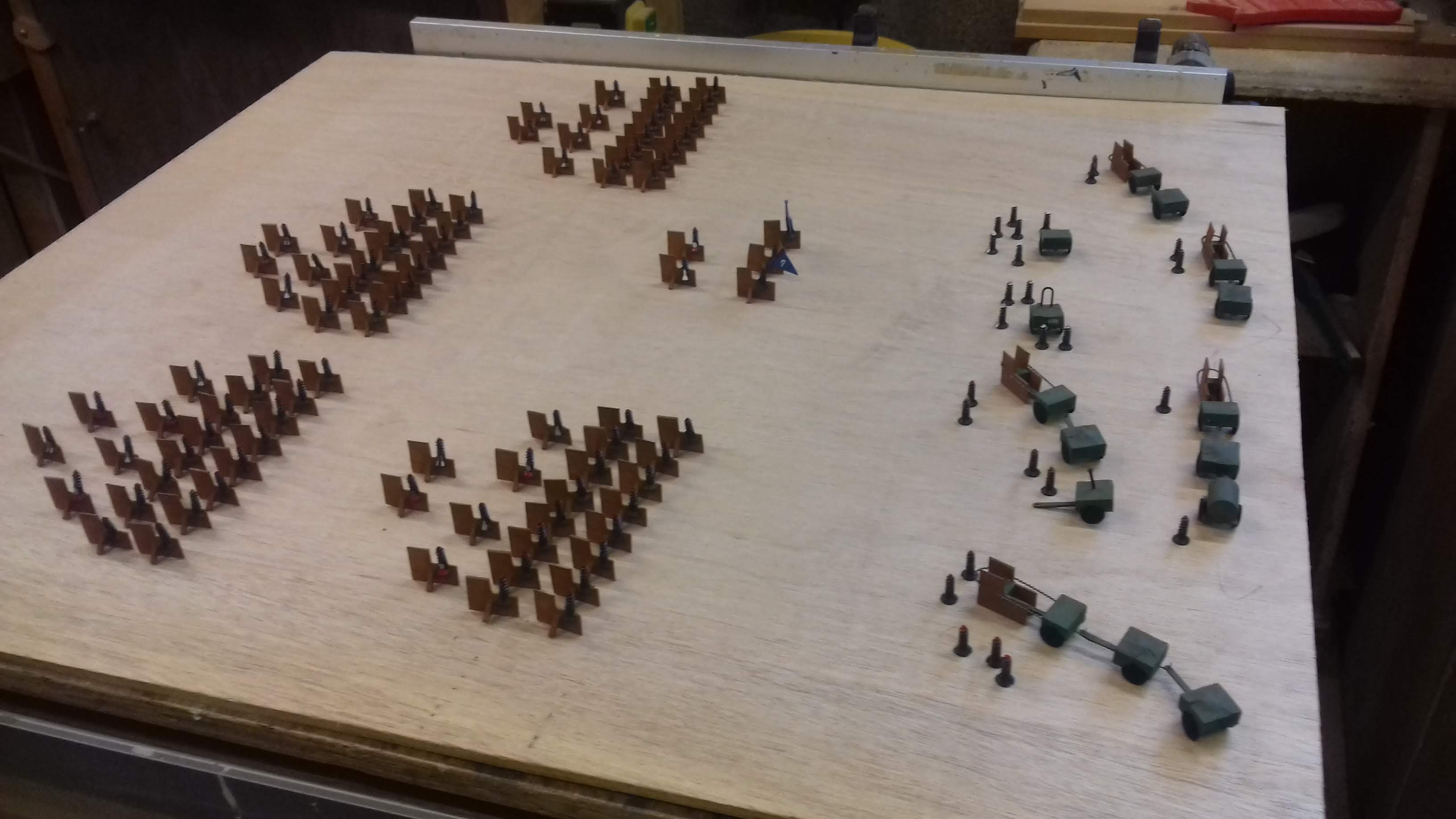
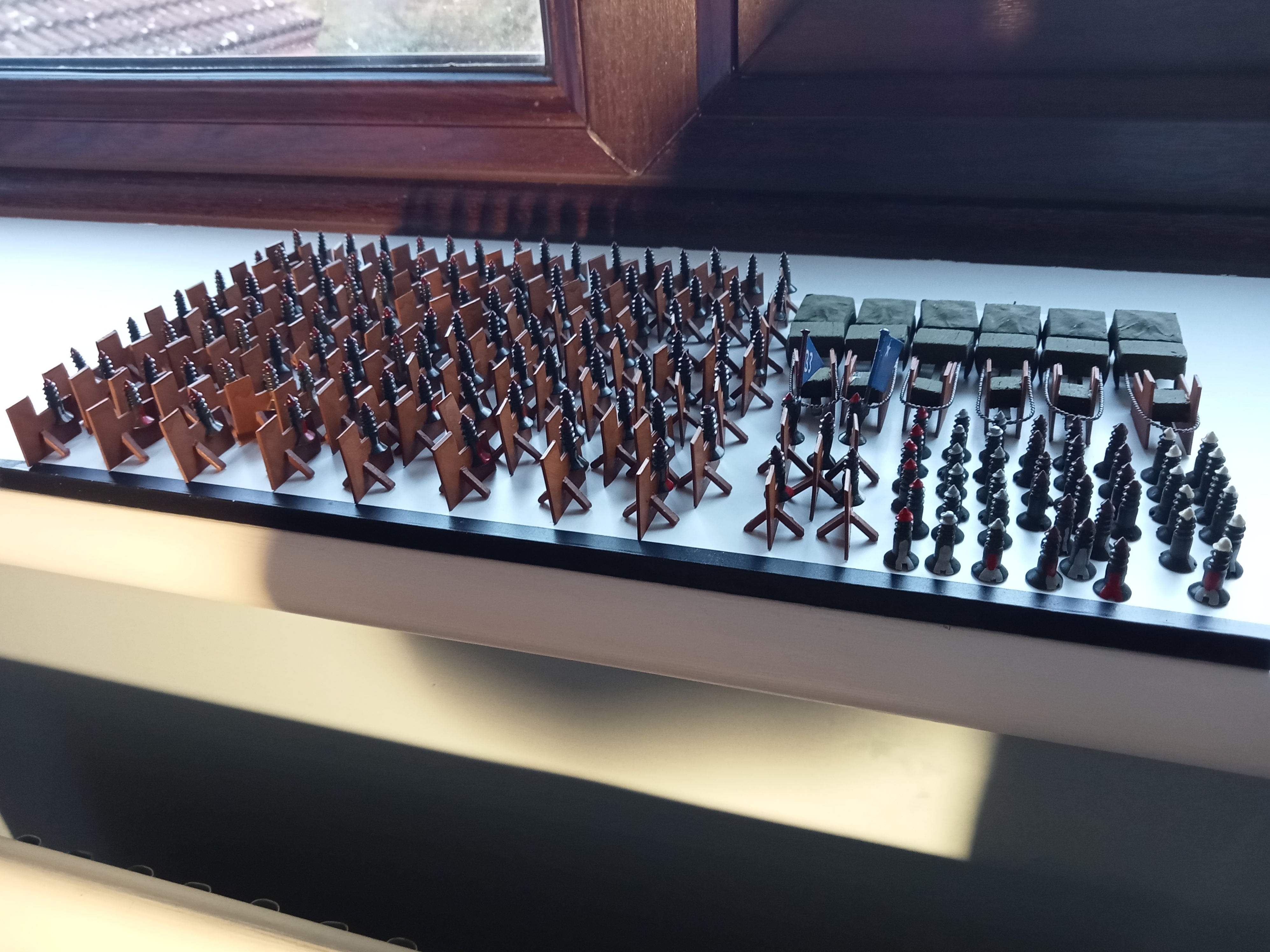
The vehicles and equipment of the regiment comprises 6 limbers each towing a light GS trailer with secondary towing of a field kitchen trailer, a water tank trailer, a signals trailer, a medical trailer and two further light GS trailers. Foot soldiers of the Regiment are carried on the various vehicles to ensure the Regiment has full mobility which is also assured by the exclusive use of two wheeled vehicles.


The photo above shows a regiment in parade formation with the combat squadrons on the left and the headquarters squadron on the right in front of the regimental vehicles. **


This photo shows the regiment drawn up ready to advance with regimental wagons to the rear. **

My armies have a total of 24 Cavalry regiments. The arm of service colour for Cavalry is German purple, a shade of burgundy.

** Both photos show the old original regimental structure. New photos will be added ASAP

Thursday, 19 January 2023

UPDATE.

 Much as I have tried over the past several weeks I am still finding less time for modelling than I would like. Perhaps over the coming weeks of deepest winter more time will become available.

That said I have at last been able to complete the first set of vehicles for my new Pontoon Bridge capability. The photos show the equipment for a single Pioneer battalion. I have now listed construction of sufficient vehicles to equip another 15 battalions.


I decided to leave the boats and chesses (pallets) unpainted. I have always felt the need to paint everything in my standard olive drab green but on this occasion I think this equipment just looks better in the natural shades of brown.


In addition to the above I have almost completed a batch of 30 field kitchen trailers. All that remains is to paint the wheels and chimneys black.


Finally I refer back to the saga of Humbrol enamel paints as mentioned a while ago. All the evidence I can find suggests that the range is being massively reduced although Humbrol (Hornby) have yet to make a public announcement. However my local retailer says the range is being reduced and the on-line colour charts only show a much reduced range. Interestingly it appears the acrylic range has been increased to include those enamel colours apparently being discontinued.

I have spent the past month  or so buying up those colours that I believe are going out of production but which I use a lot. So far there seems to be no shortage but this will soon change. My advice is if you use Humbrol enamels check the official colour charts and buy up any which you use and which not on the latest charts while you can.


Sunday, 15 January 2023

BOOK REVIEW: TERROR IN THE TUNNELS.

 BRITAIN'S DANGEROUS RAILWAY HISTORY.


 As is often the case, having read a book on a particular subject, "Rails to the Front" in this case, I then find myself reading similar books for a while. I am afraid this means the next few book reviews will be about railways !!!!!

This particular book comes from my library and has not been read for a very long time. It basically details the various accidents that occurred both during and after the construction of the many railway tunnels in the UK. Most of the material is taken from newspapers of the time supplemented with official reports. The former of course offer by far the most interesting accounts because of the headline grabbing descriptions as well as the quaint language of the time. There are not too many illustrations but those included are both interesting and informative. 

Overall a fascinating book and highly recommended to railway historians but also generally as just a good book which I should have re-read a long time ago. In fact, the author has another book on disasters during the construction of Britain's railways which I have just ordered as a direct result of enjoying this book so much !!!!


Monday, 9 January 2023

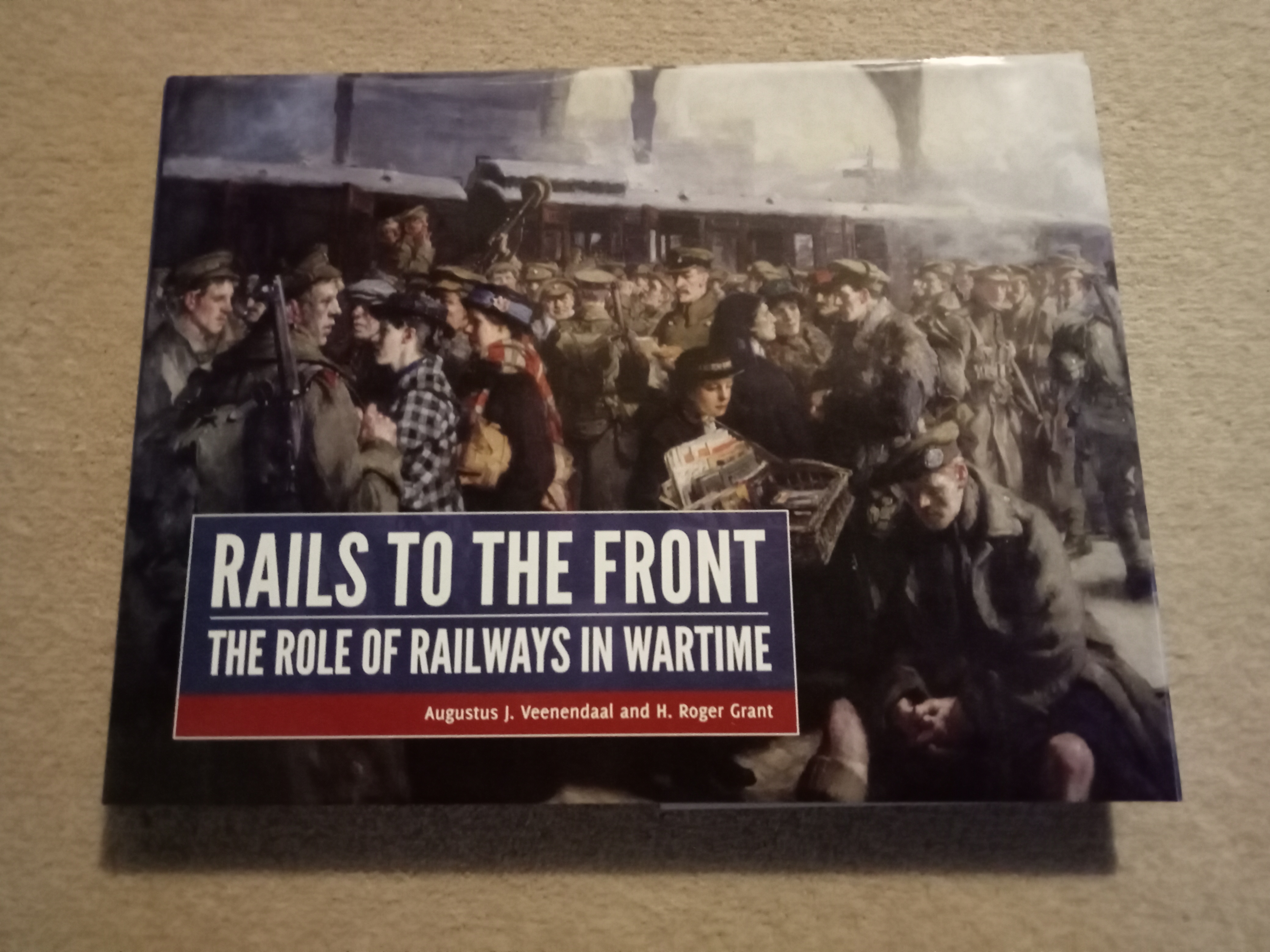
BOOK REVIEW: RAILS TO THE FRONT.

THE ROLE OF RAILWAYS IN WARTIME. 


I found this book on Amazon some time ago reasonably cheaply and have finally got around to reading it. The delay has mainly been caused by the strange shape of the book which is landscape rather than portrait which I find peculiarly disconcerting in a book.

That said the book is very well illustrated and basically covers the use of railways in war from the Crimean War right up to WW2 and into the 1960's where use of railways for military purposes is claimed to have been superseded by road transport. However anyone watching the news from Ukraine over the past year will be only too aware of just how important military use of the railways still is to both sides.

Rather than cover every conflict separately, the book discusses the use of railways more by period with only the major wars meriting a specific chapter. The book is loaded with many excellent photos and although the coverage of any particular conflict is necessarily limited, it does give an excellent overall history of railways in war. 

There is a great deal of useful information in this book which means it should appeal to the reader who is looking for a general history of railways in war and in that respect it is certainly recommended.


Tuesday, 3 January 2023

PONTOON BRIDGING EQUIPMENT.

 PONTOON BRIDGING EQUIPMENT FOR THE WOODSCREW MINIATURE ARMY.


Regular readers will recall I mentioned a while ago that I had decided to investigate the provision of pontoon bridging equipment for my armies. This was provoked by Ion of Archduke Piccolo blog when he wargamed a campaign from my Imagi-Nations series early last year. One of his background questions was whether my armies had a bridge building capability. I replied in the negative but the thought stayed with me that maybe such a capability should be provided.

Ever since I have been looking, without success, for some everyday object that could be adapted for use as a pontoon boat. I did find a model in a manufacturers range but really did not like it that much. Recently I posted asking if readers had any ideas. Steve Johnson suggested I consider 3D models and Ian Dury suggested I look at ebay where a number of 3D printers were offering model railway accessories including model rowing boats. This was something I had not considered.

A quick look revealed a manufacturer supplying rowing boats in N gauge which seemed suitable. I made contact with the supplier and got the measurements of their boats which seemed perfect. I decided to order a pack of 6 boats just to be sure. While looking at the various other products available from this business I also found OO scale pallets, in packs of 30,  which looked like perfect "chesses" for the bridge decks so I ordered a pack of them too.  My original idea was to just use bits of cut up toothpick to represent the "chesses".  

(Chesses are the name used for the bridge deck timbers, apparently from the old French words chasse meaning frame and chassis meaning framework.)  

These items arrived just before Christmas and have proved to be top quality and ideal for my needs. 

Four boats and ten pallets provide a perfect 65 mm long, scale 32 foot bridge as shown below.


I quickly designed a new flat bed wagon and flat bed heavy trailer to transport both boats and "chesses". My idea is that each of my 16 Pioneer battalions will be provided with a bridging platoon comprising a wagon and trailer carrying four pontoons and another wagon and trailer carrying  ten "chesses". The four Pioneer battalions in each army would therefore have the collective ability to build a bridge some 250 mm long which is about scale 125 feet or around 40 meters.  Manpower to build the bridges would be provided by the existing Pioneer battalion soldiers. I prefer this arrangement rather than the alternative of creating dedicated bridging columns.

Below are photos of the new wagons, unpainted and without horses so far, showing the pontoons and "chesses". Just for clarification, the boats and "chesses" will be glued to the wagons and the illustration at the beginning of this article of a completed bridge was only a "proof of concept".


Close ups of the two specific loads are below. I found that two boats fitted on each vehicle and looked better too. I decided I prefer the look of having the boats the right way up however I understand from Ian Dury that most armies carried them upside down. Any views ?????


Each "chess" vehicle carries 5 "chesses". To make it look more interesting the top pallet is turned over.


It has crossed my mind to revise the arrangements to have a wagon with boats towing a trailer with "chesses".....any thought on whether this would look better ????

I am very pleased with these new models and hope readers will agree this new equipment looks good.  Many thanks to Ian Dury and Steve Johnson for pointing me in the right direction.

I have just placed an order for another 58 boats and 130 pallets with the supplier who is Cliff at "3D pluss" on ebay. Cliff makes a fascinating and very wide variety of model railway accessories in OO and N gauge, many of which, in my opinion, could have military modelling applications and he has proven to be prompt and cooperative in responding to my enquiries.

I will post photos of fully painted up vehicles as soon as possible.


Friday, 30 December 2022

BOOK REVIEW: THE GREAT BLUE ARMY WAGON.


 To discover this book recently on Amazon was, for me, like finding the Holy Grail.

This book covers the development and construction of the US Army's standardised 6 mule heavy wagon and 4 mule Escort light wagon from their origins before and after the Civil War respectively to the final versions constructed during the First World War.

The 6 mule wagon was the first to be developed during the 1840-50's. It was a heavy wagon perfectly suited for use  supplying army outposts over very long distances. The specification for this wagon was finalised by the start of the Civil war and most of the wagons seen in Civil war photographs are of this vehicle. It remained in production throughout the second half of the 19th century with few modifications.

The Escort light wagon came about after the war due to the need for a lighter vehicle for use on post and for local short range duties such as escorting troops moving from post to post or going on campaign in more rugged country. This vehicle had became the standard army wagon by the end of the century. On the entry of the USA into the First World War some 30,000 Escort wagons were immediately ordered with about 10,000 being delivered by the end of the war.

The title of the book reflects that throughout the wagon era, until the First World War,  all military vehicles had bright colour schemes. Interiors and running gear was painted Venetian red while the outside was Prussian blue with boldly stenciled US letters on sideboards and white canvas covers. There was never any doubt as to the ownership of US army wagons.

The book provides good detail on the development history of the vehicles, construction methods and materials including full dimensions and improvements made over the years. There are many excellent photos too. There are even paint colour samples and details of standard sized packing boxes designed specifically to maximise  the use of space in wagons. Finally there is some brief information on non standard or locally used specialist vehicles used on some army posts including buggies, forge carts, water tankers and fire engines.

Clearly not a book for everyone by any means but for someone like me who is fascinated by horse drawn logistics, an absolute gold mine of information and a new star in my library destined to become a constant source of reference.


Saturday, 24 December 2022

UPDATE.

 Just a brief note to wish all my followers and everyone in blogger land a Happy Christmas with lots of new soldiers and a very prosperous New Year with a huge increase in painting productivity.

Wednesday, 21 December 2022

BOOK REVIEW: STORMING EAGLES.

 GERMAN AIRBORNE FORCE IN WORLD WAR 11.


Another book I picked up in a seaside book shop on my birthday  in October.

I have no special interest in airborne troops including the German forces however the book was very cheap and seemed well written on a thumb through.

The book gives a highly detailed history of the creation of the German airborne forces including the glider troops and air landing troops, a brief review of all the major actions involving airborne units and details of all the various formations raised during the war, all in a chronological order.

There is a strong recurring theme through out the book about the spectacular fighting spirit of German paratroopers and the fearsome reputation they enjoyed on all fronts right to the last days of the war. All were volunteers and trained to a very high standard which was reflected in regular successes although at a high cost in casualties.

There are a number of short appendix covering weapons, planes and uniforms to complete what has to be the definitive book on German airborne troops  and which I strongly recommended if you are interested in the Fallschirmjaegar.


Friday, 16 December 2022

UPDATE.

 Yes another update and very soon after the last one !!!!

 I have news to share about Humbrol paints.

One of my blog followers, Joe at FISH TALES blog, mentioned in passing that he had heard that Humbrol may be stopping production of enamel paints. Interesting as Joe is American and had heard about this but I had not here in the UK, home to Humbrol !!!!  Now I have been using these paints for over 50 years and although I have often considered moving to acrylics, being over three quarters of the way through building my armies, now is probably not the time to change.

Although I keep a good stock of paints at all times I knew I would not have sufficient to finish my fourth army so I decided to investigate.

It seems that due to a new government regulation, one of the components in all enamel paints has been banned. For reasons difficult to establish this resulted in Humbrol suddenly taking a lot of paint off the market. Again for reasons difficult to determine, Humbrol chose not to make this matter public resulting in a lot of rumours and a shortage of paints in shops.

In the YOUTUBE video I saw it was clear the audience thought  this change has been poorly managed by Humbrol.  The fact remains that their enamel paints will however remain on sale for the foreseeable future.  That said they have taken this opportunity to seriously reduce the range from about 200 to only 80 colours again with little public notice.

Typically over half the colours going out of production are colours I use a lot. I have already placed a large order with an on line supplier for sufficient paints to hopefully see me out !!!! I will also be visiting my local model shop to hoover up what ever he has left too.

Overall I am left with the impression that Humbrol have mismanaged this situation and are now making it worse by dramatically reducing the range.  If you use Humbrol I suggest you check out the new range and buy up quickly any of the soon to be discontinued colours you may need while you still can.

Sometimes I think these smaller specialist British companies almost want to go out of business by the way they operate !!!!

On a happier note I have this week started to build a batch of 25 field kitchen trailers and have prepared the screws to paint up a new infantry battalion. Hopefully I will find the time and inclination to work on these diligently over the coming few weeks.


Saturday, 10 December 2022

BOOK REVIEW: 1983.

THE WORLD AT THE BRINK.


 I bought this book on a visit to the seaside on my birthday. Not the usual subject matter I look for but a quick canter through the pages looked interesting.

The book basically relates world events leading up to the NATO war-games of late 1983 during which the Russians started to believe that NATO was about to launch a full scale nuclear first strike against them. The book gives a clear indication of just how close we came to nuclear war mainly due to the West not realising how paranoid Russia had become at the time.

The book gives a good history of Ronald Reagan coming to power and his strong anti Russian stance, the poor and geriatric leadership in Russia and the increasing weakness of the Russian economy which led to the fall of the USSR a few years later. In effect it gives the history of the final few years of the USSR as it collapsed under the weight of the Cold War which resulted in serious instability in the Russian leadership and a nuclear crisis made worse by the failure of US intelligence services to clearly recognise what was happening in Russia.

This is an exciting read much like a Tom Clancy novel....but real !!!! which of course makes it very scary.
Highly recommended for anyone interested in recent world history and the fall of the USSR.

Monday, 5 December 2022

UPDATE.

It has been over six weeks since I last updated on my activities. However the simple fact is that I have not done a great deal...again !!!!! Ordinary life seems to have continued to get in the way of modelling. I had hoped that with the miserable autumn weather I would get more modelling time but that has not happened, at least not yet anyway.

Having just said that, on reflection I have to admit I have not really tried that hard to get modelling time. If I am being totally honest, I have not actually had that much enthusiasm for modelling recently. I am sure this is a passing phase as I have really enjoyed finally getting the cavalry and heavy artillery battalions finished after so many months of them sitting on the work bench gathering dust. I think it is just a case of getting going again after so many months of modelling inactivity.

Above are the cavalry just finished on the work bases.


And here set up, with the foot elements of the regiment and most of the vehicles, on the display shelf before insertion into the display cabinet.


Here are the soldiers of the heavy artillery battalion on their display shelf. No vehicles or equipment has been built yet for this battalion.

The next vehicle construction project will be a batch of field kitchens. The next battalion to be painted will probably be another infantry unit.

Readers may have noticed that I have started updating and republishing the organisation tables of my armies. These now reflect the several upgrades I have introduced over the past couple of years.

A considerable time ago I realised that my armies lacked a bridge building capability. My initial thought was to create a couple of bridging battalions at army group level but then I decided the best way forward would be to provide the capability within each Pioneer battalion. Ever since I have been searching for some object to represent a pontoon boat. 

Scratch building one or two would be easy but I need 32. I have found a model within the Pendraken range that is the right size but it is a slab sided square shaped pontoon that does not look good in the scale I use. I want an actual rowing boat shape that can be placed upside down on a flat bed wagon. I am coming to the conclusion that I will have to make a master and mould my own. However if any reader has another suggestion please let me know. Size needed is 30 mm long, 13 mm wide and 5 mm high.


Wednesday, 30 November 2022

BOOK REVIEW: HARDTACK AND COFFEE.

THE UNWRITTEN STORY OF ARMY LIFE.


Yet another book from my library although I have a feeling I may have reviewed this book before. It is a great book however so another reading/review will not go amiss. This is a first hand account by a Union soldier of the Civil War originally published in 1887.

The author served from 1862 to the end of the war and, as is so often the case, his time in the army was the highlight of his life. However rather than write about the various battles etc in which he participated, he decided to write about ordinary day to day life as a Union soldier. 

This book is divided into chapters on subjects such as enlisting, tents, rations, offences and punishments, a day in camp, foraging, badges and flags, the army mule, hospitals, and so on.  As a result the book gives a fantastic insight into the ordinary activities and life of soldiers. In fact there is really no mention of actual battle at all. The author was determined to make a record of day to day life as he believed that over time the ordinary experiences of military service would be forgotten, which is of course quite true.

This book is now considered among the top ten of first hand histories of the Civil War which is no surprise to me given the extraordinary wealth of detail it contains.  (The author has also written a full unit history of the artillery battery in which he served, which is also highly regarded by historians.)

Highly recommended to anyone interested in the US Civil War and the ordinary day to day experiences of an ordinary soldier.


Friday, 25 November 2022

ORGANISATION OF THE ARMY.

FIELD ARTILLERY BATTALIONS.

Field Artillery battalions have two batteries and a headquarters company.

Each battery consists of  4 guns, 4 caissons, 4 limbers and 2 ammunition wagons with 24 gunners,  4 Corporals, 4 Sergeants  and 2 Lieutenants organised in  two sub sections.  Each limber and ammunition wagon also has two quartermaster drivers giving 12 QM men and 2 Corporals commanded by a QM Lieutenant supported by a QM Sergeant. The battery is commanded by a Captain supported by a battery Sergeant Major. The total strength of a battery is therefore 52.

The headquarters company has a Staff platoon of 4 men and 1 Corporal commanded by a Sergeant, a Medical platoon of 6 medics and 1 Corporal medic commanded by a Surgeon Lieutenant supported by a Sergeant medic and a Signals platoon of 10 Signallers and 2 Corporals commanded by a Lieutenant supported by a Sergeant. The Quartermaster platoon has 10 men and 1 Corporal with a Lieutenant in command supported by a Sergeant. The battalion's total QM contingent is under the overall command of a QM Captain supported by a QM Sergeant Major. The battalion is commanded by a Lieutenant Colonel with a Major as second in command and Adjutant supported by a Battalion Sergeant Major with two standard bearers carrying the national flag and the battalion flag. In addition and reporting direct to the battalion commander is a Fire Control section consisting of a Captain and a Lieutenant who are responsible for coordinating and directing the fire of the battalion. The total strength of the headquarters company is 51 giving a total battalion strength of 155.

Apart from the vehicles in each battery, the battalion also has 5 GS wagons towing a field kitchen, water tank trailer, signals trailer, observation trailer and a medical trailer. 

The following photo shows a battalion in parade formation.


The next photo shows a battalion in combat with the guns in the foreground, battery vehicles behind and battalion wagon lines at the rear.


The arm of service colour is black for Field Artillery. My armies have a scheduled total of 48 Field Artillery battalions and at the time of writing 39 have been constructed.


Thursday, 17 November 2022

BOOK REVIEW: THE WAFFEN SS.

THE THIRD REICH'S MOST INFAMOUS MILITARY ORGANISATION.


 I recently picked this book up in The Works very cheaply. 

Although no fan of the SS generally, I am interested in the Waffen SS, the military arm. There is no doubt that the divisions of the Waffen SS were among the most effective and powerful of Germany's armed forces. The book concentrates on providing a detailed history of the various divisions that were formed during the war, their military service and short profiles of some of the most important leaders of those units. In fact I think it provides the most comprehensive record of Waffen SS units I have ever seen.

No attempt is made to gloss over the atrocities perpetrated by the SS but the focus is far more on the combat history of the SS and in that it is very effective. Overall I recommend this book if you are interested in the combat units of the Waffen SS and their battle histories.


Friday, 11 November 2022

ORGANISATION OF THE ARMY.

INFANTRY BATTALIONS.


The Infantry battalion consists of 6 Infantry companies, a Heavy Weapons company and a Headquarters company.

The Infantry company comprises three platoons each of 12 privates and two Corporals under the command of a Lieutenant assisted by a Sergeant. The  company is commanded by a Captain assisted by a company Sergeant Major. The total strength of a company is 50.

The Heavy Weapons company comprises two platoons each of 12 privates and two Corporals under the command of a Lieutenant assisted by a Sergeant. The company is commanded by a Captain assisted by a company Sergeant Major. The total strength of the company is 34.

The Headquarters company comprises a Staff platoon of 4 privates, a Corporal and a Sergeant, a Medical platoon of 14 medics, two medic Corporals, 2 medic Sergeants, a surgeon Lieutenant with a surgeon Captain in command. The Quartermaster platoon has 18 privates, 3 Corporals, and a Sergeant with a Lieutenant in command. The Signals platoon has 12 signallers, 2 Corporals and a Sergeant and Lieutenant in command. The command platoon has a Lieutenant Colonel as battalion commander with three Majors, one as Adjutant and second in command and two Majors as wing commanders of three of the Infantry companies, a battalion Sergeant major and two standard bearers, one with the national flag and one with the battalion flag. The total strength of the headquarters company is 73 giving a total battalion strength of 407.

The vehicles and equipment of the battalion comprises 6 GS wagons towing a field kitchen trailer, a water tank trailer, a signals trailer, a medical trailer and two light GS trailers and two limbers, two caissons and two heavy weapons together with an ammunition wagon.


The photo above of a battalion in parade formation shows the Infantry companies on the left with the Heavy Weapons company in the centre and the Headquarters company on the right in front  of the battalion vehicles. 


This photo shows the battalion deployed for an advance with the Heavy Weapons company and command platoon in the centre and the battalion wagon lines at the rear.

My armies have a planned total of 96 Infantry battalions of which 76 have been built at the time of writing. The arm of service colour for Infantry is blue.

Sunday, 6 November 2022

BOOK REVIEW: ANIMAL MANAGEMENT 1933.


Regular readers of this blog may recall that I mentioned receiving this book as a gift from Mark at the Man Of Tin blog. Mark is aware of my interest in horse drawn logistics and this is an original War Office publication which he no longer wanted, a very generous gift indeed.

The format of the book is the usual War Office style and covers every conceivable element of the care and use of horses and mules in service in the British Army. There are chapters on the structure of the horse and points of particular types and breeds, stable construction and management including grooming, foods and watering, saddles, shoeing, transportation of horses by sea and rail and of course prevention of disease and first aid. In fact everything you could wish to know about the military use of the horse.

Although a reference book and therefore not the easiest read, as a source of information this book is a "bible" of relevant data about horses in military service and I am delighted to have it in my library.


Tuesday, 1 November 2022

BOOK REVIEW: SUPPLYING CUSTER.

 THE POWDER RIVER SUPPLY DEPOT 1876.


Another book from my library, it relates the 1876 US Army campaign against the Indians which culminated in the Battle of The Little Big Horn and Custer's last stand.

The first half of the book details the various expeditions to the Powder River country and the history of the fighting against the plains Indians in the general area including the famous battle at Little Big Horn with an emphasis on logistics. The second half of the book relates in detail the supply arrangements for the campaign of 1876 and in particular the supply depot that was established at Powder River and the archaeological excavations carried out on the site in 1983.

The historical element of the book is first class and gives a clear and detailed analysis of the US Army's activities against the Sioux Indians but the results of the archaeological investigations are really fascinating.  Items found cover the whole range of products of the time even including bottle fragments that were identified as British made beer bottles. Who would have thought that British beer would find its way to the American frontier and in large quantities too.

I accept that this is very much a highly specialised topic but it makes for very interesting reading and gives a great insight into life on the early American frontier especially for the soldiers during the Indian wars.

Highly recommended if you have an interest in this sort of history.